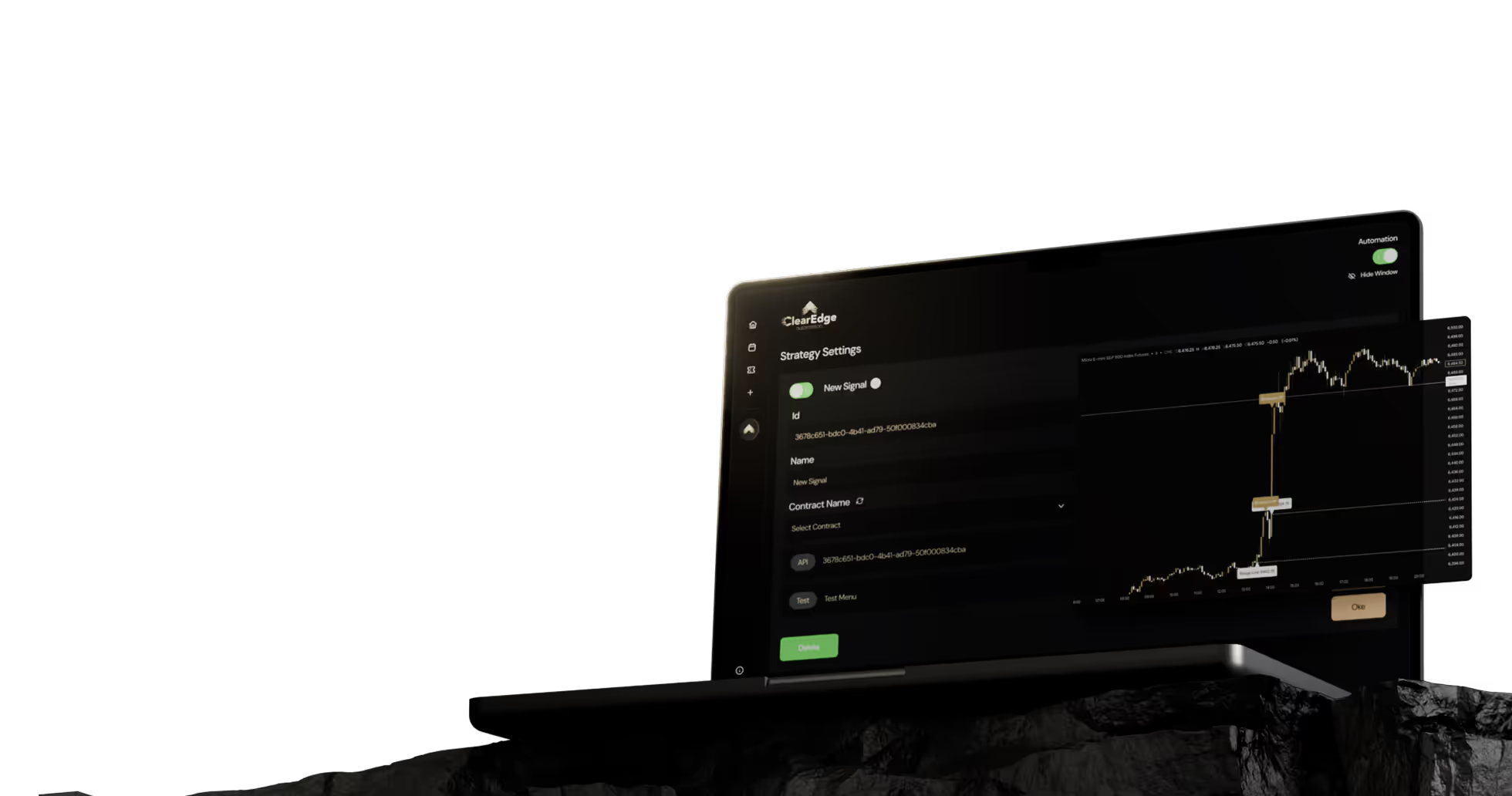
Autoview To ClearEdge Migration For Futures Trading Automation
Trade futures with direct API speed instead of browser lag. Master the switch from Autoview to ClearEdge to improve reliability and execution in under 4 hours.


Moving from Autoview to ClearEdge for futures trading means swapping a browser-extension-based automation tool for a dedicated futures automation platform with direct broker APIs. The switch typically improves execution speed, eliminates browser dependency, and adds futures-specific risk controls. Plan 2-4 hours for full migration including strategy import, webhook reconfiguration, and parallel testing before going live.
Key Takeaways
- Autoview operates as a Chrome extension routing TradingView alerts through your browser; ClearEdge runs server-side with direct broker APIs, removing the open-browser requirement.
- Migration involves five core steps: export current settings, recreate webhook URLs, reconnect broker, import strategy logic, then run parallel for 5-10 trading sessions.
- Execution latency typically drops from 200-800ms (browser-routed) to 3-40ms (direct API) depending on broker connection.
- Budget 2-4 hours for setup and 1-2 weeks of paper trading before allocating real capital to the new platform.
- Common pitfalls include duplicate alerts firing on both platforms during cutover, mismatched position sizing syntax, and skipping the parallel-running validation period.
Table of Contents
- Why Traders Move From Autoview to ClearEdge
- Pre-Migration Checklist
- Importing Your TradingView Strategy
- Migrating Webhook Alerts
- Reconnecting Your Broker
- Testing Before Cutover
- Cutover Day Walkthrough
- Common Migration Pitfalls
- Frequently Asked Questions
Why Traders Move From Autoview to ClearEdge
Most traders switching from Autoview to ClearEdge for futures cite three reasons: reliability gain, faster execution, and futures-specific features. Autoview is a Chrome extension that requires your browser to stay open and logged in, which creates a single point of failure. ClearEdge runs as a cloud service with direct broker API connections, so your trades execute even if your computer is off.
Browser-Routed Execution: A trade automation method where alerts pass through a web browser before reaching the broker. This adds 200-800ms of latency and depends on the browser staying open and authenticated.
The shift from browser to platform matters most during volatile sessions. On FOMC days or NFP releases, a frozen browser tab can mean a missed entry or, worse, a stop-loss that never fires. Direct API connections handle these moments without the failure modes inherent to extension-based tools. For a broader view of what to evaluate when changing futures bot infrastructure, see the futures automation platform comparison.
The switching cost analysis usually favors the move once traders factor in missed-fill costs from browser crashes. Even one botched exit on an ES position at $12.50 per tick can offset months of subscription difference.
Pre-Migration Checklist: What to Prepare
Before you transfer trading strategy logic to a new platform, document everything currently working in Autoview. A thorough migration checklist prevents the most common failure: discovering missing alert syntax three days after going live.
Settings Backup Items
- Screenshot every Autoview alert message JSON payload
- Export your TradingView alert list (alert names, conditions, intervals)
- Record current broker credentials and account numbers
- Note position sizing rules (contracts per signal, max open positions)
- Document your daily loss limits and max drawdown thresholds
- Save Pine Script source for any custom strategies
- Record current performance baseline (win rate, average R, max drawdown over last 90 days)
Performance Baseline: Documented metrics from your current platform used as a comparison reference after migration. Without it, you cannot tell if the new platform is performing better, worse, or the same.
The performance baseline matters more than traders realize. After migration, every losing streak feels like the new platform's fault. Hard numbers from before the switch keep evaluation honest.
How Do You Import a TradingView Strategy?
To import tradingview strategy logic into ClearEdge, you keep your Pine Script in TradingView and only change the alert delivery destination. The strategy itself never moves. What changes is the webhook URL and the JSON message format.
Autoview uses a specific syntax in the alert message body, typically prefixed with commands like c=order b=long. ClearEdge uses standard JSON. You will rewrite the alert message field on every alert, but the underlying chart, indicator, and entry conditions stay identical.
Here's a practical example of how the alert message changes:
Autoview FormatClearEdge Formatc=order b=long q=1 s=ESZ5{"action":"buy","symbol":"ES","qty":1}c=order b=short q=1 s=NQZ5{"action":"sell","symbol":"NQ","qty":1}c=cancel{"action":"close","symbol":"ES"}
Document each alert before changing it. The TradingView webhook setup guide covers the exact JSON structure ClearEdge expects, including symbol mapping for ES, NQ, GC, and CL.
Migrating Webhook Alerts
Webhook alert migration is the technical core of the switch. You will export webhook alerts conceptually, meaning you'll recreate them with new URLs, but TradingView itself does not allow bulk export of alert webhook URLs. Each alert needs manual updating.
Webhook Migration Steps
- Generate your ClearEdge webhook URL from the platform dashboard
- Open TradingView's Alerts panel
- For each alert, click the edit icon
- Replace the Autoview webhook URL with the ClearEdge URL
- Update the message body to ClearEdge JSON format
- Save and verify the alert is still active
Parallel Running Test: A validation period where two automation systems run simultaneously on the same signals, with one in live mode and one in paper mode, to confirm the new system behaves as expected before full cutover.
During downtime planning, set a window where market impact is minimal. Sunday evening before the 6pm ET reopen is ideal. Avoid switching webhook URLs midweek during active sessions. For specific webhook troubleshooting, the webhook fix guide covers common errors.
Reconnecting Your Broker
To transfer broker connection from Autoview to ClearEdge, you generate fresh API credentials from your broker and enter them into the new platform. Autoview connects through the broker's web interface; ClearEdge uses direct API authentication, which means new keys.
Supported brokers include Tradovate, AMP, NinjaTrader Brokerage, TradeStation, and Interactive Brokers, among others. Check the full supported brokers list to confirm your account works.
Account Migration Steps by Broker Type
- Tradovate: Generate API token from Tradovate web app, paste into ClearEdge broker settings
- AMP/CQG: Provide CQG credentials, ClearEdge handles the gateway connection
- TradeStation: OAuth flow through ClearEdge, log in once and authorize
- Interactive Brokers: Configure TWS or IB Gateway with API permissions enabled
Verify the connection with a small test order, one micro contract on MES or MNQ, before exposing full position sizes. The IBKR TWS API guide covers IB-specific gotchas.
Testing Before You Cut Over
The parallel running test is non-negotiable. Run ClearEdge in paper mode while Autoview continues live for 5-10 trading sessions. Compare fills, latency, and any deviation in entries or exits.
Testing Checklist
- Confirm every alert fires on both platforms with matching timestamps
- Compare fill prices between paper ClearEdge and live Autoview
- Verify position sizing matches contract-for-contract
- Test at least one stop-loss trigger and one take-profit hit
- Run through one high-volatility event (FOMC, NFP, or CPI)
- Verify the platform handles partial fills correctly
- Confirm daily loss limits halt new entries when triggered
If you find a discrepancy, fix it in paper mode. Don't go live until at least three consecutive sessions show identical behavior. For deeper validation methodology, see forward testing automated futures strategies.
Cutover Day Walkthrough
Cutover day is when you flip Autoview off and ClearEdge on. The biggest risk here is duplicate execution: both platforms firing on the same alert. The fix is sequential, not simultaneous.
Cutover Sequence
- Sunday 4:00 PM ET: Close all open Autoview positions manually if needed
- Sunday 4:30 PM ET: Disable all Autoview alerts in TradingView
- Sunday 5:00 PM ET: Verify Autoview shows zero active connections
- Sunday 5:30 PM ET: Switch ClearEdge from paper to live
- Sunday 5:45 PM ET: Confirm webhook URLs all point to ClearEdge
- Sunday 6:00 PM ET: Market opens, monitor first hour closely
Watch the first 60 minutes after market open. If anything looks wrong, you can disable ClearEdge alerts and revert to manual trading while you diagnose. Don't try to re-enable Autoview mid-session, that's how duplicate fills happen.
Common Migration Pitfalls
Most failed migrations share a few patterns. Knowing them in advance saves real money.
- Duplicate alerts firing: Both platforms active simultaneously, doubling positions. Always disable old before enabling new.
- Symbol mismatch: Autoview uses contract codes like ESZ5; ClearEdge often uses continuous symbols like ES. Map every symbol carefully.
- Skipping paper trading: Going live immediately is the fastest way to discover a JSON syntax error during a real signal.
- Ignoring time zones: Alert timestamps and broker timestamps may differ. Verify your platform handles your trading hours correctly.
- Not updating risk limits: Daily loss limits configured in Autoview don't transfer. Re-enter every risk parameter.
- Forgetting prop firm rules: If you trade prop accounts, see the prop firm automation guide for rule-compliance settings.
One more pitfall worth flagging: traders sometimes evaluate the new platform after only 10-15 trades. That's not enough data. Give the migration at least 30-50 trades before judging performance against your baseline.
Frequently Asked Questions
1. How long does moving from Autoview to ClearEdge for futures take?
Plan 2-4 hours for the technical migration: webhook updates, broker reconnection, and alert reconfiguration. Add 1-2 weeks of parallel paper trading before fully switching live capital.
2. Will my TradingView Pine Script work the same on ClearEdge?
Yes, the Pine Script stays in TradingView untouched. Only the alert message format and webhook URL change to point at ClearEdge instead of Autoview.
3. Do I need a new broker account to switch platforms?
No, you keep your existing broker account. You generate new API credentials so ClearEdge can connect directly via the broker's API instead of through a browser session.
4. What happens to my open positions during the switch?
Open positions remain in your broker account regardless of which automation platform you use. Best practice is to either close positions before cutover or manually monitor them while you transition.
5. Can I run Autoview and ClearEdge at the same time?
Only during paper-mode testing. Running both live on the same alerts causes duplicate orders and doubled position sizes, which can violate broker margin rules or prop firm limits.
6. How much faster is execution after switching?
Browser-routed automation typically runs 200-800ms latency; direct API platforms run 3-40ms depending on broker. The speed gain matters most during fast-moving markets and at session opens.
7. What if my strategy performs worse after migrating?
Compare against your documented performance baseline over at least 30-50 trades. Small samples are unreliable, and minor differences in fill prices or slippage even out across enough trades.
Conclusion
Switching futures automation platform infrastructure from Autoview to ClearEdge trades a browser dependency for a server-side execution model with direct broker APIs. The migration is straightforward when you document settings first, run parallel paper tests, and execute cutover during low-volume windows.
Start by reviewing the platform comparison to confirm the move makes sense for your setup, then check ClearEdge pricing and supported brokers before beginning your migration checklist.
Ready to migrate your futures automation? Explore ClearEdge Trading and see how direct-API execution works with your existing TradingView strategies.
References
- TradingView - About Webhooks
- CME Group - E-mini S&P 500 Contract Specs
- CFTC - Trading Organizations Oversight
- ClearEdge - TradingView Webhook Setup Guide
- ClearEdge - Supported Brokers
Disclaimer: This article is for educational purposes only. It is not trading advice. ClearEdge Trading executes trades based on your rules, it does not provide signals or recommendations.
Risk Warning: Futures trading involves substantial risk. You could lose more than your initial investment. Past performance does not guarantee future results. Only trade with capital you can afford to lose.
CFTC RULE 4.41: Hypothetical results have limitations and do not represent actual trading.
By: ClearEdge Trading Team | 29+ Years CME Floor Trading Experience | About














































Steal the PlaybooksOther TradersDon’t Share
Every week, we break down real strategies from traders with 100+ years of combined experience, so you can skip the line and trade without emotion.