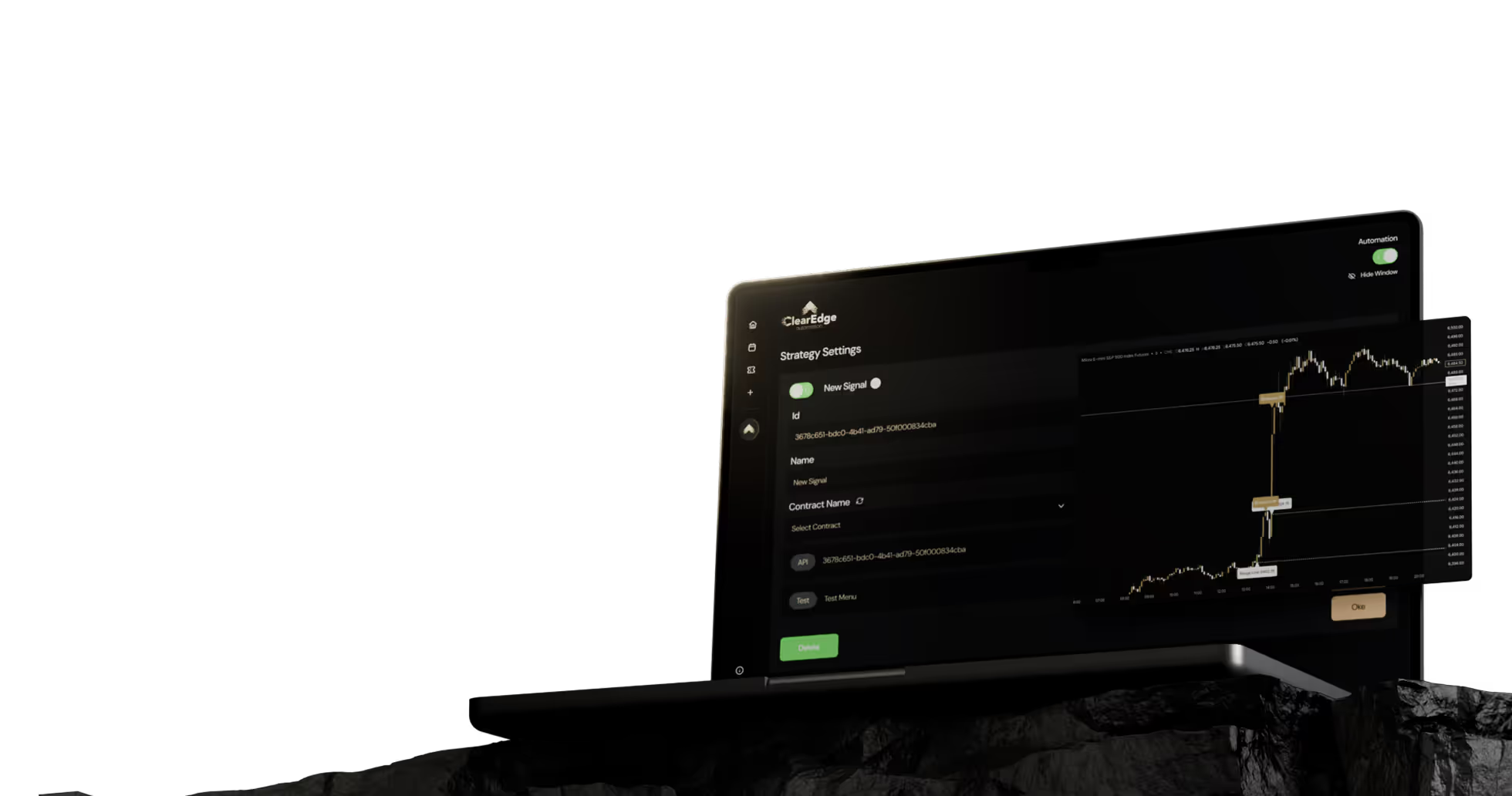
Automated Futures Trading Time Commitment: 4-12 Hours Monthly
Trade while you sleep and audit while you're free. Automated futures trading requires only 4-12 hours of monthly oversight to keep things running smoothly.


Automated futures trading typically requires 4-12 hours per month once your system is running, with most of that time spent on weekly performance reviews, monthly strategy audits, and routine monitoring. Setup demands more upfront (20-40 hours), but ongoing maintenance is light because the platform handles execution. Active oversight matters more than total hours.
Key Takeaways
- Expect 4-12 hours monthly for ongoing automated futures trading maintenance after setup is complete
- Weekly tasks (1-2 hours): trade log review, alert verification, and broker connection checks
- Monthly tasks (2-4 hours): performance metrics analysis, strategy audit, and risk parameter review
- Initial setup takes 20-40 hours including paper trading, which is separate from ongoing time commitment
- Part-time traders with full-time jobs find automated futures trading viable at this time commitment level
Table of Contents
- How Many Hours Per Month Does Automated Futures Trading Actually Require?
- What Weekly Monitoring Tasks Are Required?
- Monthly Review and Strategy Audit
- Setup Time vs. Ongoing Time Commitment
- Is Automated Futures Trading Part-Time Trader Friendly?
- Common Time-Commitment Mistakes
- Frequently Asked Questions
How Many Hours Per Month Does Automated Futures Trading Actually Require?
Automated futures trading time commitment per month typically runs 4-12 hours for traders with established systems. That breaks down to roughly 1-2 hours weekly for monitoring plus 2-4 hours monthly for deeper review. The actual number depends on how many strategies you run, how many instruments you trade, and how stable your setup is.
The whole point of automation is that the software handles execution. You're not sitting at the screen watching every tick. Instead, you check that things are working, review what happened, and make occasional adjustments. Traders running a single strategy on one or two instruments often land at the lower end of this range.
Time Commitment: The recurring hours required to maintain an automated trading system after initial setup. This matters because automation only saves time if the maintenance burden stays manageable around your day job or other commitments.
Here's a realistic breakdown of where the hours go:
- Daily checks (5-10 min): Confirm broker connection, verify any open positions match expectations
- Weekly review (60-90 min): Trade log analysis, alert verification, equity curve check
- Monthly audit (2-4 hours): Performance metrics, strategy health, risk parameter review
- Quarterly deep work (3-5 hours): Walk-forward testing, parameter review, broker statements reconciliation
Total monthly: roughly 8-14 hours when you include daily checks. Quarterly months bump higher. New traders should plan for the upper end until routines are established.
What Weekly Monitoring Tasks Are Required?
Weekly monitoring takes 60-90 minutes and covers four areas: trade log review, alert/webhook verification, broker connection health, and equity curve check. These tasks catch issues before they become expensive problems.
Skipping weekly checks is one of the more common mistakes new automated traders make. The system runs fine for weeks, then something breaks (an expired TradingView alert, a broker API change, a webhook timeout) and you don't notice until you've missed real signals or executed wrong-sized positions.
Weekly Checklist
- Trade log review (20-30 min): Did every alert produce the expected order? Were fills reasonable? Any partial fills or rejections?
- Alert and webhook verification (10-15 min): Send a test alert if you haven't had recent triggers. TradingView alert expirations catch traders off guard regularly.
- Broker connection check (5-10 min): Confirm API status, account balance, margin available
- Equity curve review (15-20 min): Compare actual results against expected drawdown ranges
- News and economic calendar scan (10-15 min): Note upcoming FOMC, NFP, CPI events that might warrant pausing automation
Monitoring Tasks: Recurring verification activities that confirm an automated system is operating as designed. These are not trading decisions, they are health checks on the infrastructure.
Most traders do this on Sunday evenings or Saturday mornings before the week starts. The goal isn't to second-guess the strategy. It's to confirm the plumbing works.
Monthly Review and Strategy Audit
The monthly review takes 2-4 hours and goes deeper than weekly checks. You're looking at performance metrics, comparing live results to backtest expectations, and deciding whether anything needs adjustment. This is where automation pays off because you have clean data instead of foggy memory.
Run this on the last weekend of the month or the first weekend of the new month. Block the time on your calendar. Skipping monthly reviews is how strategies degrade silently for months before traders notice.
Monthly Review Checklist
MetricWhat To CheckAction ThresholdWin rateCompare to backtest baseline±10% deviation warrants investigationAverage win/loss ratioR-multiple distributionSustained drop = parameter reviewMax drawdownCurrent vs. historical maxApproaching 80% of historical = cautionSlippageActual vs. expected fillsPersistent slippage = broker or timing reviewProfit factorGross profit / gross lossBelow 1.2 sustained = strategy review
You're not making changes every month. Most months, the answer is "system is operating within expected ranges, continue." That's the goal. Frequent tinkering is a bigger risk than under-tinkering. For deeper context on metric thresholds, see the performance tracking guide.
Quarterly, add walk-forward validation and broker statement reconciliation. That adds 2-3 hours but only four times a year.
Setup Time vs. Ongoing Time Commitment
Setup is front-loaded and takes 20-40 hours for most beginner futures automation systems. This is separate from monthly maintenance and shouldn't be confused with ongoing time commitment. Plan for setup as a one-time project, not a recurring cost.
Setup includes strategy definition, TradingView alert configuration, webhook integration, broker API connection, and (most importantly) paper trading first. The paper trading phase alone usually consumes 10-20 hours over several weeks, and skipping it is a documented common mistake.
Paper Trading First: Running an automated strategy with simulated capital before connecting real money. This validates that webhooks fire, orders execute correctly, and the strategy behaves as expected in live market conditions.
Typical Setup Time Breakdown
- Strategy definition and rules documentation: 3-6 hours
- TradingView alert and Pine Script setup: 4-8 hours
- Webhook and broker connection: 2-4 hours
- Paper trading validation: 10-20 hours over 2-4 weeks
- Risk management configuration: 2-4 hours
- Initial small-size live trading: Ongoing, monitored closely first 2 weeks
The minimum capital requirement varies by broker and instrument, but most retail traders start with $2,000-$10,000 for micro futures or $10,000-$25,000 for full-size contracts. Capital doesn't change time commitment much, but undercapitalization adds emotional pressure that makes monitoring feel heavier than it should.
Is Automated Futures Trading Part-Time Trader Friendly?
Yes, automated futures trading is well-suited for part-time traders with full-time jobs because the 4-12 hours monthly fits around standard work schedules. Most monitoring happens evenings and weekends. The execution itself runs without you watching, which is the actual value proposition.
That said, "set and forget" is a marketing phrase, not reality. You still need disciplined weekly and monthly routines. Traders who treat automation as truly hands-off tend to discover problems too late. The right framing is "execute without me, but verify with me."
Realistic Expectations for Part-Time Traders
Position sizing and account scaling decisions can wait for weekends. Strategy adjustments don't need to happen during market hours. Your day job stays your priority while the system handles trade execution during market sessions you'd otherwise miss.
What automation won't do: turn unrealistic return expectations into reality. The futures markets don't care that you're trading part-time. Realistic annual returns for systematic retail futures traders historically run in single to low double digits with appropriate drawdowns. Past performance does not guarantee future results, and any specific number depends entirely on strategy, risk management, and market conditions.
Platforms like ClearEdge Trading handle the execution layer (TradingView alerts to broker orders) so part-time traders aren't manually clicking trades during work hours. Full-time workers using automation covers scheduling specifics in more depth.
Common Time-Commitment Mistakes
Three mistakes consistently inflate time commitment beyond the 4-12 hour baseline. Each is avoidable with realistic upfront planning.
- Overtrading strategies: Running five different systems simultaneously when you can barely monitor two. Each strategy adds review burden. Start with one.
- Skipping paper trading first: Going live without validation produces emergency troubleshooting that eats 10+ hours in the first month.
- Constant tinkering: Adjusting parameters weekly based on small sample results. This both wastes time and degrades strategy performance through curve-fitting. See curve-fitting prevention for context.
- No documented routine: Without a checklist, monitoring becomes ad hoc and either gets skipped or expands inefficiently. Build the checklist once, follow it weekly.
The traders who hit the 4-6 hour monthly minimum are the ones with documented routines, single-strategy focus, and patience to let the system run.
Frequently Asked Questions
1. Can I run automated futures trading with a full-time job?
Yes, the 4-12 hours monthly maintenance fits around standard work schedules, with most tasks happening evenings and weekends. Setup is more demanding (20-40 hours over a few weeks), but ongoing commitment is light once routines are established.
2. How long does initial automated futures trading setup take?
Plan for 20-40 hours including paper trading validation, spread across 3-6 weeks. Rushing setup is a common mistake that creates problems later, so treat the paper trading phase as non-negotiable.
3. Do I need to watch trades during market hours?
No, that defeats the purpose of automation, but you should check the system briefly each day (5-10 minutes) to confirm broker connections and review open positions. The execution itself runs without supervision.
4. What happens if I skip weekly monitoring?
Issues like expired TradingView alerts, webhook failures, or broker API changes can go undetected, causing missed signals or incorrect order execution. Most automation problems are catchable in 60-90 minutes weekly but become expensive when ignored for a month.
5. Does running multiple strategies multiply time commitment?
Roughly yes, each additional strategy adds 30-60 minutes weekly and 1-2 hours monthly to review burden. Starting with one strategy and adding more only after the first runs cleanly for several months is the standard recommendation.
6. Is automated futures trading really hands-off?
Execution is hands-off, but oversight is not. The honest framing is that automation removes the manual click-the-button work while keeping you responsible for strategy validation, risk management, and system health checks.
Conclusion
Automated futures trading time commitment per month runs 4-12 hours for established systems, with weekly monitoring (60-90 minutes) and monthly review (2-4 hours) forming the core routine. Setup is heavier upfront (20-40 hours) but doesn't repeat. The system is genuinely viable for part-time traders when expectations and routines are realistic.
For a complete walkthrough of beginner setup decisions including capital requirements and scaling, see the automated futures trading guide. Paper trade first, document your routine, and resist the urge to tinker weekly.
Want to dig deeper? Read our complete guide to automated futures trading for more detailed setup instructions and strategies.
References
- CME Group - E-mini S&P 500 Contract Specifications
- CFTC - Designated Contract Markets and Trading Organizations
- TradingView - Webhook Documentation
- NFA - Commodity Pool Operator Registration Requirements
Disclaimer: This article is for educational purposes only. It is not trading advice. ClearEdge Trading executes trades based on your rules, it does not provide signals or recommendations.
Risk Warning: Futures trading involves substantial risk. You could lose more than your initial investment. Past performance does not guarantee future results. Only trade with capital you can afford to lose.
CFTC RULE 4.41: Hypothetical results have limitations and do not represent actual trading.
By: ClearEdge Trading Team | About















































Steal the PlaybooksOther TradersDon’t Share
Every week, we break down real strategies from traders with 100+ years of combined experience, so you can skip the line and trade without emotion.