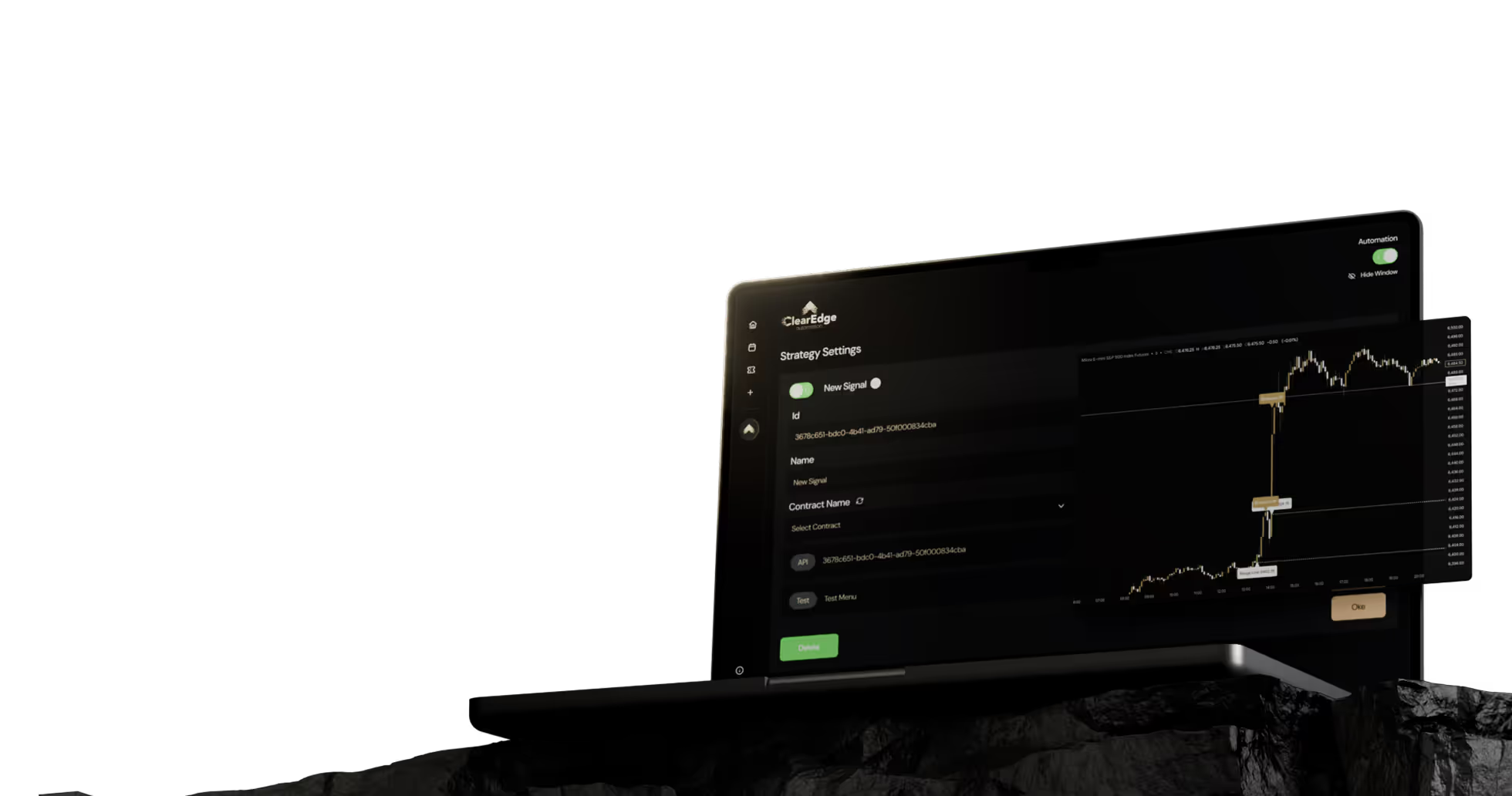
Unified Trading Platform: Your Comprehensive All-In-One Futures Bot Ecosystem
Stop juggling separate subscriptions and simplify your workflow with an integrated futures trading platform. Save time, cut costs, and boost trade reliability.


An all-in-one futures trading platform bundles charting, alerts, automation, broker connections, and infrastructure into a single login. For futures traders, this comprehensive futures bot ecosystem reduces setup friction, lowers total monthly cost compared to stitching separate tools together, and removes integration failures that break automated execution. The tradeoff: less flexibility than custom-built stacks.
Key Takeaways
- An all-in-one futures trading platform combines charting, alerts, broker APIs, risk controls, and execution in one dashboard, eliminating the need for 4-6 separate subscriptions.
- Bundled stacks typically run $100-$250/month versus $300-$500/month for fully separate tools (TradingView Premium + VPS + execution layer + analytics).
- Integrated platforms reduce webhook failures and broker disconnects because internal handoffs replace third-party API chains.
- Non-technical traders save 8-15 hours during initial setup by skipping API key configuration across multiple services.
- The main limitation is vendor lock-in: switching later means rebuilding strategies, alerts, and broker connections from scratch.
Table of Contents
- Defining All-In-One For Futures
- Cost Of Bundled vs Separate
- Time Saved With Integrated Tools
- Reliability Benefits
- Single Dashboard Walkthrough
- Who Benefits Most
- Limitations To Consider
- Common Mistakes To Avoid
- Frequently Asked Questions
What Is An All-In-One Futures Trading Platform?
An all-in-one futures trading platform is a single product that handles charting, signal generation, alert routing, risk management, broker execution, and account monitoring without requiring third-party setup. Instead of subscribing to TradingView for charts, paying for a VPS to host webhooks, using a separate execution bridge, and managing broker API keys yourself, the comprehensive futures bot ecosystem covers each layer under one login.
The category exists because retail futures automation usually requires 4-6 distinct services to function. Each handoff between services adds latency, billing, and a potential point of failure. A unified trading platform consolidates those layers.
Comprehensive Futures Bot Ecosystem: A bundled stack where charting, alerts, automation logic, and broker execution live inside one platform. It matters because every external integration is a point that can disconnect during a live trade.
Not every product marketed as "all-in-one" actually delivers full ecosystem coverage. Some still require you to bring your own VPS, your own TradingView subscription, or your own broker API setup. Read the fine print before assuming a single subscription replaces your entire stack.
How Much Does Bundled vs Separate Cost?
A bundled all-in-one futures trading platform typically costs $100-$250 per month, while assembling separate tools usually runs $300-$500 monthly once you add charting, VPS hosting, an execution bridge, analytics, and broker data feeds. The gap widens when you factor in setup time and recurring maintenance.
Here's a rough breakdown of what a separated stack looks like for a futures trader running automated strategies on ES and NQ:
ComponentSeparate StackAll-In-OneCharting (TradingView Premium)$60/moIncluded or BYOVPS Hosting$30-$80/moIncludedExecution Bridge / Webhook Layer$50-$150/moIncludedAnalytics / Journaling$30-$50/moIncludedBroker Data Feed (CME)$15-$120/moOften passed throughTypical Total$185-$460/mo$100-$250/mo
Bundled trading software wins on raw price for most retail traders. The exception is the trader running custom Python strategies with niche data feeds, where a separated stack offers flexibility a one-stop futures platform cannot match. For a deeper feature breakdown, see our platform comparison guide.
Time Saved With Integrated Tools
Integrated futures trading platforms cut initial setup time from 12-20 hours down to 1-3 hours for non-technical traders. The savings come from skipping API key generation across services, avoiding webhook URL routing, and removing the trial-and-error of matching alert payloads to broker order formats.
A separated stack requires you to:
- Configure TradingView alerts with custom JSON payloads
- Spin up and harden a VPS
- Install an execution bridge and configure ports
- Generate broker API credentials and test order flow
- Build a journaling pipeline that pulls fills from your broker
An end-to-end futures platform replaces those steps with a guided setup. You connect your broker once, pick a strategy template, and the platform handles webhook routing internally. Time savings compound over months because there's no third party setup to debug when something breaks. Our webhook setup guide shows what the separated path actually requires.
Integrated VPS Included: The platform hosts your automation on its own infrastructure, so you don't rent or maintain a separate server. It matters because VPS downtime is a leading cause of missed trades for retail automation.
Why Are All-In-One Platforms More Reliable?
Reliability improves because internal handoffs replace external API chains. When your charting tool, alert layer, and broker connection are separate products, every handoff is a potential failure point. A single dashboard futures setup keeps the entire signal-to-fill pathway inside one system.
Common failure modes that disappear with bundled platforms:
- Webhook timeouts: Direct internal routing replaces public webhook URLs that can drop during traffic spikes.
- API key expiration: One credential set instead of three or four to rotate.
- Version mismatches: Updates to one service no longer break compatibility with another.
- VPS reboots: Provider-managed infrastructure handles failover automatically.
That said, an integrated platform is still a single point of failure at the vendor level. If the platform itself goes down, everything goes down. Traders running prop firm evaluations or large accounts often keep a manual override path ready. For more on monitoring practices, see our monitoring best practices.
Single Dashboard Walkthrough
A single login dashboard for an all-in-one futures trading platform typically organizes around four panels: positions, strategies, alerts, and account health. The layout matters because futures automation requires constant visibility into open risk, not just historical fills.
What you typically see in one screen:
- Active positions: Open contracts on ES, NQ, GC, CL with current P&L, stop levels, and time in trade.
- Strategy status: Which automated rules are running, paused, or in error state.
- Alert log: Recent TradingView alerts received, including any that failed to fire orders and why.
- Account metrics: Daily P&L, drawdown from peak, contracts traded, and prop firm rule status if applicable.
The alternative, a separated stack, forces you to flip between TradingView, your broker's DOM, a journaling app, and a VPS terminal. For traders managing multiple accounts or running concurrent strategies, the unified view is often the deciding factor. Our multi-account automation guide covers this in more depth.
Who Benefits Most From An All-In-One Platform?
Non-technical traders, prop firm participants, and part-time futures traders gain the most from a complete automation stack. These groups share a common need: reliable execution without becoming part-time system administrators.
Non-technical traders benefit because no-code automation removes the Python and API knowledge barrier. Prop firm traders benefit because integrated risk controls enforce daily loss limits and trailing drawdown rules that match firm requirements, which is critical when a single rule violation can void an evaluation. Part-time traders benefit because the time savings let them focus on strategy rather than infrastructure.
Traders who probably don't need an all-in-one platform: institutional desks with dedicated dev teams, quants running custom ML models on proprietary data, and high-frequency operators where every microsecond matters. Those use cases justify the complexity of a custom stack. For prop firm specifics, see our prop firm automation guide.
Limitations To Consider
The two real downsides of any all-in-one futures trading platform are vendor lock-in and reduced flexibility. If you build a year of strategies, alerts, and broker connections inside one ecosystem, switching means rebuilding most of it.
Specific tradeoffs:
- Strategy portability: Strategies built in proprietary formats don't move easily to other platforms.
- Broker selection: You're limited to brokers the platform supports. Check supported brokers before committing.
- Custom logic ceiling: No-code platforms handle 80-90% of common strategies. Edge cases requiring custom code may not fit.
- Pricing changes: Bundled platforms can raise prices, and you have less leverage to switch when everything is integrated.
Vendor Lock-In: The cost (in time and rebuilding effort) to leave one platform for another. It matters because automation setups accumulate value over time, and switching erases that value.
The mitigation: document your strategies in platform-neutral terms, keep TradingView Pine Script as your master strategy source where possible, and verify export options before signing up.
Common Mistakes To Avoid
Three mistakes show up repeatedly when traders evaluate or adopt an all-in-one futures platform:
- Assuming "all-in-one" means everything: Some platforms still require a separate TradingView subscription or external data feed. Read what's actually included.
- Skipping the paper trade phase: Even on a unified trading platform, paper trade first to validate your strategy before risking capital. Past performance does not guarantee future results.
- Picking on price alone: The cheapest bundle that doesn't support your broker or strategy type is the most expensive choice in the long run.
Frequently Asked Questions
1. What does "all-in-one" actually include for futures trading?
A true all-in-one futures trading platform includes charting access, alert routing, automation logic, broker execution, risk controls, and infrastructure hosting in one subscription. Some products use the label loosely, so verify each component is bundled rather than a third-party requirement.
2. Is a comprehensive futures bot ecosystem worth it for a beginner?
For most beginners, yes, because the time and complexity savings outweigh the small flexibility cost. The exception is a beginner who plans to learn Python and build custom systems from day one.
3. How does an all-in-one platform handle TradingView alerts?
Most platforms accept TradingView webhooks directly and route them to your broker via internal APIs. You typically paste a single webhook URL into TradingView, and the platform parses the alert payload to fire the corresponding order.
4. Can I use a unified trading platform for prop firm accounts?
Yes, if the platform supports your prop firm's broker and includes risk controls that match firm rules. Always verify daily loss limit and trailing drawdown enforcement before running a live evaluation.
5. What happens if the all-in-one platform has an outage?
If the platform goes down, your automation pauses until service restores. Most traders mitigate this with manual override access at the broker level and by monitoring open positions during high-impact news like FOMC or NFP.
6. Do all-in-one platforms support ES, NQ, GC, and CL automation?
Most major platforms support the core CME contracts including ES, NQ, GC, and CL, along with their micros. For instrument-specific settings, see our futures instrument automation guide.
7. How long does it take to set up a complete automation stack?
An integrated platform typically takes 1-3 hours from signup to first live trade, while a separated stack takes 12-20 hours. The gap is mostly API configuration and webhook debugging that bundled platforms handle internally.
Conclusion
An all-in-one futures trading platform makes sense when you value reliability and simplicity over maximum flexibility. The bundled approach saves money and time for most retail futures traders, while a separated stack remains the right choice for custom quant work or institutional setups.
Before committing, paper trade the platform with your actual strategy, verify broker support, and confirm what's actually included in the subscription. Do your own research and testing before trading live.
Want to see what a complete automation stack looks like in practice? Explore ClearEdge Trading features to compare what an integrated platform includes versus building it yourself.
References
- CME Group. "E-mini S&P 500 Contract Specifications." cmegroup.com
- CFTC. "Customer Advisory: Beware of Automated Trading Systems." cftc.gov
- TradingView. "Webhooks Documentation." tradingview.com
- Futures Industry Association. "Annual Volume Survey." fia.org
- NFA. "Electronic Trading Systems Compliance Rules." nfa.futures.org
Disclaimer: This article is for educational purposes only. It is not trading advice. ClearEdge Trading executes trades based on your rules, it does not provide signals or recommendations.
Risk Warning: Futures trading involves substantial risk. You could lose more than your initial investment. Past performance does not guarantee future results. Only trade with capital you can afford to lose.
CFTC RULE 4.41: Hypothetical results have limitations and do not represent actual trading.
By: ClearEdge Trading Team | 29+ Years CME Floor Trading Experience | About














































Steal the PlaybooksOther TradersDon’t Share
Every week, we break down real strategies from traders with 100+ years of combined experience, so you can skip the line and trade without emotion.