All-in-One Trading Platform For Automating Your Prop Firm Challenges
Simplify prop firm challenges with an all-in-one platform that automates risk rules, tracks drawdowns, and manages multiple funded accounts from one dashboard.


An all-in-one trading platform for prop firm challenges combines TradingView automation, broker connectivity, risk controls, and multi-account management in a single dashboard. For funded account traders, this means daily loss limits, trailing drawdowns, and consistency rules can be enforced automatically across one or several evaluations without juggling separate tools or third-party services.
Key Takeaways
- An all-in-one trading platform for prop firm challenges bundles execution, risk enforcement, and account management so trailing drawdowns and daily loss limits are tracked in real time.
- Common prop firm thresholds (2-5% daily loss, 3-6% trailing drawdown, 30-40% consistency caps) require automation that reacts in milliseconds, not minutes.
- Multi-account routing lets traders mirror one strategy across FTMO, Apex, Topstep, or TopOne evaluations from a single login.
- Bundled platforms reduce setup friction (no separate VPS, copier, or webhook bridge) but may have fewer custom-coding options than à la carte stacks.
- Paper trade and forward test any automation against the specific firm's rule set before risking evaluation fees.
Table of Contents
- What Is an All-in-One Platform for Prop Firm Challenges?
- Which Prop Firm Rules Need Automation Support?
- How Does Multi-Account Management Work?
- Who Benefits Most From a Bundled Platform?
- Comparing All-in-One vs Stitched-Together Stacks
- Common Mistakes When Automating Challenges
- Frequently Asked Questions
What Is an All-in-One Trading Platform for Prop Firm Challenges?
An all-in-one trading platform for prop firm challenges is a unified trading platform that handles signal intake, order routing, risk enforcement, and reporting from one dashboard. Instead of wiring together TradingView, a webhook bridge, a copier, a separate risk monitor, and a VPS, you get a complete automation stack built to respect funded account rules.
The appeal for prop traders is simple: evaluation rules are strict, and missed automation between tools is how accounts blow up. A single dashboard futures setup keeps the daily loss counter, trailing drawdown tracker, and position sizing logic on the same clock as the broker connection.
All-in-One Trading Platform: A bundled trading software environment where strategy automation, broker integration, risk controls, and multi-account features run inside one product. For prop firm traders, it means rule compliance and execution share the same data and timing.
Which Prop Firm Rules Need Automation Support?
The rules that matter most for an end-to-end futures platform are daily loss limits, trailing drawdowns, max position size, consistency, and minimum trading days. Each of these can be violated in seconds without automated enforcement, especially during news events.
Here is how typical thresholds map to automation requirements:
| Rule | Common Threshold | Automation Requirement |
|---|---|---|
| Daily Loss Limit | 2-5% of account | Hard flatten + lockout for the day |
| Trailing Drawdown | 3-6% from peak equity | Real-time peak tracking, intra-bar exits |
| Max Position Size | 1-20 contracts (firm specific) | Pre-trade size validation |
| Consistency Rule | No day >30-40% of total profits | Daily profit cap with auto-stop |
| Minimum Trading Days | 5-10 trading days | Pacing logic across the evaluation |
| News Trading | Restricted on FOMC, NFP, CPI | Economic calendar filter |
A platform that handles rule support natively is more reliable than scripting these in Pine and hoping the alert fires. For a deeper breakdown of how each firm structures these rules, see the prop firm automation guide and the firm-specific notes in FTMO, Apex, and Topstep rules.
Trailing Drawdown: A moving stop on account equity that locks in gains as the account grows. Once equity exceeds the threshold, the drawdown anchor often freezes, but during the evaluation phase it trails in real time and a single tick over the line ends the challenge.
How Does Multi-Account Management Work?
Multi-account management lets one strategy fire orders to several funded or evaluation accounts simultaneously, with per-account sizing and risk rules. This is core to the integrated futures trading approach because most serious prop traders run 3-10 accounts to diversify firm risk and scale payouts.
A complete automation stack handles three things on multi-account:
- Signal fan-out: One TradingView alert routes to multiple broker accounts (Tradovate, Rithmic, NinjaTrader Brokerage) without a separate copier.
- Per-account scaling: A 50K Apex account trades 2 micros while a 150K Topstep account trades 6 minis, off the same signal.
- Independent rule enforcement: Each account's daily loss and trailing drawdown are tracked separately, so one account hitting its limit does not stop the others.
For trailing drawdown specifics across accounts, see the trailing drawdown automation guide. For scaling logistics, the multi-account scaling plan covers position-size math.
Who Benefits Most From a Bundled Platform?
Bundled platforms fit non-technical traders, traders running multiple prop firm accounts, and anyone who values time savings over deep customization. If you can write Pine Script, set up a Linux VPS, and configure a copier API, the simplification benefit matters less to you.
The clearest fit profiles:
- The evaluation grinder: Running 4-8 challenges across FTMO, Apex, Topstep, and TopOne. Needs ecosystem coverage so one missed config does not violate rules across the board.
- The funded swing trader: Holds positions overnight or across sessions. Needs reliable execution without babysitting a VPS at 3 AM.
- The full-time worker: Trades 1-2 funded accounts on the side. Cannot afford the time to maintain a custom stitched stack. See the full-time worker automation guide.
Traders who do best with separate tools are those running heavily customized strategies, latency-sensitive scalping, or institutional-style infrastructure. The cloud vs desktop infrastructure comparison gets into the trade-offs.
Comparing All-in-One vs Stitched-Together Stacks
An all-in-one platform reduces setup friction at the cost of some flexibility. A stitched-together stack offers maximum customization but has more breakage points. For prop firm work, the question is which failure mode hurts more: a missed rule violation or a missed signal.
| Factor | All-in-One Platform | Stitched-Together Stack |
|---|---|---|
| Setup time | 30-90 minutes | 4-20 hours |
| VPS required | Often included | Separately rented ($25-80/mo) |
| Webhook bridges | Native | Third-party service needed |
| Multi-account copier | Built in | Separate license |
| Rule enforcement | Pre-coded for major firms | Custom-coded by trader |
| Customization ceiling | Moderate | Very high |
| Failure points | Fewer (one vendor) | More (multiple vendors) |
| Monthly cost | $50-200 typical | $100-300+ across services |
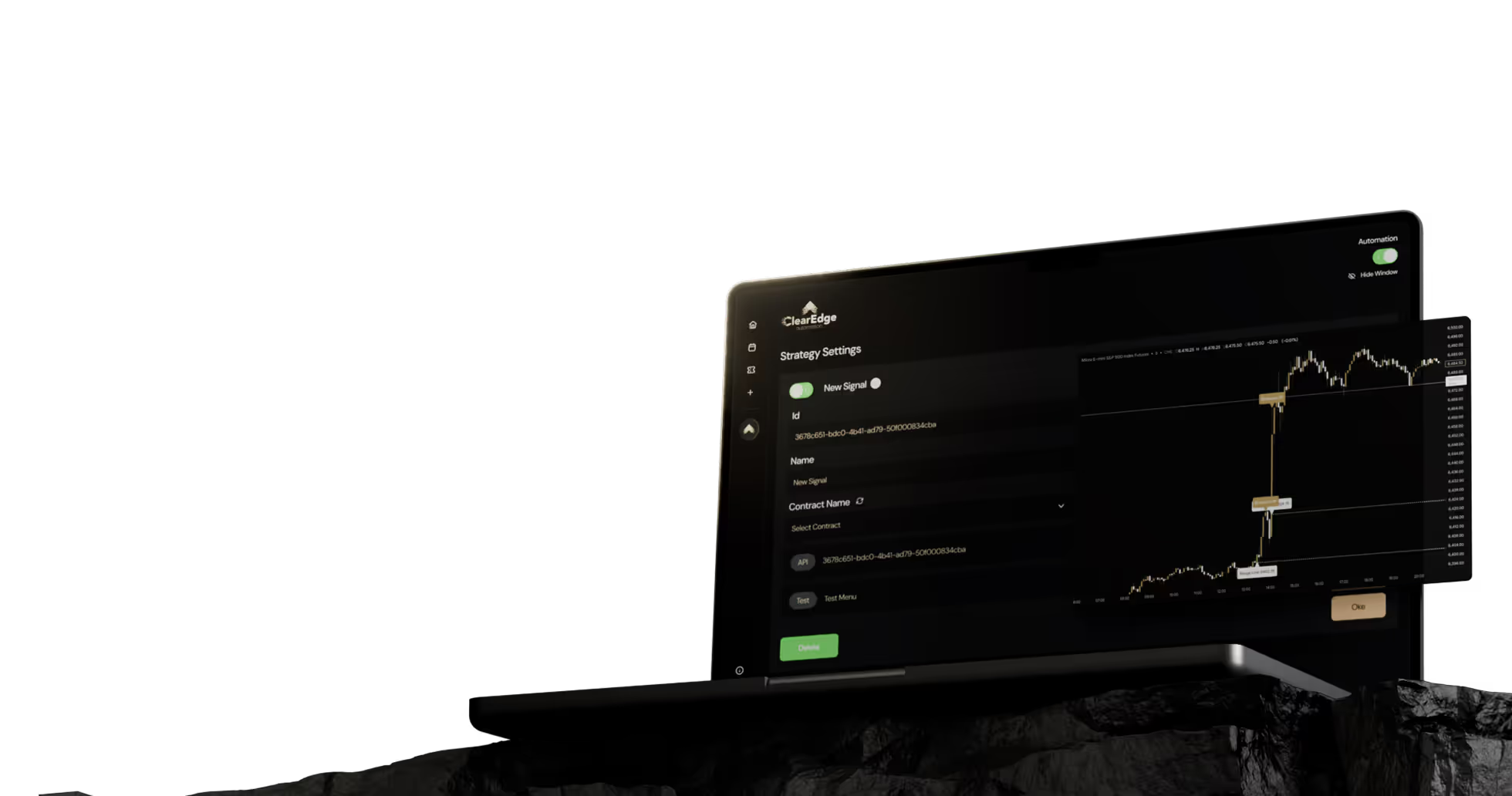
Platforms like ClearEdge connect TradingView alerts directly to supported brokers with built-in multi-account routing and rule-aware risk controls. You can review the feature set and check supported brokers to see whether your evaluation firm's clearing broker is covered. For broader platform comparisons, the platform comparison pillar walks through the major options.
Webhook Bridge: A service that translates a TradingView alert (HTTP POST) into a broker API order. In a bundled platform this is internal; in a stitched stack it is a separate paid service that adds another failure point.
Common Mistakes When Automating Prop Firm Challenges
Most blown evaluations come from automation gaps, not bad strategy logic. The four mistakes below account for a large share of rule violations on funded accounts.
- Trusting a strategy without forward testing on the firm's data feed. Backtest results assume fills that may not happen in live markets. Forward test on demo before paying evaluation fees.
- Ignoring news restrictions. Many firms ban trades within 2-5 minutes of FOMC, NFP, or CPI. Without a calendar filter, a single auto-fired trade can disqualify the account. The news restrictions guide covers this.
- Using one daily loss limit across all accounts. Each account has its own counter. A bundled platform tracks them independently; a misconfigured stack often does not.
- Skipping the consistency rule check. A single big day above 30-40% of total profits can void the payout even if all other rules are clean. Daily profit caps need to be in the automation, not in your head.
Frequently Asked Questions
1. Do prop firms allow automated trading on evaluations?
Most major firms (FTMO, Apex, Topstep, TopOne) allow automation, but specific rules vary on copy trading, EA usage, and news trading. Always check the firm's terms before connecting any platform, and review the prop firm automated trading bots overview.
2. Can one all-in-one platform handle multiple prop firms at once?
Yes, if the platform supports the brokers each firm clears through (commonly Tradovate, Rithmic, or proprietary platforms). Multi-account routing fans out one signal across all connected accounts with per-account sizing.
3. What happens if the platform misses an exit during a news event?
The trade stays open and risks violating daily loss or news restriction rules. This is why bundled platforms with built-in calendar filters and hard stop logic are safer than ad-hoc Pine Script automation for funded accounts.
4. Is a VPS still needed with a cloud-based all-in-one platform?
Cloud-hosted platforms run on the vendor's infrastructure, so a personal VPS is usually not required. Desktop-based platforms still need a VPS for 24/7 uptime, which adds $25-80 per month.
5. How much does an all-in-one platform cost compared to building your own stack?
Bundled platforms typically run $50-200 per month including VPS and webhook bridge. A custom stack of TradingView Pro ($30) + webhook service ($30-50) + VPS ($30-60) + copier ($50-100) often totals $140-240 with more setup work.
6. Can automation alone pass a prop firm challenge?
Automation handles execution and rule enforcement, but the underlying strategy still needs an edge. Past performance does not guarantee future results, and you should paper trade and forward test any system before risking evaluation fees.
Conclusion
An all-in-one trading platform for prop firm challenges is most useful when you value reliable rule enforcement, multi-account routing, and a single login dashboard over deep customization. For traders running several evaluations, the simplification benefit and reduced failure points often outweigh the loss of à la carte flexibility.
Before committing, paper trade your strategy against the specific firm's rule set, confirm broker compatibility, and verify how the platform handles news events and trailing drawdowns. Do your own research and testing before trading live.
Ready to automate your prop firm challenge? Explore ClearEdge Trading to see how no-code automation, multi-account routing, and built-in risk controls work with your TradingView strategies.
References
- CME Group. "E-mini S&P 500 Futures Contract Specs." cmegroup.com
- CFTC. "Customer Advisory: Use Caution When Considering Trading on Behalf of Others." cftc.gov
- NFA. "Compliance Rules for Futures Trading." nfa.futures.org
- TradingView. "Webhook Alerts Documentation." tradingview.com
- Futures Industry Association. "Annual Volume Survey." fia.org
Disclaimer: This article is for educational purposes only. It is not trading advice. ClearEdge Trading executes trades based on your rules, it does not provide signals or recommendations.
Risk Warning: Futures trading involves substantial risk. You could lose more than your initial investment. Past performance does not guarantee future results. Only trade with capital you can afford to lose.
CFTC RULE 4.41: Hypothetical results have limitations and do not represent actual trading.
By: ClearEdge Trading Team | 29+ Years CME Floor Trading Experience | About















































Steal the PlaybooksOther TradersDon’t Share
Every week, we break down real strategies from traders with 100+ years of combined experience, so you can skip the line and trade without emotion.