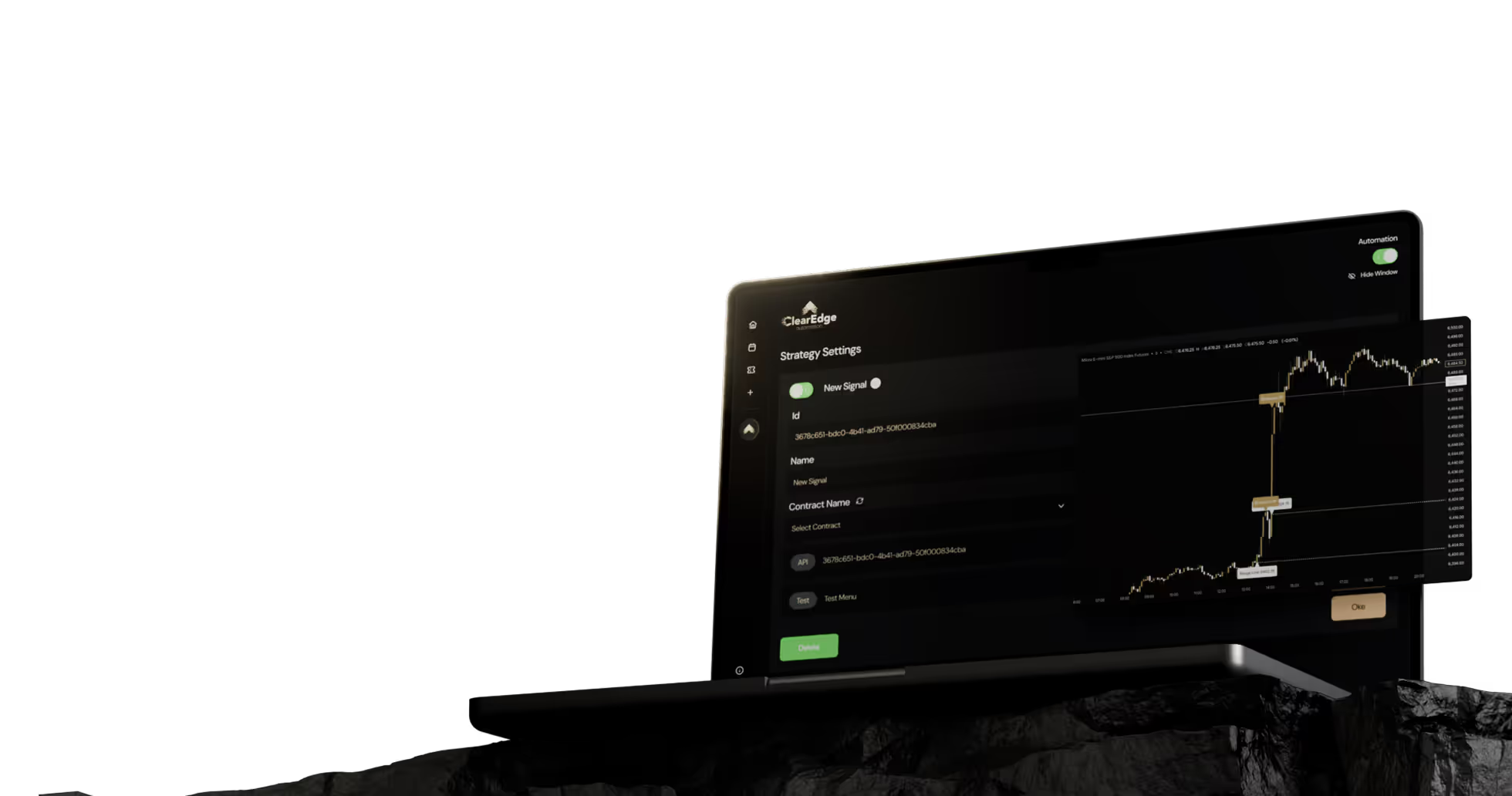
QuantView To ClearEdge Migration: Complete Step By Step Walkthrough
Switch from QuantView to ClearEdge in 2-4 hours with our migration guide. Learn to rebuild alerts, sync brokers, and run parallel tests to protect capital.


Switching from QuantView to ClearEdge takes about 2-4 hours when planned correctly. The process involves exporting your TradingView strategies, rebuilding webhook alerts in ClearEdge format, reconnecting your futures broker, running a parallel test for 3-5 trading days, then cutting over live. This walkthrough covers each step with specific settings and a downtime plan to protect your capital.
Key Takeaways
- Plan a 2-4 hour migration window, plus 3-5 days of parallel running before going live with real capital.
- Export your QuantView alert configurations and broker credentials before cancelling, you cannot retrieve them after account closure.
- Webhook URLs and JSON payloads differ between platforms, every alert needs to be rebuilt, not copy-pasted.
- Run both platforms side-by-side on a paper account to compare fills, latency, and slippage before cutover.
- Establish a performance baseline (win rate, average slippage, fill quality) on QuantView first, so you can verify ClearEdge matches or improves it.
Table of Contents
- Why Traders Switch From QuantView
- Pre-Migration Checklist
- Exporting Your QuantView Strategies
- Rebuilding Webhook Alerts in ClearEdge
- Reconnecting Your Futures Broker
- Parallel Running Test
- Cutover Day Walkthrough
- Common Migration Pitfalls
- FAQ
Why Are Traders Switching From QuantView to ClearEdge?
Most traders switching futures automation platform options cite three reasons: execution latency, broker support gaps, and pricing structure. The decision to migrate trading platform setups usually follows weeks of frustration with one of these areas, not a single bad trade.
Before committing to any platform change, run a switching cost analysis. Add up the time to rebuild alerts, the days of paper testing required, and any subscription overlap during the transition. For most traders, the total cost of changing futures bot infrastructure runs $50-200 plus 8-12 hours of work, which is recoverable within a month if the new platform fixes a real execution problem.
Switching Cost Analysis: The full accounting of money, time, and risk required to move from one trading platform to another. It includes subscription overlap, alert rebuild time, paper testing days, and the opportunity cost of any trading downtime.
Pre-Migration Checklist: What to Do Before You Touch Anything
The pre-migration checklist exists to prevent the worst-case scenario: cancelling your old platform before confirming the new one works. Complete every item below before disabling any QuantView alerts or cancelling subscriptions.
- Document current strategy settings: entry/exit conditions, position size rules, stop loss percentages, take profit levels.
- Record your performance baseline: 30-day win rate, average slippage in ticks, fill rate, average latency.
- Export TradingView alert messages: copy each alert's JSON payload to a text file, you'll need these for the rebuild.
- Save broker connection details: API keys, account numbers, OAuth tokens (where applicable).
- Note your current TradingView plan: alert count, webhook eligibility, indicator slots used.
- Schedule the migration window: avoid FOMC, NFP, CPI weeks. Pick a Friday afternoon or Saturday.
- Settings backup: screenshot every QuantView dashboard, settings page, and risk control configuration.
Performance Baseline: A documented record of your strategy's recent execution metrics on the old platform. This baseline lets you verify the new platform matches or improves on fills, latency, and slippage rather than relying on memory or assumption.
Exporting Your QuantView Strategies
QuantView stores strategy logic in two places: TradingView (the Pine Script and alert conditions) and the platform itself (webhook routing, position sizing, broker mapping). You need both to fully transfer trading strategy configurations.
Step 1: Export From TradingView
Open each chart with an active strategy. For Pine Script strategies, copy the full script source to a text file. For each alert, open the alert dialog and copy the alert message body, the trigger condition, and the webhook URL field. Save these in a spreadsheet with columns for symbol, timeframe, alert name, condition, message, and webhook URL.
Step 2: Export Platform-Side Settings
From the QuantView dashboard, navigate to your strategy list and document: position sizing rules, daily loss limits, max concurrent positions, allowed trading hours, and any prop firm rule configurations. Take screenshots, the export tools on most platforms do not capture every setting.
Step 3: Verify Broker Mapping
Note which QuantView account ID maps to which broker subaccount. If you trade multiple accounts, this mapping is the most common thing traders forget during account migration.
How Do You Rebuild Webhook Alerts in ClearEdge?
Webhook URLs and JSON payload formats differ between platforms, so every alert needs to be rebuilt with a new URL and message body. The Pine Script logic in TradingView stays the same, only the alert's webhook target and message format change.
In ClearEdge, each strategy generates a unique webhook URL. You paste this URL into the TradingView alert's "Webhook URL" field, then format the alert message as JSON with the fields ClearEdge expects: ticker, action, quantity, and any optional fields like stop loss or take profit. The webhook setup guide covers the exact JSON structure.
Common Field Mapping
QuantView FieldClearEdge EquivalentNotessymboltickerUse full futures symbol (ESZ5, NQZ5)sideactionbuy, sell, closesizequantityNumber of contractssl_pricestop_lossAbsolute price, not offsettp_pricetake_profitAbsolute price, not offset
Test each rebuilt alert by triggering it manually on a paper account before relying on it for live trading. The alert message variables guide covers dynamic values like {{close}} and {{strategy.order.action}}.
Reconnecting Your Futures Broker
Broker reconnection is the step where most migration timelines slip. The process involves generating new API credentials, authorizing ClearEdge to access your account, and verifying that orders route correctly. Plan 30-60 minutes per broker.
Step 1: Confirm Broker Support
Check supported brokers to confirm your futures broker integrates with ClearEdge. The platform supports 20+ brokers including AMP, Tradovate, TradeStation, NinjaTrader, and Interactive Brokers.
Step 2: Generate Fresh API Credentials
Do not reuse the API keys from QuantView. Most brokers tie keys to a specific application or IP, and reusing them creates routing conflicts. Log into your broker's portal, revoke the QuantView keys, and generate new ones for ClearEdge.
Step 3: Authorize and Test
In ClearEdge, add your broker connection and paste the credentials. Place a 1-contract test order on a micro futures contract (MES or MNQ) during regular hours. Verify the order shows in both ClearEdge's order log and your broker's platform.
Transfer Broker Connection: The process of authorizing a new automation platform to place orders through your existing futures broker account. Your money and positions stay at the broker, only the order-routing software changes.
Running a Parallel Test Before Going Live
A parallel running test is when you run both QuantView and ClearEdge simultaneously on paper accounts for 3-5 trading days, comparing fills and latency on identical signals. This catches subtle differences in execution before real money is at stake.
How to Set Up the Parallel Test
Duplicate your TradingView alerts so each signal fires twice: once to QuantView's webhook and once to ClearEdge's. Both should hit paper accounts with matching starting balances and identical position sizing rules. Record every trade in a spreadsheet with columns for: signal time, fill time on each platform, fill price, slippage in ticks, and order status.
What to Compare
- Latency: time between signal and fill on each platform.
- Slippage: difference between expected price and fill price.
- Fill rate: percentage of orders that fill at all.
- Order accuracy: did the position size, stop loss, and take profit match your alert message?
If ClearEdge matches or beats QuantView across these four metrics over 3-5 sessions, the migration is validated. If results lag, troubleshoot before cutting over. The forward testing guide covers parallel test methodology in more depth.
Cutover Day Walkthrough
Cutover day is when you disable QuantView alerts and enable ClearEdge alerts for live trading. Run this on a low-volatility session, never during a major economic release. Here is the sequence:
- Pre-market (60 min before open): verify ClearEdge broker connection is active, account balance matches expected, and risk controls (daily loss limit, max position size) are configured.
- 30 min before open: in TradingView, disable QuantView webhooks on each alert. Enable the ClearEdge webhooks. Trigger a test alert manually to confirm the round-trip works.
- Market open: monitor the first 3-5 trades closely. Watch the ClearEdge dashboard, your broker's order log, and TradingView side-by-side.
- Mid-session check: after 90 minutes, verify all fills, slippage, and position sizing match expectations.
- End of day: reconcile every trade. Compare against your performance baseline from QuantView. Document anything unusual.
Keep your QuantView subscription active for 7-14 days after cutover. If you discover an issue with ClearEdge, you can roll back without rebuilding from scratch.
Ready to automate your futures trading? Explore ClearEdge Trading and see how no-code automation works with your TradingView strategies.
Common Migration Pitfalls
Most failed migrations share the same handful of mistakes. Knowing these in advance prevents 80% of post-cutover problems.
Skipping the Parallel Test
The temptation to flip the switch immediately is strong, especially when the old platform is annoying you. Resist it. Three days of paper-mode parallel testing has prevented countless live-trading disasters where a JSON field name was wrong or a position size calculation rounded differently.
Forgetting About Active Positions
If QuantView is managing an open position with a trailing stop, that stop lives on QuantView's servers. When you disable QuantView, the stop disappears unless your broker holds it natively. Close all positions before cutover, or manually replicate working orders at the broker level.
Underestimating Webhook URL Differences
Each ClearEdge strategy has its own webhook URL. Pasting the same URL into all alerts routes every signal to the same strategy. Double-check that each TradingView alert points to its corresponding ClearEdge strategy URL.
Cutting Over on a High-Volatility Day
FOMC, NFP, CPI, and earnings reports introduce slippage and rejected orders that have nothing to do with platform performance. You won't be able to tell if a problem is the new platform or just market conditions. Pick a quiet Tuesday or Wednesday session for cutover.
Frequently Asked Questions
1. How long does it take to switch trading software from QuantView to ClearEdge?
Most traders complete the active migration work in 2-4 hours, plus 3-5 trading days of parallel testing. Total elapsed time from decision to live cutover typically runs 7-10 days when done properly.
2. Will I lose my TradingView Pine Script strategies during the migration?
No, your Pine Script code lives in TradingView, not in QuantView or ClearEdge. The platforms only handle alert routing and broker execution, so your charts and strategies remain unchanged when you switch automation providers.
3. Do I need to close my QuantView account before setting up ClearEdge?
No, and you should not. Keep QuantView active during your parallel testing phase and for 7-14 days after cutover as a rollback option. Cancel only after you've confirmed ClearEdge handles your full trading workload reliably.
4. Can I import my QuantView webhook alerts directly into ClearEdge?
Not directly, because the webhook URLs and JSON payload formats differ between platforms. You'll need to update each TradingView alert with a new ClearEdge webhook URL and reformat the message body to match ClearEdge's expected fields.
5. What happens to my open positions during the cutover?
Your positions live at your broker, not on the automation platform, so they remain open during the switch. However, any trailing stops or working orders managed by QuantView's software will need to be re-established in ClearEdge or held natively at the broker.
6. How do I know if ClearEdge is performing better than QuantView?
Compare four metrics from your parallel test: latency, slippage, fill rate, and order accuracy. If ClearEdge matches or beats QuantView across all four over 3-5 sessions, the migration is validated by data rather than guesswork.
7. Is there downtime during a futures platform migration?
There can be, but careful downtime planning eliminates it. Run both platforms in parallel during testing, then schedule cutover for a low-volatility session with QuantView still on standby for 1-2 weeks as a rollback option.
Conclusion
Switching futures automation platform setups from QuantView to ClearEdge is a structured process: export, rebuild, parallel test, then cut over. The work is mostly mechanical, but skipping any step (especially the parallel test) is where traders get hurt. Treat the migration like a strategy change, document everything, validate against a baseline, and only commit live capital when the data confirms the new setup works.
For a deeper look at platform selection criteria, see our futures automation platform comparison. For broker-specific setup, check switching futures brokers.
References
- CME Group. "E-mini S&P 500 Contract Specifications." cmegroup.com
- TradingView. "Webhooks Documentation." tradingview.com
- CFTC. "Customer Advisory: Beware of Automated Trading Systems." cftc.gov
- NFA. "Compliance Rules for Automated Order Routing." nfa.futures.org
Disclaimer: This article is for educational purposes only. It is not trading advice. ClearEdge Trading executes trades based on your rules, it does not provide signals or recommendations.
Risk Warning: Futures trading involves substantial risk. You could lose more than your initial investment. Past performance does not guarantee future results. Only trade with capital you can afford to lose.
CFTC RULE 4.41: Hypothetical results have limitations and do not represent actual trading.
By: ClearEdge Trading Team | About















































Steal the PlaybooksOther TradersDon’t Share
Every week, we break down real strategies from traders with 100+ years of combined experience, so you can skip the line and trade without emotion.