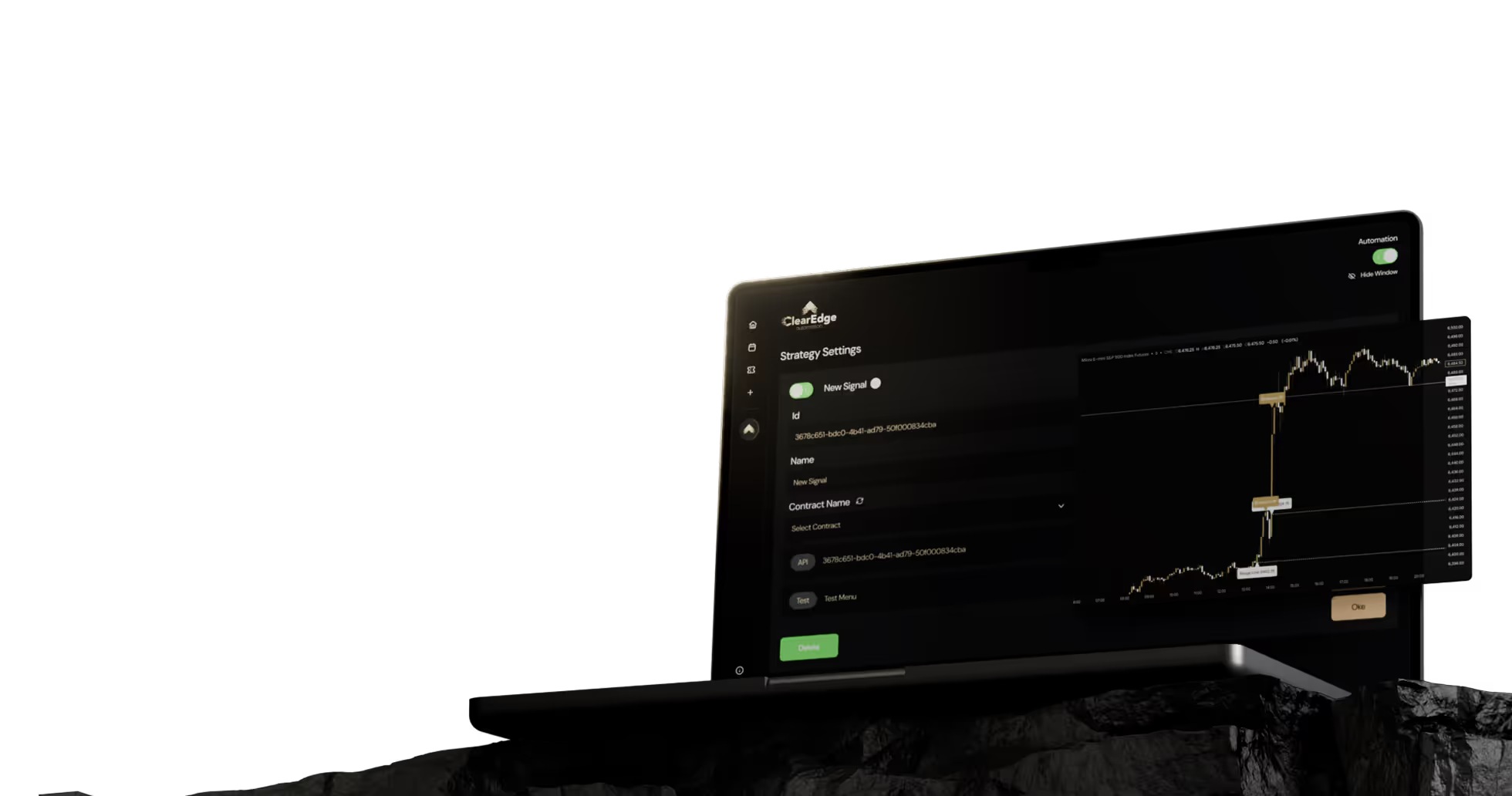
Why All-In-One Platforms Beat Third-Party Stacks For Automated Futures
Stop letting fragile webhook chains cost you trades. Unified futures platforms slash latency, eliminate failure points, and simplify your automation in minutes.


All-in-one futures trading platforms beat third-party tool stacks by consolidating TradingView alerts, broker connections, risk controls, and execution into one system. This eliminates webhook routing failures, reduces setup time from days to minutes, and removes the latency added by chaining separate services. For automated futures traders, integration cuts failure points and simplifies troubleshooting when trades go wrong.
Key Takeaways
- Third-party stacks typically chain 4-6 separate services (alert relay, webhook router, position manager, broker bridge), each adding 50-200ms of latency and a potential failure point.
- An all-in-one futures trading platform consolidates these into one login, one billing relationship, and one support team to call when something breaks.
- Bundled platforms with integrated VPS save roughly $40-80/month versus paying separately for alert services, webhook relays, and cloud hosting.
- Single-dashboard systems reduce setup time from 8-15 hours of configuration across multiple tools to under an hour for most users.
- All-in-one platforms have limitations: less flexibility for custom code, vendor lock-in, and fewer specialized features than dedicated tools.
Table of Contents
- What Is an All-in-One Futures Platform?
- Why Third-Party Stacks Create Problems
- Cost: Bundled vs Separate Tools
- Reliability and Failure Points
- Time Saved With Integrated Tools
- Who Benefits Most From All-in-One?
- Limitations to Consider
- Frequently Asked Questions
What Is an All-in-One Futures Platform?
An all-in-one futures trading platform is a single system that handles signal reception, order routing, broker connection, risk management, and monitoring without requiring third-party add-ons. You log in once, configure your rules in one place, and the platform runs end-to-end execution from your TradingView alert to a filled order at the exchange.
The alternative is a stacked approach: TradingView for charts, a separate webhook relay service, another tool for position sizing, a third for prop firm rule compliance, and a broker API bridge. Each link in that chain is a separate vendor with its own pricing, downtime windows, and support queue. When something fails at 9:31 AM ET, you have to figure out which service caused it.
All-in-One Trading Platform: Software that integrates alert handling, strategy logic, broker connection, and risk controls into a single product. It matters because each external dependency you remove cuts a potential point of failure during live trading.
Why Third-Party Stacks Create Problems
Chaining third-party tools sounds flexible, but the reality is fragile. A typical retail stack might look like this: TradingView fires an alert, a webhook service receives it, a translation layer reformats the JSON, a position-sizing tool calculates contracts, then a broker bridge submits the order. That is four hops before the order hits your broker.
Common breakdowns include webhook delivery delays of 200-800ms during high-volume periods, JSON parsing errors when one tool updates its format, expired API keys at any link in the chain, and rate limits at intermediate services that drop alerts entirely. The TradingView webhook troubleshooting guide covers the most common failures in detail.
The integration benefit of a unified trading platform is that internal handoffs happen in the same process. There is no public webhook URL exposed to the internet between your alert and your order. There is no second vendor's outage that takes down your trading. The whole automation stack lives in one place.
Webhook Relay: A third-party service that receives a TradingView alert and forwards it to your broker or another tool. Each relay adds latency and creates a dependency that can fail independently.
Cost: Bundled vs Separate Tools
Bundled trading software is typically cheaper than assembling the same capabilities from separate vendors. A complete automation stack built from individual services often costs more than a one-stop futures platform that includes the same features.
| Component | Third-Party Stack | All-in-One |
|---|---|---|
| TradingView Pro+ | $25-60/mo | $25-60/mo (still required) |
| Webhook relay service | $15-30/mo | Included |
| Position sizing tool | $20-40/mo | Included |
| VPS hosting | $20-50/mo | Often included |
| Prop firm rule monitor | $15-25/mo | Included |
| Total (excluding TV) | $70-145/mo | $50-120/mo |
The savings are real, but the bigger value is in time. Configuring five tools to talk to each other takes hours. Renewing five subscriptions, debugging five APIs, and contacting five support teams adds friction that a single login dashboard removes. See ClearEdge pricing for a current example of a bundled platform cost structure.
Reliability and Failure Points
Reliability is where all-in-one platforms have the clearest edge. Each separate service in a third-party stack has its own uptime SLA, and the math compounds against you. Five services at 99.5% uptime each give you a combined uptime closer to 97.5%, which is roughly 18 hours of downtime per month.
Failure points to consider in a chained setup:
- Webhook URL endpoint fails or rate-limits during news events
- JSON format changes break parsing between tools
- API keys expire on different schedules across vendors
- One service updates and breaks compatibility with another
- Broker connection drops and intermediate tools do not retry
An integrated futures trading platform reduces these to one set of failure modes you can monitor and one support team responsible for fixing them. When a trade does not execute, you have one log to read instead of five. The platform uptime standards guide covers what to expect from production systems.
Failure Point: Any component in an automation chain that can break and stop trade execution. Fewer failure points generally means better reliability and faster troubleshooting when issues happen.
Time Saved With Integrated Tools
Setup time is one of the most overlooked costs of a third-party stack. A typical multi-tool configuration takes 8-15 hours: signing up for each service, generating API keys, configuring webhook URLs, mapping JSON fields between tools, testing each link, and debugging the inevitable mismatches.
An end-to-end futures platform with no third-party setup typically gets a user from signup to first paper trade in under an hour. You connect your TradingView account, link your broker, set your risk parameters, and the platform handles the rest. There is no webhook URL to copy between services, no JSON template to format, no intermediate VPS to provision.
Ongoing time savings matter too. When you want to change a position size rule or add a new contract, you do it in one place. With a stacked setup, you might need to update the position sizer, the broker bridge, and the risk monitor separately. Our TradingView automation guide walks through what a streamlined setup looks like.
Who Benefits Most From All-in-One?
All-in-one platforms work best for non-technical traders, prop firm participants, and anyone who wants to spend time on strategy rather than infrastructure. If you do not write code, do not run your own servers, and do not enjoy debugging API integrations, a unified trading platform removes the parts of automation that have nothing to do with trading.
Specific groups that gain the most:
- Prop firm traders: Built-in rule compliance prevents disqualification from a missed daily loss limit. The prop firm automation guide covers this in depth.
- Multi-account traders: A single dashboard for ES, NQ, GC, CL, and micro contracts beats juggling multiple terminals.
- Part-time traders: People with day jobs cannot babysit five services. One system that runs reliably is the difference between trading and not trading.
- New automation users: The learning curve for one platform is steep enough without adding four more.
Discretionary traders who only place a few orders per week and developers who want full code control are less likely to benefit, since they either do not need the integration or want to build it themselves.
Limitations to Consider
All-in-one platforms have real trade-offs. Honest evaluation matters before committing to one approach.
- Less flexibility: If the platform does not support a specific broker, indicator format, or strategy structure, you cannot work around it the way you can with separate tools.
- Vendor lock-in: Migrating away requires rebuilding everything. Keep documentation of your strategies in a portable format.
- Feature depth: A specialized tool often does one thing better than a bundled feature. Dedicated order flow software typically has deeper analytics than the order flow module in a general platform.
- Single point of failure: If the entire platform goes down, everything stops. Some traders run a backup manual setup for this reason.
For traders weighing options, the platform comparison guide covers feature-by-feature differences. The right choice depends on your strategy complexity, technical skill, and how much time you want to spend on infrastructure.
Frequently Asked Questions
1. Is an all-in-one platform faster than a webhook stack?
Usually yes, because internal handoffs do not require a public network round trip between services. Typical end-to-end latency for a unified platform runs 3-40ms versus 200-800ms for a multi-hop webhook chain.
2. Do I still need TradingView with an all-in-one platform?
Yes, in most cases. TradingView remains the charting and alert engine; the all-in-one platform handles everything downstream from the alert. You still need a TradingView Pro or higher plan for webhook alerts.
3. What happens if the all-in-one platform has an outage?
Trading stops until the platform recovers, which is the main reliability trade-off. Reputable platforms publish uptime SLAs and status pages so you can monitor and plan for downtime.
4. Can I use an all-in-one platform with multiple brokers?
Most modern platforms support multiple broker connections from a single login. Check the supported brokers list before signing up to confirm your broker is integrated.
5. Are all-in-one platforms suitable for prop firm trading?
Many are designed specifically for prop firm rule compliance, including daily loss limits, trailing drawdown tracking, and consistency rules. Confirm the platform supports your specific prop firm before relying on it.
6. How much technical skill do I need to use an all-in-one platform?
Most no-code platforms require no programming knowledge, just the ability to configure rules through a dashboard. Basic familiarity with TradingView alerts and broker accounts is usually enough to get started.
Conclusion
The case for why all-in-one beats third-party tools for automated futures comes down to fewer failure points, lower total cost, and less time spent on infrastructure instead of trading. Bundled platforms work especially well for non-technical traders, prop firm participants, and anyone who values reliability over maximum flexibility.
The trade-off is reduced customization and vendor dependence, which matters more for advanced developers than for most retail traders. Paper trade any platform first to validate it fits your strategy, and do your own research before trading live.
Want to dig deeper? Read our complete guide to automated futures trading for setup instructions and strategy frameworks.
References
- CME Group. "Globex Electronic Trading Platform." cmegroup.com/globex.html
- TradingView. "Webhook Alerts Documentation." tradingview.com/support
- CFTC. "Automated Trading and Risk Management." cftc.gov
- Futures Industry Association. "Industry Statistics and Reports." fia.org
Disclaimer: This article is for educational purposes only. It is not trading advice. ClearEdge Trading executes trades based on your rules, it does not provide signals or recommendations.
Risk Warning: Futures trading involves substantial risk. You could lose more than your initial investment. Past performance does not guarantee future results. Only trade with capital you can afford to lose.
CFTC RULE 4.41: Hypothetical results have limitations and do not represent actual trading.
By: ClearEdge Trading Team | About















































Steal the PlaybooksOther TradersDon’t Share
Every week, we break down real strategies from traders with 100+ years of combined experience, so you can skip the line and trade without emotion.