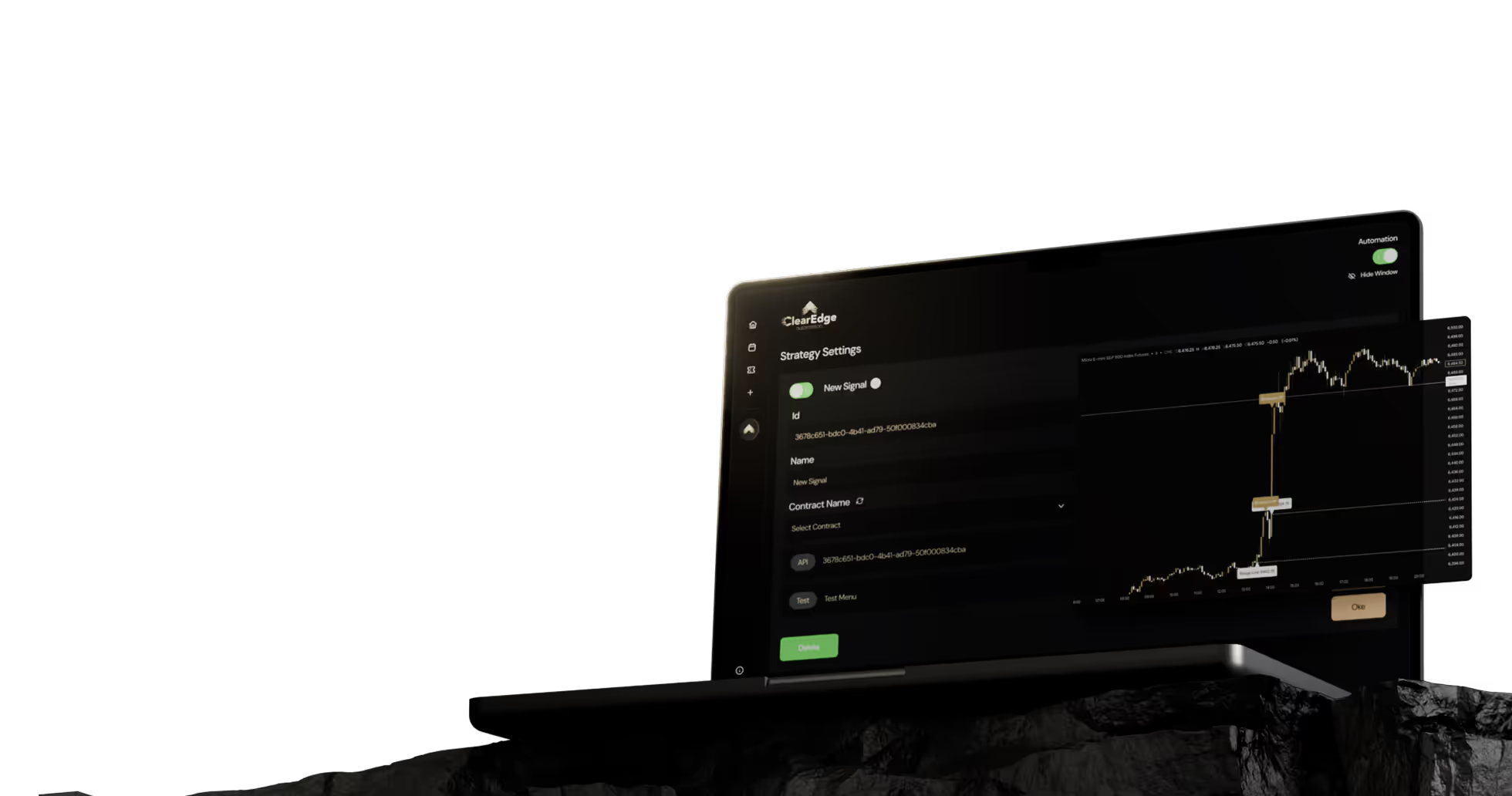
Trading Psychology Benefits Of Switching To Automated Futures Trading
Eliminate the fear and greed that derail your strategy. Automation enforces discipline, reduces screen time, and builds consistency through systematic execution.


Trading psychology benefits of switching to automation include removing fear and greed from execution, enforcing your rules without override, reducing screen time and decision fatigue, and building consistency through systematic execution. Automation does not eliminate market risk, but it can eliminate the emotional mistakes that turn good strategies into losing ones.
Key Takeaways
- Automation removes the hesitation gap between signal and execution, often the difference between a +1.5R winner and a breakeven scratch on ES futures.
- Screen time can drop from 6-8 hours daily to 30-60 minutes of monitoring, reducing burnout risk for full-time traders.
- Systematic execution enforces your stop loss and position sizing rules even after a string of losses, when discipline typically breaks down.
- Discipline metrics like rule adherence rate, override count, and overtrading frequency become trackable instead of guesswork.
- The shift from manual to automated trading is a mindset change first, a technical setup second.
Table of Contents
- How Automation Removes Emotion From Execution
- Stress Reduction and Burnout Prevention
- Discipline Gain Through Rules Enforcement
- Consistency: Why Systematic Beats Discretionary
- Screen Time Reduction and Quality of Life
- The Mindset Shift From Manual to Auto
- Common Psychological Pitfalls of Automated Trading
- Frequently Asked Questions
How Does Automation Remove Emotion From Trading?
Automation removes emotion by executing your predefined rules the moment a signal fires, before fear or greed can intervene. The trade goes out based on the conditions you set hours, days, or weeks earlier, when you were thinking clearly. That is the core trading psychology benefit of switching to automation.
Manual traders face a documented problem: the gap between seeing a signal and clicking the button. In that gap, the brain runs through every recent loss, every news headline, every "what if." A 2024 study from the CFA Institute found that retail discretionary traders override their own signals roughly 40-60% of the time during drawdown periods. Automated execution closes that gap to milliseconds.
Emotional trading removal: The systematic elimination of fear, greed, and hesitation from the execution decision by handing trade entry and exit to a rules-based system. It matters because most retail losses come from overriding good strategies, not from bad strategies.
Fear greed elimination is not abstract. On NQ futures, hesitating 8 seconds on a momentum entry can mean entering 6-10 points worse, which is $12-$20 of slippage per contract. Multiply that across 200 trades a year and the cost of emotion is measurable.
Stress Reduction and Burnout Prevention
Switching to automation reduces stress by removing the constant decision-making load that drains traders during the session. You stop watching every tick. You stop second-guessing entries. The system executes; you supervise.
Burnout in active futures traders shows up as poor sleep, irritability, and progressively worse decision quality after 3-6 months of full-time screen work. The American Psychological Association documents decision fatigue as a measurable phenomenon: cognitive performance declines after 3-4 hours of continuous high-stakes choices. Manual day traders are making hundreds of micro-decisions per session.
Automation reframes the work. Instead of 6-8 hours of execution, you spend that time on strategy research, backtesting, and reviewing trade logs. The cognitive load shifts from reactive to analytical, which most traders find sustainable for years rather than months. For more on this, see our guide on automated trading burnout recovery.
Decision fatigue: The deteriorating quality of decisions made over a long session of high-stakes choices. For futures traders, it explains why P&L often degrades in the afternoon session compared to the morning.
What Discipline Benefits Come From Automated Decision Making?
Automated decision making enforces trading discipline by making rule-following the default rather than the goal. You cannot move a stop loss in a panic if the system holds it. You cannot add to a losing position if the algorithm rejects oversized orders. Automated rules enforcement is the practical expression of trading discipline.
Most discretionary traders know what they should do. The problem is doing it consistently after three losing trades in a row, on FOMC day, when the P&L is red. Discipline fails at exactly the moments it matters most. A systematic execution layer removes that failure mode.
Rules Automation Typically Enforces
- Maximum position size per trade and per account
- Daily loss limit with automatic shutdown
- Stop loss placement that cannot be widened mid-trade
- Maximum trades per session to prevent overtrading
- Time-of-day filters to avoid news events
- Correlation limits across ES, NQ, YM positions
For prop firm traders, this is more than psychology. It is compliance. Daily loss limits of 2-5% and trailing drawdowns of 3-6% are hard rules. One emotional override can end an evaluation. The prop firm automation guide covers this in detail.
Consistency: Why Systematic Execution Beats Discretionary
Systematic execution produces consistency because the same setup gets the same treatment every time, regardless of recent results or current mood. Discretionary trading varies with the trader's state. Automated trading does not.
Consistency matters because trading edges are typically thin. An ES strategy with a 55% win rate and 1.2 reward-to-risk ratio is profitable on paper. Skip three of the worst-looking setups (the ones that often work) and the win rate drops to 48%, turning the strategy unprofitable. Discretionary skipping is one of the largest hidden costs in retail trading.
Systematic execution: Trading where every signal that meets predefined criteria is taken without filtering by current opinion or recent results. It matters because edge expression requires sample size, and skipped trades destroy sample integrity.
Confidence building follows from this. After 200-300 automated trades, you have real data on your strategy's behavior. Compare that to a discretionary trader who took some signals and skipped others, who has no clean dataset to evaluate. Trust in the bot grows from seeing the system perform across the full distribution of trades, including the ones you would have skipped manually.
Screen Time Reduction Benefits
Screen time reduction is one of the most tangible trading psychology benefits of switching to automation. Manual day traders often log 6-8 hours daily glued to charts. Automated traders typically check positions 2-4 times per session and spend 30-60 minutes on monitoring and review.
This matters for three reasons. First, prolonged screen exposure during high-stress decision-making correlates with elevated cortisol, which research from the American Heart Association links to cardiovascular risk over time. Second, the opportunity cost of full-time screen watching is significant: time not spent on strategy improvement, family, exercise, or recovery. Third, traders who maintain outside lives report better long-term performance because their psychological baseline is healthier.
The catch: screen time reduction only works if you actually trust the system. New automation users often watch every trade execute, defeating the purpose. The transition takes 30-90 days for most traders. Our guide on reducing screen time with futures automation covers this transition.
The Mindset Shift From Manual to Automated
The mindset shift from manual to automated is the hardest part of the switch, and it is psychological rather than technical. Manual traders identify with their decisions: the entry was theirs, the exit was theirs, the P&L is theirs. Automated traders shift identity to system designer and supervisor.
This shift is uncomfortable initially. Letting a system take a trade you would have skipped, and watching it work, can feel worse than taking a losing trade you chose yourself. Loss of control is the consistent reason traders abandon automation in the first 60 days. The fix is not willpower; it is process. Track override decisions, review whether overrides helped or hurt over 50+ trades, and let data settle the question.
Once the shift completes, most traders report relief. The job becomes building and refining the system, not executing it. That is a different relationship with markets, and for many it is more sustainable. The full trading psychology automation pillar covers the broader framework.
Mindset shift: The reframing of the trader's role from real-time decision maker to system designer and supervisor. It is the psychological prerequisite for benefiting from automation.
Common Psychological Pitfalls of Automated Trading
Automation solves emotional execution problems but introduces new psychological challenges. Knowing them in advance helps you avoid the pattern that derails most new automated traders.
Pitfall 1: Manual Override on Drawdown
Three losing trades in a row and the urge to "just turn it off for now" appears. This is the same fear that hurt manual trading, expressing itself differently. The fix is a written drawdown rule: the system runs unless it hits a defined stop level. Feelings do not pause it.
Pitfall 2: Over-Optimization After Losses
A losing week triggers the urge to tweak parameters. This is curve-fitting, and it usually makes the strategy worse. Set a rule: parameters change only after a defined sample size (typically 50-100 trades) and only based on out-of-sample testing.
Pitfall 3: Strategy Hopping
When one system underperforms for a month, switching to a new one feels productive. Most strategies underperform 25-35% of months even when the long-term edge is real. Strategy hopping locks in the bottom of every drawdown.
Pitfall 4: False Sense of Security
Automation handles execution, not market risk. Position sizing, account risk, and strategy validity all still require human judgment. Treating the bot as set-and-forget without supervision is how blown accounts happen.
Manual Trading ProblemAutomation SolutionNew Risk IntroducedHesitation on entriesInstant execution on signalBad signals also execute instantlyMoving stops in panicHard-coded stop lossTechnical failures can prevent stopsRevenge trading after lossesDaily loss limit auto-shutdownSystem override during drawdownSkipping setups that workEvery qualified signal takenCurve-fitting after losing periodsDecision fatigueReduced cognitive loadComplacency and reduced supervision
Frequently Asked Questions
1. Does automation guarantee better trading results?
No. Automation enforces rule-based execution, which can improve consistency, but it does not change whether your underlying strategy has an edge. A losing strategy automated is still a losing strategy, just executed faster and more consistently.
2. How long does it take to trust an automated system?
Most traders report meaningful trust developing after 50-100 live trades, typically 30-90 days for active strategies. Paper trading first and starting with micro contracts (MES, MNQ) shortens the adjustment period significantly.
3. Can I still override trades when I want to?
Most platforms allow manual override, but tracking shows discretionary overrides hurt performance more often than they help over a meaningful sample size. The discipline gain comes from minimizing overrides, not eliminating the option entirely.
4. What if I get bored without active trading?
Boredom is a common reason traders sabotage automated systems with unnecessary trades. The fix is redirecting energy to strategy research, backtesting new ideas, and reviewing trade logs rather than supervising live execution minute by minute.
5. Does automation work for prop firm accounts?
Many prop firms allow automation, though rules vary by firm regarding news trading, copy trading, and EAs. Automation often helps with prop firm compliance because daily loss limits and consistency rules become hard-coded rather than relying on willpower.
6. Is the psychological benefit worth the setup time?
For traders who experience hesitation, revenge trading, or rule-breaking under pressure, the psychological benefit typically outweighs the 10-30 hours of initial setup. For traders without these issues, the benefit is more modest and centers on screen time reduction.
7. What is the biggest mistake new automated traders make?
Switching off the system during drawdown, which is the same fear response that hurt their manual trading. Predefined rules for when to pause a system (not based on feelings) are the single most important safeguard.
Conclusion
The trading psychology benefits of switching to automation come down to closing the gap between knowing your rules and following them. Stress reduction, discipline gain, and consistency are not promises of profit; they are removal of the failure modes that derail otherwise sound strategies.
If you are evaluating the switch, start with paper trading or micro futures to build trust before committing real capital, and read the full trading psychology automation pillar for the broader framework.
Want to dig deeper? Read our complete guide to trading psychology automation for more detailed setup instructions and strategies.
References
- CFA Institute. "Behavioral Biases in Retail Trading." cfainstitute.org
- CME Group. "E-mini S&P 500 Contract Specifications." cmegroup.com
- American Psychological Association. "Decision Fatigue Research." apa.org
- CFTC. "Risk Disclosure for Futures and Options." cftc.gov
- Futures Industry Association. "Algorithmic Trading Volume Reports." fia.org
Disclaimer: This article is for educational purposes only. It is not trading advice. ClearEdge Trading executes trades based on your rules, it does not provide signals or recommendations.
Risk Warning: Futures trading involves substantial risk. You could lose more than your initial investment. Past performance does not guarantee future results. Only trade with capital you can afford to lose.
CFTC RULE 4.41: Hypothetical results have limitations and do not represent actual trading.
By: ClearEdge Trading Team | 29+ Years CME Floor Trading Experience | About















































Steal the PlaybooksOther TradersDon’t Share
Every week, we break down real strategies from traders with 100+ years of combined experience, so you can skip the line and trade without emotion.