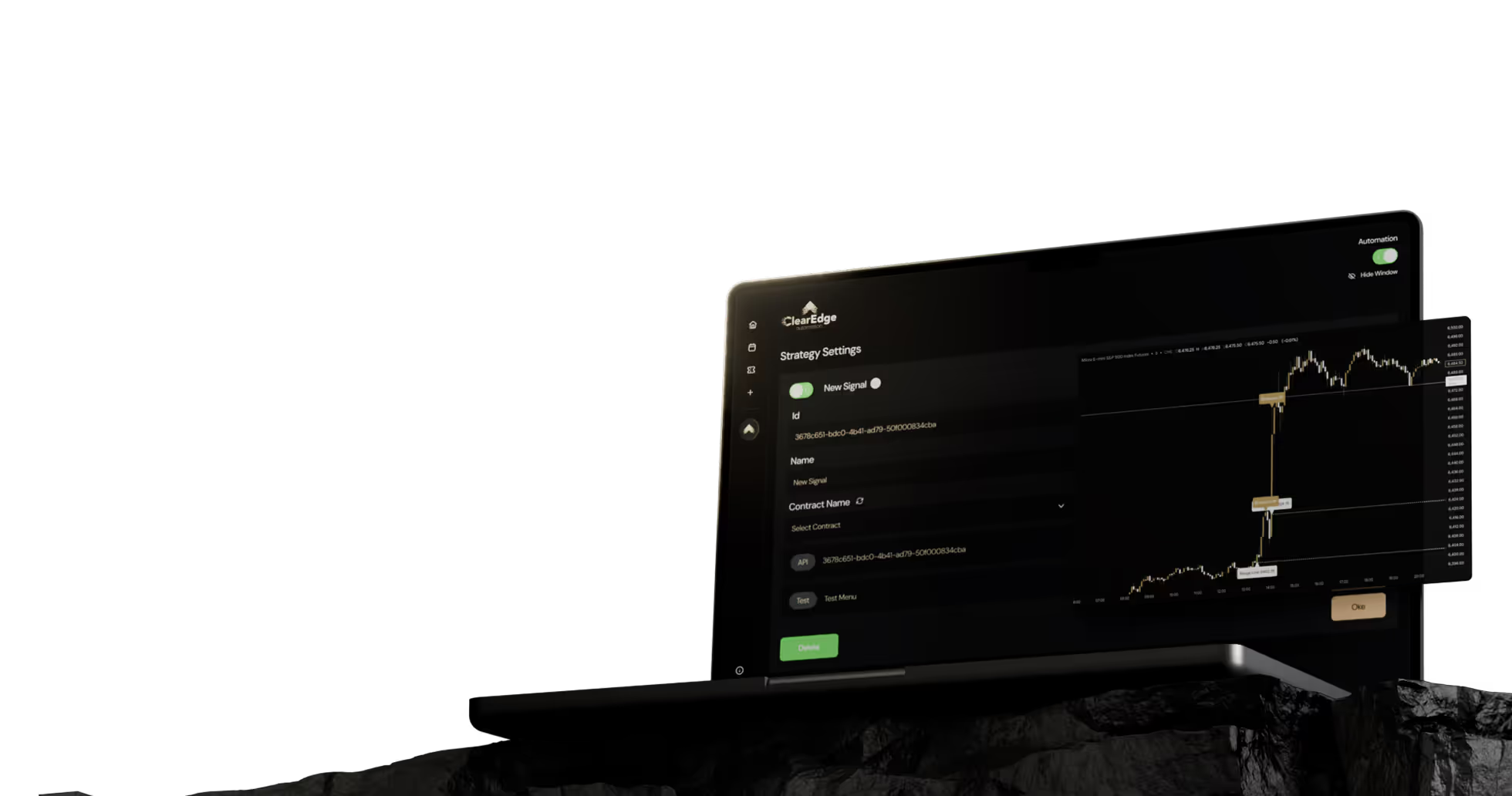
ES Futures Opening Range Automation Strategy Guide
Capture ES futures volatility by automating opening range breakout trades. Set precise 30-60 minute levels and execute flawlessly using TradingView alerts.


ES futures opening range automation strategy captures price movement during the first 30-60 minutes of the regular trading session (9:30-10:00 AM or 10:30 AM ET) and executes trades when price breaks above or below this range. This approach automates entries at defined breakout levels, removes emotional decision-making, and allows traders to capitalize on initial volatility without manual monitoring.
Key Takeaways
- Opening Range (OR) strategies trade breakouts from the first 30-60 minutes of ES regular session trading hours (9:30 AM ET)
- Automation removes the need to manually watch breakout levels and executes trades at precise price points with 3-40ms latency
- ES futures have a $12.50 tick value (0.25 points), requiring precise stop-loss placement to manage risk during volatile opening periods
- Most OR strategies use 2-4 point stops on ES, representing $100-$200 risk per contract during typical session volatility
Table of Contents
- What Is the Opening Range in ES Futures?
- Why Automate Opening Range Strategies?
- How ES Opening Range Automation Works
- What You Need to Automate OR Strategies
- What Time Parameters Work Best?
- How to Set Stop Loss and Take Profit Levels
- Common Opening Range Automation Mistakes
- Frequently Asked Questions
- Conclusion
What Is the Opening Range in ES Futures?
The Opening Range (OR) is the high and low price established during the first 30 or 60 minutes of the regular ES futures trading session starting at 9:30 AM ET. Traders use these levels as potential breakout points, with the theory that directional moves often occur when price breaks and holds above the OR high or below the OR low. The strategy gained popularity on CME floor trading desks and translates well to automation because entry levels are clearly defined.
Opening Range (OR): The price range (high to low) established during a specific period at the start of a trading session, typically the first 30 or 60 minutes. Breakouts from this range often signal the session's directional bias.
ES futures trade nearly 24 hours (Sunday 6 PM to Friday 5 PM ET), but the OR strategy specifically targets regular trading hours (RTH) from 9:30 AM to 4:15 PM ET. This period sees the highest volume and liquidity as equity markets open. The first 30-60 minutes often produces two-way action as overnight positions adjust and institutional orders enter the market.
A 30-minute OR uses the range from 9:30-10:00 AM ET. A 60-minute OR extends to 10:30 AM ET. Shorter ranges provide tighter breakout levels but may produce more false signals. Longer ranges give price more time to establish a true range but delay entry signals.
Why Automate Opening Range Strategies?
Manual execution of OR strategies requires constant chart monitoring from 9:30 AM until breakout occurs, which may happen at 10:01 AM or 2:30 PM. Automation watches the market continuously and executes immediately when price crosses your defined breakout level. This removes the hesitation, distraction, and execution delays that come with manual trading.
During the opening 30-60 minutes, ES futures can move 5-15 points (0.25 point increments), establishing the OR high and low. Once the range is set, you need to place orders above the high and below the low. If you're manually entering these orders, you risk missing the breakout by seconds—enough time for price to move 1-2 points ($50-$100 per contract).
Automation platforms like ClearEdge Trading connect TradingView alerts directly to your broker, executing trades in 3-40ms. You define your OR parameters in TradingView (using Pine Script or manual alert levels), configure your webhook, and the platform handles execution. This lets you step away from the screen while the strategy runs.
Advantages of Automation
- No need to watch charts during OR period or wait for breakout
- Executes at exact breakout level without human delay
- Manages multiple contracts or accounts simultaneously
- Removes emotional response to false breakouts
Limitations
- Requires accurate range calculation and alert setup
- False breakouts still occur—automation doesn't predict direction
- System or connection failures can prevent execution
- Requires testing and optimization for your specific parameters
How ES Opening Range Automation Works
ES opening range automation follows a four-step process: calculate the OR high/low, set breakout alert levels, trigger webhook when price crosses, and execute trade at your broker. Each step happens programmatically once you've configured your system. The automation doesn't decide whether to trade—it executes the rules you define.
Step 1: Your TradingView indicator or script calculates the OR high and low. You can use a custom Pine Script indicator that marks these levels automatically, or manually draw horizontal lines at the 10:00 AM or 10:30 AM high and low. The script tracks when price crosses these levels during the rest of the session.
Step 2: You create alerts in TradingView that fire when price crosses above OR high (long signal) or below OR low (short signal). The alert includes a webhook URL pointing to your automation platform and a JSON message specifying contract (ES), direction (long/short), quantity, and any stop/target levels.
Webhook: An automated HTTP message sent from one application to another when a specific event occurs. In TradingView automation, webhooks carry your alert data (symbol, direction, quantity) to your execution platform.
Step 3: When price crosses your breakout level, TradingView sends the webhook to your automation platform. The platform receives the JSON payload, validates the format, and translates it into a broker order.
Step 4: The platform submits the order to your connected broker (TradeStation, NinjaTrader, AMP, etc.). The broker executes the trade in the ES futures market. Total time from alert trigger to order execution typically runs 3-40ms depending on your broker's API speed and server location.
StepManual ExecutionAutomated ExecutionRange CalculationWatch chart, note high/lowScript calculates automaticallyOrder EntryManually place limit ordersAlert triggers webhookExecution Speed2-5 seconds (human reaction)3-40ms (platform + broker API)MonitoringMust watch chart continuouslyRuns unattended after setup
What You Need to Automate OR Strategies
You need three components: a TradingView account with alert capability, an automation platform that accepts webhooks, and a futures broker account with API access. Most traders use TradingView Pro or higher ($14.95+/month) for reliable alerts and webhook functionality. Free TradingView accounts have limited alert capabilities.
Your automation platform must support futures brokers that offer ES contracts. Common choices include TradeStation, NinjaTrader, AMP Futures, and Interactive Brokers. Verify your broker provides API access and that your platform integrates with it. Some platforms charge monthly fees ranging from $49-$299 depending on features and account count.
For the TradingView side, you'll need either a pre-built OR indicator from the TradingView library or a custom Pine Script that calculates range levels. The indicator should mark OR high/low clearly and allow you to set alert conditions. If you're not comfortable with Pine Script, search TradingView's public library for "Opening Range" or "Initial Balance" indicators.
Setup Checklist
- ☐ TradingView Pro or higher account ($14.95+/month)
- ☐ Automation platform subscription with webhook support
- ☐ Funded futures broker account with API access enabled
- ☐ Opening Range indicator or Pine Script installed in TradingView
- ☐ Webhook URL from your automation platform
- ☐ JSON alert message template configured
- ☐ Risk parameters defined (stop loss, take profit, position size)
What Time Parameters Work Best?
The 30-minute OR (9:30-10:00 AM ET) provides faster signals but generates more false breakouts, while the 60-minute OR (9:30-10:30 AM ET) offers more reliable levels but delays entry. Your choice depends on your risk tolerance and available trading capital for stop losses. Traders using smaller accounts or prop firm accounts with tight daily loss limits often prefer the 60-minute OR for fewer false signals.
Some traders use a 15-minute OR (9:30-9:45 AM ET) for more aggressive entries, particularly on high-volatility days like FOMC announcements or Non-Farm Payrolls (first Friday of the month, 8:30 AM ET). These shorter ranges require wider stops because the range itself is tighter and price can whipsaw more easily. A 15-minute OR might be 2-3 ES points, requiring 3-4 point stops to avoid premature exit.
You can also use the Initial Balance (IB), a related concept from pit trading that uses the first hour (9:30-10:30 AM ET) as the reference range. IB strategies work identically to 60-minute OR strategies in automation—the only difference is terminology. Both establish high/low levels from the first hour and trade breakouts.
Avoid trading OR strategies on low-volume holidays or half-days when RTH closes early (1:00 PM ET). Reduced participation leads to choppy price action and less reliable breakouts. The economic calendar drives much of ES movement, so check for scheduled reports before activating your automation on any given day.
How to Set Stop Loss and Take Profit Levels
ES futures have a $12.50 tick value per 0.25 point movement, so a 2-point stop loss represents $100 risk per contract (8 ticks × $12.50). Most OR strategies use 2-4 point stops, balancing the need to survive normal volatility without getting stopped out prematurely. During typical RTH conditions, ES spreads run 0.25-0.50 points; during overnight sessions, spreads may widen to 0.50-1.00 points.
A common approach places the stop loss 1-2 points beyond the opposite side of the OR. If you go long on a breakout above the OR high, place your stop 1-2 points below the OR low. This gives price room to retest the range before confirming direction. If the OR is 4 points wide (e.g., 4500.00 to 4504.00), your stop might be 1-2 points outside, creating a 5-6 point total risk.
Tick Value: The dollar amount gained or lost per minimum price movement. For ES, each 0.25 point tick equals $12.50, so a 1-point move equals $50 per contract.
Take profit targets vary by trader preference. Conservative approaches use a 1:1 or 1.5:1 reward-to-risk ratio—if you risk 3 points ($150), target 3-4.5 points ($150-$225) profit. Aggressive traders trail stops or use no fixed target, letting the trade run until end of session or until a reversal signal. Automation platforms typically support both fixed take-profit levels and trailing stops.
For micro futures automation using MES (Micro E-mini S&P 500), divide risk by 10. MES has a $1.25 tick value, so the same 2-4 point stops represent $10-$20 risk per contract. This makes OR strategies accessible to smaller accounts or traders testing strategies before scaling to full-size ES contracts.
ContractTick SizeTick Value2-Point Stop Risk4-Point Stop RiskES0.25$12.50$100$200MES0.25$1.25$10$20
Common Opening Range Automation Mistakes
The most frequent error is using range levels from overnight or pre-market sessions instead of RTH. ES trades nearly 24 hours, but OR strategies specifically reference the 9:30 AM ET open. If your TradingView chart session settings include extended hours, your indicator may calculate range from 6:00 PM the prior evening, producing incorrect levels.
Another mistake is failing to account for economic news releases during or immediately after the OR period. If Non-Farm Payrolls releases at 8:30 AM (one hour before RTH open), the 9:30-10:00 AM range reflects post-news volatility, which may not hold as cleanly. Some traders skip OR strategies on major news days entirely.
Traders also commonly place stops too tight, getting stopped out during normal range retests. A breakout above the OR high doesn't guarantee price won't dip back to test the high once or twice before continuing higher. Stops placed exactly at the OR high (rather than 1-2 points below the OR low) frequently get hit before the trade moves in your favor.
Finally, many traders forget to disable automation during rollover week when ES contracts transition (typically the second week of March, June, September, December). During rollover, volume shifts from the front month to the next contract, creating unusual price action and potential for whipsaw losses. For more on this, see how to handle rollover in automated futures trading.
Frequently Asked Questions
1. Can I use Opening Range strategies on NQ futures instead of ES?
Yes, NQ futures (E-mini Nasdaq) work with OR strategies using the same time parameters (9:30 AM ET RTH open). NQ has a $5.00 tick value per 0.25 point, and typically requires wider stops (4-8 points) due to higher volatility compared to ES.
2. What happens if price never breaks the Opening Range during the session?
If price stays inside the OR all session, no trade triggers and no positions open. This occurs on low-volatility days or tight consolidation patterns—your automation simply waits for the next session.
3. Should I trade both sides of the Opening Range or just one direction?
Many traders set alerts for both long (breakout above OR high) and short (breakdown below OR low), taking whichever triggers first. Some traders use bias from overnight price action or previous day's close to trade only one side.
4. Do I need to manually calculate the OR high and low every day?
No, a TradingView Pine Script indicator calculates OR levels automatically each session. You set the time parameters (30 or 60 minutes) once, and the script updates daily without manual input.
5. How do I backtest an Opening Range automation strategy?
TradingView's Strategy Tester allows backtesting of Pine Script strategies against historical ES data. Set your OR parameters, stops, and targets in the script, then run the strategy tester to see historical performance—though past results do not guarantee future outcomes.
Conclusion
ES futures opening range automation strategy removes manual execution from a well-established breakout approach, executing trades at precise levels during the first 30-60 minutes of regular trading hours. Automation handles the monitoring and execution, allowing you to define risk parameters once and let the system run without constant chart watching.
Start by paper trading your OR parameters to validate alert triggers and execution before risking live capital. Check your TradingView session settings, verify your stops account for typical ES volatility, and review your automation platform's connection to your broker.
Ready to automate your ES opening range strategy? Explore ClearEdge Trading to see how no-code automation connects TradingView alerts to your futures broker for precise execution.
References
- CME Group. "E-mini S&P 500 Futures Contract Specs." https://www.cmegroup.com/markets/equities/sp/e-mini-sandp500.html
- CME Group. "Equity Index Futures Trading Hours." https://www.cmegroup.com/trading-hours.html
- TradingView. "Webhooks in Alerts Documentation." https://www.tradingview.com/support/solutions/43000529348-about-webhooks/
- U.S. Bureau of Labor Statistics. "Economic News Release Schedule." https://www.bls.gov/schedule/news_release/empsit.htm
Disclaimer: This article is for educational purposes only. It is not trading advice. ClearEdge Trading executes trades based on your rules—it does not provide signals or recommendations.
Risk Warning: Futures trading involves substantial risk. You could lose more than your initial investment. Past performance does not guarantee future results. Only trade with capital you can afford to lose.
CFTC RULE 4.41: Hypothetical results have limitations and do not represent actual trading. Simulated results may have under- or over-compensated for market factors such as lack of liquidity.
By: ClearEdge Trading Team | About























































Steal the PlaybooksOther TradersDon’t Share
Every week, we break down real strategies from traders with 100+ years of combined experience, so you can skip the line and trade without emotion.