Why Your Futures Bot Needs A Low Latency Trading VPS
Stop letting milliseconds eat your profits. A low latency trading VPS reduces slippage and provides the 24/7 sub-10ms execution your futures bot demands.


A low latency VPS keeps your futures trading bot running 24/7 with sub-millisecond connections to broker APIs. For TradingView-based automation, latency between alert firing and order execution directly affects slippage and fill quality. Running your bot on a home computer introduces 100-500ms delays from internet routing, OS interruptions, and connection drops. A trading VPS in a data center near your broker reduces that to 1-10ms, which matters most during volatile sessions like FOMC and NFP.
Key Takeaways
- Home internet adds 100-500ms latency between TradingView alerts and broker execution; a low latency VPS reduces this to 1-10ms.
- On ES futures, each tick of slippage costs $12.50 per contract, so a 200ms delay during fast markets can cost 2-4 ticks per trade.
- VPS providers in NY4, NY5, or Chicago data centers sit closest to CME Globex matching engines for fastest fills.
- Minimum specs for futures bots: 2 vCPU, 4GB RAM, SSD storage, 99.99% uptime SLA, Windows Server for most broker platforms.
- Integrated VPS through your automation platform often beats third-party VPS for ease of setup and monitoring.
Table of Contents
- Why Latency Matters For Futures Bots
- The Real Cost Of Slippage
- VPS Specs Your Bot Actually Needs
- Why Server Location Matters
- Integrated VPS vs Third Party VPS
- Common VPS Mistakes To Avoid
- Frequently Asked Questions
Why Latency Matters For Futures Bots
Latency is the time between your strategy firing a signal and the order reaching the exchange. For automated futures trading, the path runs from TradingView's servers to your bot, then to your broker's API, and finally to CME Globex. Every hop adds milliseconds.
Why your futures bot needs a low latency VPS comes down to one fact: markets move during those milliseconds. A breakout strategy that backtests perfectly on bar close prices can lose money in live trading because by the time your home PC processes the alert and sends the order, price has already moved 1-3 ticks past your entry. The bot's logic is sound; the infrastructure is the bottleneck.
Latency: The total time delay between a trigger event (like a TradingView alert) and the corresponding action (order arrival at the exchange). Measured in milliseconds, it directly affects fill quality and slippage on automated futures trades.
Home internet connections add unpredictable delays. Residential ISPs route traffic through multiple hops, throttle during peak hours, and drop connections during weather events or maintenance. A trading VPS in a commercial data center bypasses all of that with redundant fiber connections and direct routes to broker infrastructure.
How Much Does Latency Actually Cost?
On ES futures, one tick equals $12.50 per contract. On NQ, one tick is $5.00. Slippage compounds fast when latency is high during volatile periods.
Consider a real scenario: your TradingView alert fires at 2:00 PM ET on FOMC day. Home internet adds 250ms of latency. During those 250ms, ES moves 3 ticks. You wanted to enter at 5825.00, you fill at 5825.75. That's $37.50 lost per contract before the trade even starts working. Run that bot 50 times a month across 2 contracts, and the math gets ugly fast.
Slippage: The difference between the expected entry/exit price and the actual fill price. Slippage grows with latency, market volatility, and order size.
Fill quality also degrades with latency. Limit orders that arrive late may miss the price entirely, causing your bot to either skip the trade or chase with a market order. Both outcomes hurt expectancy. For details on measuring this in your own system, see our guide on algorithmic trading slippage and execution costs.
According to CME Group market data, ES futures average roughly 1.5 million contracts daily, with most volume concentrated in the RTH session. Bid-ask spreads stay tight (typically 1 tick) during normal hours but widen quickly around news. A low latency VPS gives your bot the best chance of hitting the inside quote before it moves.
What Specs Does A Trading VPS Need?
A futures trading VPS needs enough resources to run your broker platform, charting software, and any custom scripts without lag. Underspec'd machines cause CPU bottlenecks that add latency just as bad as a slow internet connection.
Minimum specifications for most automated futures setups:
- CPU: 2-4 vCPU, modern Xeon or EPYC class
- RAM: 4-8 GB (8GB if running NinjaTrader, TradeStation, or multiple charts)
- Storage: 50-100 GB SSD (NVMe preferred)
- Network: 1 Gbps port, low-latency routing
- Uptime SLA: 99.99% minimum
- OS: Windows Server 2019 or 2022 for most broker platforms; Linux works for API-only setups
vCPU: A virtual CPU core allocated to your VPS from the host server's physical processors. More vCPUs means better handling of concurrent tasks like charting, order routing, and indicator calculations.
Windows VPS dominates retail futures trading because most broker platforms (NinjaTrader, TradeStation, Sierra Chart) require Windows. Linux VPS works well for traders running pure API automation without GUI charting. If you connect TradingView alerts directly to a broker via webhook, you may not need a VPS at all for the alert path, though you still benefit from one for any local components like trade copiers or risk dashboards.
Why Does Server Location Matter?
The closer your VPS sits to the exchange matching engine, the lower your network latency. CME Globex matching engines run in Aurora, Illinois (the CME data center). Most low latency trading VPS providers locate servers in Chicago-area facilities or in NY4/NY5 (Equinix, Secaucus NJ), which connects to Aurora via dedicated fiber.
Distance matters because data travels at roughly two-thirds the speed of light through fiber optics. A round trip from a New York data center to Aurora takes about 6-8ms. From a London data center, that jumps to 80-90ms. For most retail automation strategies (anything beyond pure HFT), Chicago, New York, or Northern Virginia data centers are sufficient.
Co-location: Placing servers in the same data center as the exchange's matching engine to minimize network distance. True co-location is expensive and reserved for institutional traders; retail VPS in nearby data centers offers most of the benefit at a fraction of the cost.
Check your broker's recommended VPS providers. Most futures brokers publish a list of nearby data centers and recommended specs. For example, AMP Futures and NinjaTrader Brokerage typically point to Chicago or New York facilities. The algorithmic trading VPS setup guide walks through location selection in more detail.
Integrated VPS vs Third Party VPS
Two paths exist for hosting your bot: rent a third party VPS and install everything yourself, or use an integrated VPS platform that handles infrastructure as part of the automation service. Each approach has tradeoffs.
Comparison Table
FactorThird Party VPSIntegrated Platform VPSSetup time2-4 hoursMinutesMonthly cost$25-$80Bundled with platform feeMaintenanceYou handle updates, restartsProvider handles itBroker compatibilityAny broker you installLimited to platform's brokersMonitoringBuild your own alertsBuilt into platformBest forCustom multi-broker setupsTradingView-based automation
Third party VPS providers like ForexVPS, BeeksFX, and CNS give you a blank Windows or Linux server. You install your broker platform, configure firewalls, and manage updates. This works well if you run multiple brokers or custom code, but the maintenance burden adds up.
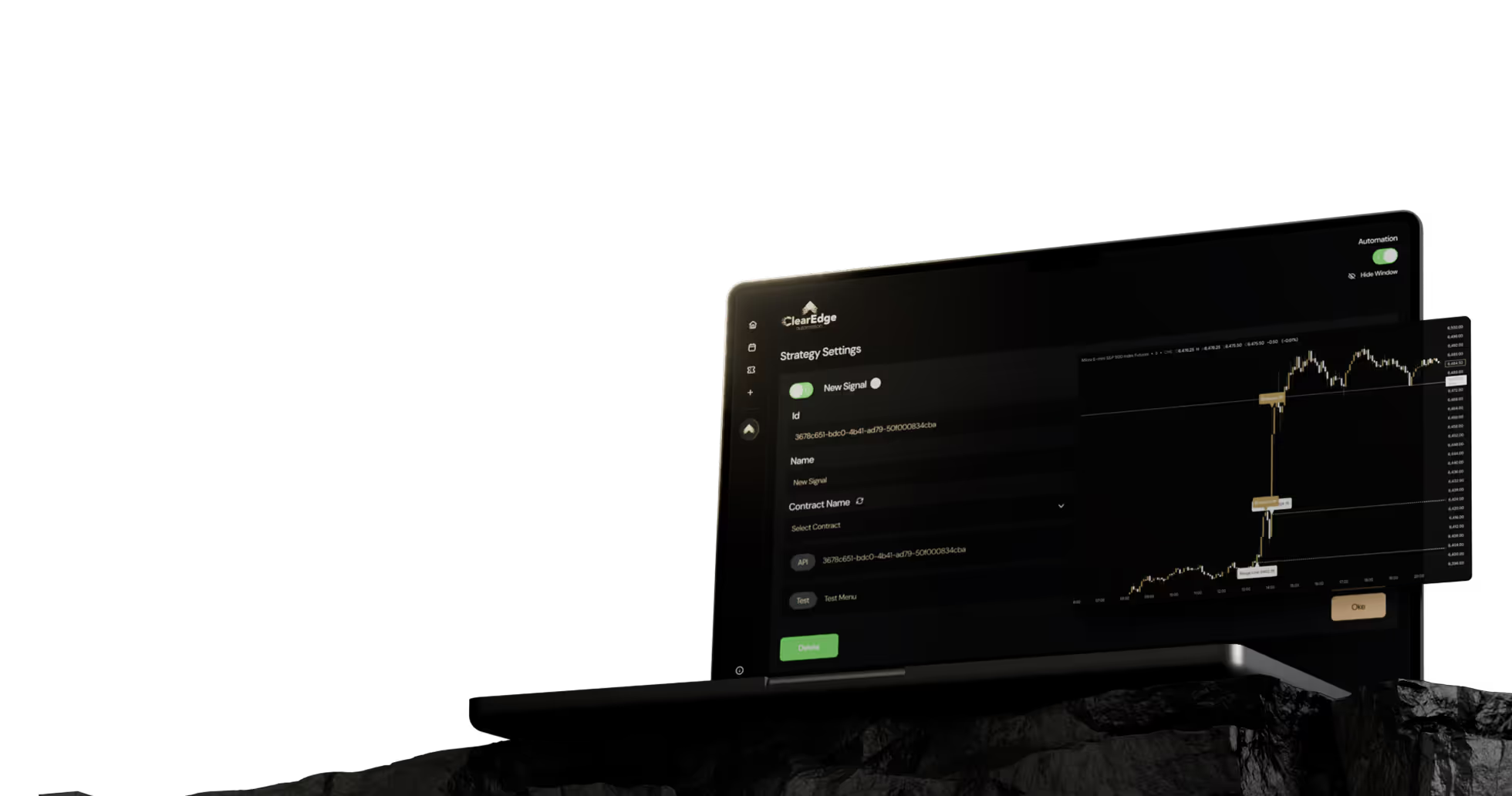
Integrated platforms convert TradingView alerts into broker orders without requiring you to run your own server. Platforms like ClearEdge Trading process webhooks in their cloud infrastructure with execution speeds of 3-40ms depending on broker. For traders who only need TradingView-to-broker automation, this often replaces the need for a third party VPS entirely. See platform features and supported brokers for compatibility details.
Webhook: An HTTP request sent automatically when a TradingView alert fires. The webhook delivers your order details to the automation platform, which then routes the order to your broker.
If you're choosing between approaches, the question isn't really "which is faster" but "which path matches your strategy." Multi-broker arbitrage and custom Pine Script strategies that need local processing favor a dedicated VPS. Standard TradingView alert automation favors an integrated platform.
Common VPS Mistakes To Avoid
Three mistakes wreck VPS performance for futures bots, and all are avoidable.
1. Underspec'd hardware. Cheap $5-$10 VPS plans share resources with too many tenants. Your bot competes for CPU cycles with other users, causing random latency spikes during high-volume periods. Pay for dedicated resources.
2. Wrong data center location. A VPS in Singapore or Frankfurt may be cheaper, but if you trade US futures, the round trip latency to CME will hurt every fill. Match your VPS region to the exchange you trade.
3. Skipping uptime monitoring. A VPS that crashes at 2:00 AM with an open position is a disaster. Set up email or SMS alerts that notify you if the VPS goes offline or if your broker connection drops. Test the alerts monthly.
For a complete checklist, the automated futures trading monitoring best practices article covers what to watch and how often.
Frequently Asked Questions
1. Do I really need a VPS for TradingView automation?
If you use an integrated platform that processes webhooks in the cloud, you may not need your own VPS. If you run any local component (trade copier, custom script, broker desktop platform), a VPS keeps it running 24/7 without depending on your home internet.
2. How much should a futures trading VPS cost?
Quality dedicated trading VPS plans run $25-$80 per month for retail-grade specs. Anything under $15 typically uses oversold shared resources that introduce latency spikes. Institutional co-location is far more expensive and unnecessary for most retail strategies.
3. Windows VPS or Linux VPS for trading?
Windows VPS is required for most broker desktop platforms (NinjaTrader, TradeStation, Sierra Chart). Linux VPS works for API-only automation and uses fewer resources, but compatibility is limited.
4. What uptime should I expect from a trading VPS?
A 99.99% uptime SLA equals roughly 53 minutes of downtime per year. Anything below 99.9% (about 8.7 hours yearly) is unacceptable for live trading. Always check the SLA terms before committing.
5. Can I use a free VPS or AWS free tier for trading?
Free tiers typically lack the dedicated resources, low-latency routing, and uptime guarantees needed for reliable execution. They're fine for testing and paper trading but risky for live capital. Paper trade first to validate your strategy before deciding on infrastructure.
6. How do I test if my VPS latency is good enough?
Run ping tests from your VPS to your broker's API endpoint and to TradingView's webhook IPs. Sub-20ms is excellent, 20-50ms is acceptable, above 100ms suggests a location or provider problem. Most providers offer a trial period to test before committing.
Conclusion
Why your futures bot needs a low latency VPS comes down to math: latency creates slippage, slippage erodes expectancy, and a few ticks per trade compound into real money over hundreds of trades. The fix is straightforward, run your automation on infrastructure built for speed and uptime, not on a home PC competing with Netflix and Windows updates.
For deeper coverage of VPS selection, setup, and cost optimization, read our complete guide to VPS for automated futures trading. Do your own research and testing before going live with any infrastructure setup.
Want to skip the VPS setup entirely? Explore ClearEdge Trading to see how cloud-based webhook automation handles execution without requiring you to manage a server.
References
- CME Group - E-mini S&P 500 Contract Specs
- CME Group - Globex Overview
- TradingView - About Webhooks
- CFTC - Trading Organizations Oversight
Disclaimer: This article is for educational purposes only. It is not trading advice. ClearEdge Trading executes trades based on your rules, it does not provide signals or recommendations.
Risk Warning: Futures trading involves substantial risk. You could lose more than your initial investment. Past performance does not guarantee future results. Only trade with capital you can afford to lose.
CFTC RULE 4.41: Hypothetical results have limitations and do not represent actual trading.
By: ClearEdge Trading Team | 29+ Years CME Floor Trading Experience | About














































Steal the PlaybooksOther TradersDon’t Share
Every week, we break down real strategies from traders with 100+ years of combined experience, so you can skip the line and trade without emotion.