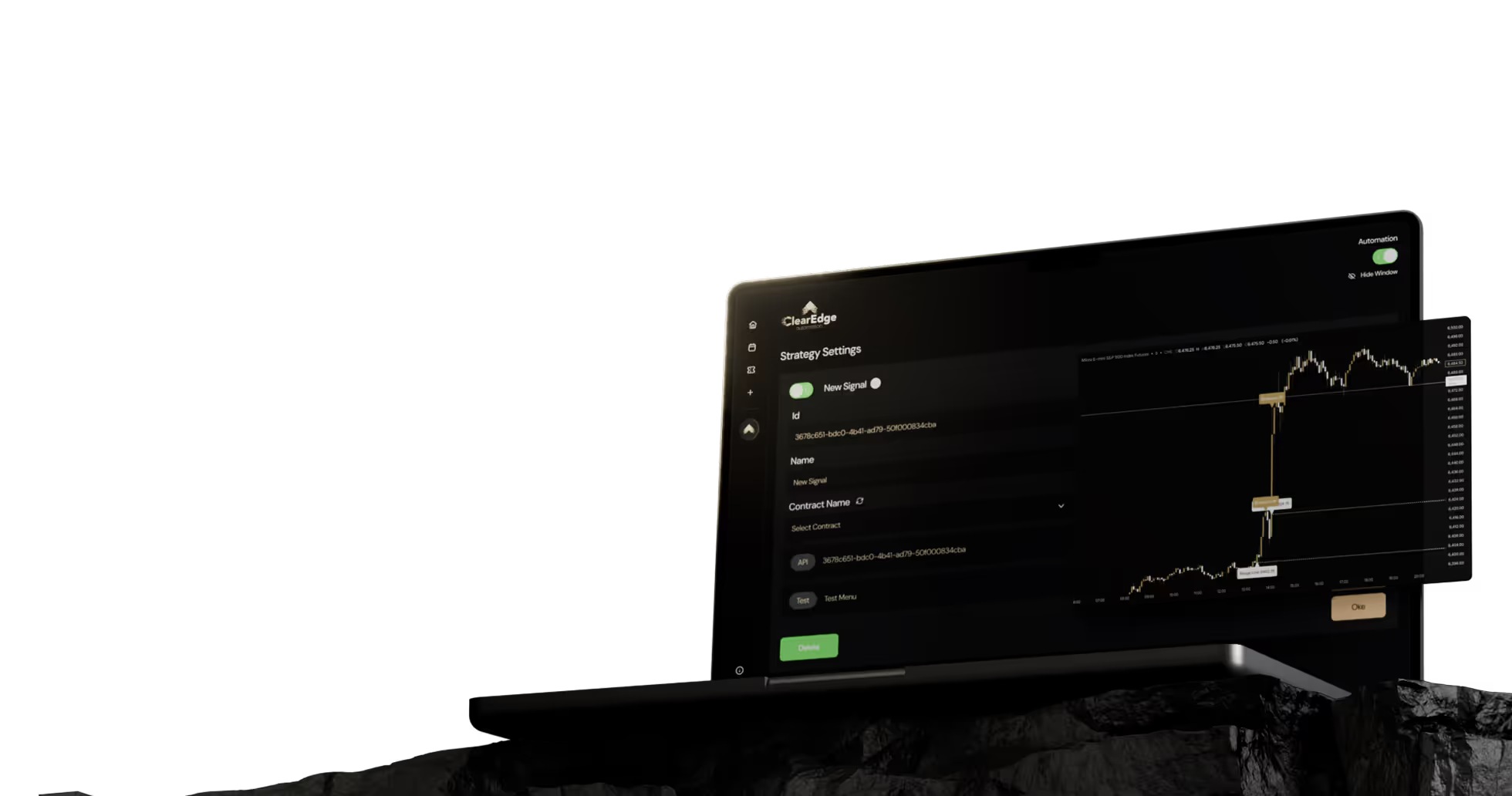
Prop Firm Initial Balance Strategy Automation Guide
Optimize your prop firm initial balance with automated strategies that enforce drawdown limits, manage position sizing, and scale multiple funded accounts.


Prop firm initial balance strategy automation involves using automated trading systems to manage and optimize the starting capital provided during prop firm evaluation phases. This approach helps traders systematically execute strategies that comply with strict prop firm rules—including daily loss limits, trailing drawdowns, and profit targets—while maintaining consistency across multiple accounts. Automation removes emotional decision-making and ensures precise risk management required to pass challenges and maintain funded accounts.
Key Takeaways
- Prop firms typically provide $25,000-$250,000 initial balance with 2-5% daily loss limits that automation can enforce automatically
- Automated systems help meet consistency rules by preventing single-day profit spikes above 30-40% of total gains
- Position sizing algorithms adjust trade quantities based on remaining drawdown buffer to protect initial capital
- Scaling multiple prop firm accounts requires automation to maintain rule compliance across 5-10+ simultaneous evaluations
Table of Contents
- What Is Initial Balance in Prop Firm Trading?
- Why Automate Initial Balance Strategy Execution?
- How to Calculate Position Sizing Based on Initial Balance
- Setting Risk Parameters for Prop Firm Rules
- Scaling Automation Across Multiple Prop Firm Accounts
- Frequently Asked Questions
- Conclusion
What Is Initial Balance in Prop Firm Trading?
Initial balance refers to the starting capital amount a prop firm provides when you begin an evaluation phase or funded account. Most prop firms offer evaluation accounts ranging from $25,000 to $250,000, with corresponding profit targets (typically 8-10% for phase one) and maximum drawdown limits (usually 3-6% trailing or 2-5% daily). Your strategy must generate consistent profits while staying within these constraints to advance through evaluation phases and receive payouts as a funded trader.
Evaluation Phase: The testing period where traders must demonstrate profitability and risk management before receiving a funded account. Most firms require 1-2 phases with specific profit targets and drawdown limits.
The initial balance determines your position sizing, risk per trade, and overall strategy parameters. A $50,000 account with a 5% maximum daily loss gives you $2,500 of drawdown buffer—meaning your automation must halt trading if losses approach this threshold. This hard stop protection is exactly where automation excels, since manual traders often hesitate or miscalculate in real-time.
Different prop firms structure their initial balance rules differently. Some use trailing drawdown (measured from peak equity), others use static drawdown (measured from starting balance), and many enforce both daily and overall limits. Your automation setup must account for whichever rule type your specific prop firm uses.
Why Automate Initial Balance Strategy Execution?
Automation ensures you never violate prop firm trading rules due to emotional decisions or calculation errors during live markets. Manual traders frequently misjudge their remaining drawdown buffer, especially when managing multiple positions or trading during volatile sessions like FOMC announcements or Non-Farm Payrolls. Automated systems track your exact equity position in real-time and enforce stops before you breach daily loss limits.
Prop firm consistency rules present another challenge for manual execution. Many firms require that no single trading day accounts for more than 30-40% of your total profits during the evaluation phase. If you're targeting $4,000 in profits for a $50,000 account (8% target), you can't bank $1,600+ in one day without potentially failing the consistency requirement. Automation can throttle daily profit-taking to maintain even distribution across minimum trading days.
Advantages of Automation
- Real-time drawdown tracking prevents rule violations
- Position sizing adjusts automatically based on remaining buffer
- Eliminates emotional trading during drawdown periods
- Manages multiple prop accounts simultaneously with identical rules
Limitations
- Requires upfront configuration and testing time
- Technical failures can still occur (internet, broker API issues)
- Some prop firms explicitly prohibit bot trading—verify rules first
For traders scaling to 5-10 prop firm accounts, manual execution becomes practically impossible. You can't watch 10 charts simultaneously and calculate risk parameters for each account individually. Platforms with multi-account support automate this entirely, applying your TradingView strategy across all accounts while maintaining independent risk tracking per account.
How to Calculate Position Sizing Based on Initial Balance
Position sizing for prop firm automation starts with your maximum daily loss limit as the primary constraint. For a $100,000 account with a 3% daily limit, you have $3,000 maximum drawdown per day. If you're trading ES futures with $12.50 per tick and using a 10-tick stop loss ($125 per contract), your maximum position size is 24 contracts ($3,000 ÷ $125) if you're willing to risk the full daily limit on one trade.
Tick Value: The dollar amount each minimum price movement represents in a futures contract. ES futures have a tick value of $12.50, meaning each 0.25-point move equals $12.50 profit or loss per contract.
Most successful prop firm traders risk 1-2% of their initial balance per trade, not the full daily limit. Using 1% risk on that $100,000 account means $1,000 per trade. With the same 10-tick ES stop, that's 8 contracts per trade ($1,000 ÷ $125). This approach allows multiple trades per day before approaching the daily loss limit, which is critical for strategy types that require several attempts to catch the right market conditions.
Account SizeDaily Limit (3%)Risk Per Trade (1%)ES Contracts (10-tick stop)$25,000$750$2502 contracts$50,000$1,500$5004 contracts$100,000$3,000$1,0008 contracts$150,000$4,500$1,50012 contracts
Your automation should recalculate position size dynamically as your account grows during evaluation. If that $100,000 account reaches $105,000, your 1% risk becomes $1,050, allowing 8.4 contracts (round down to 8 for safety). Some traders use fixed position sizing throughout the evaluation to maintain consistency, while others scale up as they build buffer above the initial balance.
For contracts with different tick values, apply the same formula. NQ futures have a $5 tick value, so that same 10-tick stop equals $50 per contract. Your $1,000 risk allows 20 contracts on NQ versus 8 on ES—automation handles these calculations instantly when you switch instruments or manage multiple strategies across different contracts.
Setting Risk Parameters for Prop Firm Rules
Automated risk parameters must enforce both daily loss limits and trailing drawdown limits simultaneously. Set your automation platform to halt all trading when either threshold is breached. If your prop firm uses a 3% daily limit and 6% trailing drawdown, your automation tracks both in real-time—stopping trading if you lose $3,000 in one day on a $100,000 account OR if your equity drops $6,000 from your highest achieved balance.
Trailing drawdown is particularly tricky because the threshold moves. If you grow your $100,000 account to $108,000, your trailing drawdown limit is now $6,480 (6% of $108,000). Your violation point is $101,520—higher than your initial $94,000 threshold. This dynamic calculation is where automation prevents mistakes that manual tracking often misses.
Trailing Drawdown: A maximum loss limit calculated from your highest account equity rather than starting balance. If your account peaks at $110,000 with a 6% trailing drawdown, you fail if equity drops below $103,400 at any point afterward.
Prop Firm Rule Configuration Checklist
- ☐ Set maximum daily loss limit (typically 2-5% of initial balance)
- ☐ Configure trailing drawdown monitoring (typically 3-6% from peak equity)
- ☐ Define maximum position size per trade (based on stop loss and risk %)
- ☐ Set maximum open positions simultaneously (1-3 for most strategies)
- ☐ Configure consistency tracking if required (max % of profits per day)
- ☐ Block trading during restricted news events (check firm rules)
- ☐ Set minimum trading days pacing (avoid rushing to hit profit target)
Some prop firms enforce profit target timeframes—you might need to hit your 8% target within 30 calendar days or unlimited days. Automation can pace your trading to avoid excessive risk-taking when approaching deadlines. If you're on day 25 of a 30-day evaluation and need $2,000 more in profits, your automation might increase position sizing slightly (within risk parameters) rather than forcing you to make desperate manual decisions.
For funded accounts after passing evaluation, payout structure becomes relevant. If your firm offers 80% profit splits up to $10,000 in withdrawals, then 90% above that threshold, your automation tracking should log cumulative payouts to optimize your split tier. This isn't a trading rule but an accounting advantage that prop firm automation platforms can monitor alongside risk parameters.
Scaling Automation Across Multiple Prop Firm Accounts
Traders who pass initial evaluations often scale to 5-10 prop firm accounts to multiply their earning potential. Managing this manually is impractical—you need automation that applies your TradingView strategy across all accounts while maintaining independent risk tracking per account. Each account has its own initial balance, daily loss limit, and trailing drawdown, so your automation must treat them as separate entities despite using identical entry/exit rules.
Multi-account automation from platforms like ClearEdge Trading connects one set of TradingView alerts to multiple broker accounts. When your Opening Range breakout strategy triggers, the automation calculates appropriate position sizing for each account based on that account's current equity, remaining daily buffer, and trailing drawdown status. An account approaching its daily limit might receive a reduced position size or skip the trade entirely while other accounts take full positions.
Scaling FactorManual ExecutionAutomated ExecutionSimultaneous accounts2-3 maximum10+ feasibleRisk calculation time30-60 seconds per tradeInstant per accountRule violation riskHigh during volatilityNear zero if configured correctlyConsistency across accountsImpossible to match exactlyIdentical execution timing
Different prop firms have different rules, so your automation needs account-specific parameters. FTMO might use 5% daily loss and 10% maximum drawdown, while The5ers uses 4% daily and 6% trailing. Your automation profile for each account must reflect that firm's specific rules. Check supported brokers to ensure your prop firm's broker integration works with your automation platform.
Tax implications multiply with scale. Running 10 prop firm accounts means tracking profits, losses, and payouts across all entities. Some traders treat prop firm payouts as 1099 contractor income, others structure through LLCs. Automation platforms that log all trades and P&L per account simplify year-end reporting, though you should consult a tax professional familiar with prop firm trading structures.
Frequently Asked Questions
1. Which prop firms explicitly allow automated trading bots?
Firms like FTMO, The5ers, and Earn2Trade generally permit automated trading, but you must verify current rules before starting. Some firms prohibit high-frequency trading (HFT) or require disclosure of automation tools, while others have no restrictions if you meet evaluation rules honestly.
2. How do I set position sizing when prop firm initial balance varies?
Use percentage-based risk rather than fixed contract quantities. Risk 1-2% of each account's initial balance per trade, which automatically scales position size proportionally—a $50,000 account risks $500-$1,000 per trade, while a $100,000 account risks $1,000-$2,000.
3. Can automation help pass consistency rules in prop firm challenges?
Yes, by capping daily profit-taking at 25-35% of your total profit target. If you need $4,000 total and target $1,200 per day maximum, automation can close positions early or skip afternoon trades once you hit the daily threshold.
4. What happens if my automation fails during a prop firm evaluation?
Technical failures—internet outages, broker API issues, or platform bugs—can cause rule violations that fail your evaluation. Use VPS hosting for 24/7 uptime, monitor positions via mobile alerts, and understand your prop firm's policies on technical failure appeals.
5. Should I use the same strategy for all prop firm initial balances?
Your core strategy can remain identical, but position sizing and risk parameters must adjust per account size. An Opening Range breakout strategy works the same way on $25,000 and $150,000 accounts, but the $150,000 account trades larger size with proportionally scaled stops.
Conclusion
Prop firm initial balance strategy automation removes the manual tracking burden and emotional decision-making that causes most evaluation failures. By enforcing daily loss limits, trailing drawdowns, and consistency rules automatically, you maintain compliance while focusing on strategy execution rather than risk calculations.
Start by paper trading your automated setup on one prop firm demo account to validate that all risk parameters work correctly. Once verified, scale to live evaluations gradually—master one funded account before adding multiple accounts that multiply both profits and complexity.
Ready to automate your prop firm trading strategy? Explore ClearEdge Trading to see how no-code automation handles multi-account management with built-in risk controls.
References
- CME Group. "E-mini S&P 500 Futures Contract Specs." https://www.cmegroup.com/markets/equities/sp/e-mini-sandp500.html
- CFTC. "CFTC Rule 4.41 - Hypothetical Performance Disclosures." https://www.cftc.gov/
- Futures Industry Association. "Algorithmic Trading in Futures Markets - 2024 Report." https://www.fia.org/
- NFA. "Forex Fraud and Commodity Pool Operator Compliance." https://www.nfa.futures.org/
Disclaimer: This article is for educational purposes only. It is not trading advice. ClearEdge Trading executes trades based on your rules—it does not provide signals or recommendations.
Risk Warning: Futures trading involves substantial risk. You could lose more than your initial investment. Past performance does not guarantee future results. Only trade with capital you can afford to lose.
CFTC RULE 4.41: Hypothetical results have limitations and do not represent actual trading.
By: ClearEdge Trading Team | About























































Steal the PlaybooksOther TradersDon’t Share
Every week, we break down real strategies from traders with 100+ years of combined experience, so you can skip the line and trade without emotion.