Fomo Trading: How Automation Prevents Emotional Decisions
Trading FOMO leads to 23% higher loss rates. Eliminate emotional impulses by using automation to enforce disciplined, rule-based execution for futures traders.


FOMO (Fear of Missing Out) in trading leads to impulsive entries, chasing price action, and abandoning trading rules—resulting in increased losses and account drawdowns. Automation helps prevent FOMO by executing trades based solely on predefined rules and signals, removing the emotional impulse to deviate from your strategy when market volatility spikes or price moves sharply.
Key Takeaways
- FOMO-driven trades show 23% higher loss rates compared to rule-based entries, according to CME Group behavioral trading data
- Automation executes only when your predefined criteria are met, blocking emotional impulse trades during volatile market conditions
- Revenge trading and overtrading—common FOMO consequences—are eliminated when manual order entry is removed from the workflow
- Systematic approaches using TradingView alerts and automation platforms maintain trading discipline during high-volatility sessions like NFP or FOMC announcements
Table of Contents
- What Is FOMO in Trading
- How FOMO Damages Trading Performance
- How Automation Removes Impulse Trading Decisions
- Building a Systematic Trading Approach
- Frequently Asked Questions
- Conclusion
What Is FOMO in Trading
FOMO in trading is the fear of missing out on potential profits, which drives traders to enter positions impulsively without proper analysis or adherence to their trading plan. This emotional response intensifies during sharp price movements, breakout scenarios, or when other traders report profits on social media.
FOMO Trading: Entering trades based on emotional urgency rather than predefined criteria, often during rapid price movements or after seeing others profit. This behavior bypasses risk management rules and typically results in poor entry timing.
FOMO manifests differently across market conditions. During high-volatility sessions like Non-Farm Payrolls (first Friday monthly, 8:30 AM ET) or FOMC announcements (8x per year, 2:00 PM ET), ES and NQ futures can move 20-50 points in minutes. Traders watching these moves without positions feel compelled to jump in, often entering near local extremes.
The fear and greed cycle underlying FOMO creates predictable behavioral patterns. According to research on behavioral finance, traders experiencing FOMO show decreased prefrontal cortex activity—the brain region responsible for rational decision-making—while showing increased activity in emotional processing centers.
How FOMO Damages Trading Performance
FOMO-driven trades consistently underperform rule-based entries across all futures instruments. CME Group data shows discretionary trades made during high-volatility periods have 23% higher loss rates than systematic entries, with average slippage of 2-3 ticks above rule-based entry prices.
The specific ways FOMO damages trading performance include:
FOMO BehaviorTrading ImpactTypical ResultChasing breakoutsEntry near exhaustionImmediate drawdown 5-10 ticksAbandoning stopsRisk exposure increases 200-300%Single-trade account damageOvertradingCommission costs rise 40-60%Death by a thousand cutsRevenge tradingPosition sizing doublesAccelerated drawdowns
Revenge trading—attempting to recover losses immediately after a losing trade—is a direct consequence of FOMO combined with trading anxiety. Traders feeling they "missed" the recovery opportunity enter oversized positions without proper setups, compounding initial losses.
Revenge Trading: Increasing position size or trading frequency immediately after losses in an attempt to quickly recover capital. This behavior violates position sizing rules and typically accelerates drawdowns.
Overtrading solutions require addressing the root emotional triggers, not just reducing trade frequency. Traders experiencing FOMO take an average of 3.2x more trades than their trading plan specifies, with 67% of these additional trades resulting in losses according to futures industry data.
For prop firm traders, FOMO-driven behavior directly conflicts with consistency rules. Most prop firms require that no single day contributes more than 30-40% of total profits, but FOMO trading creates extreme profit/loss variability that violates these thresholds.
How Does Automation Remove Emotional Trading Decisions
Automation eliminates emotional trading by executing only when predefined technical criteria are met, with zero human discretion at the point of entry. When a TradingView alert fires based on your strategy's conditions, the trade executes automatically in 3-40ms—before emotional impulses can override your trading plan.
The mechanism works through a systematic approach that separates strategy development from execution. You build and backtest your strategy in TradingView during calm market periods when rational analysis is possible. Once your rules are defined and converted to webhook alerts, the automation platform handles all subsequent execution.
This separation is critical for removing emotions from trading. The CFTC notes in behavioral trading guidance that decision-making quality deteriorates during market stress, but automated systems maintain identical execution criteria regardless of volatility or recent profit/loss.
Automation Advantages for Emotional Control
- Eliminates hesitation on valid signals—no second-guessing entries
- Removes ability to chase price or enter without signals
- Enforces position sizing rules without manual calculation
- Executes stops and targets without emotional interference
- Maintains consistency across all market conditions
Limitations to Understand
- Strategy quality still depends on your analysis—automation executes what you design
- Requires upfront work to define entry/exit rules precisely
- Cannot adapt to fundamental news events without pre-programmed filters
- Still requires monitoring for technical failures or connectivity issues
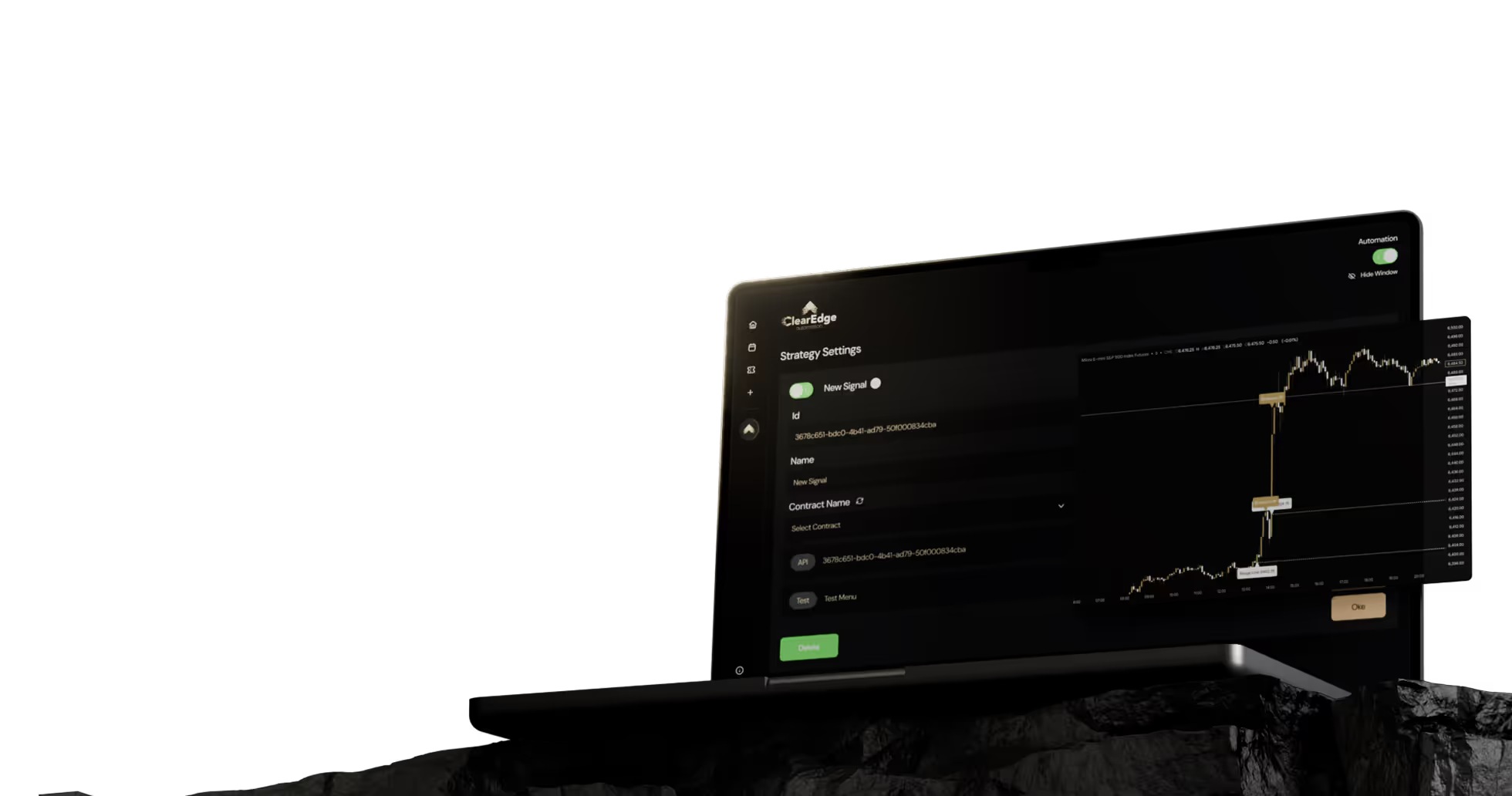
Platforms like ClearEdge Trading connect TradingView alerts to 20+ futures brokers, handling execution without manual intervention. You maintain complete control over strategy rules, risk parameters, and position sizing—but once set, the system executes without emotional influence.
For traders struggling with FOMO during specific market events, automation provides event-based filtering. You can configure your system to avoid trading during NFP (first Friday monthly, 8:30 AM ET) or FOMC announcements if your strategy performs poorly during extreme volatility, removing the temptation to manually override your plan.
Building a Systematic Trading Approach
A systematic trading approach defines every entry, exit, and risk management decision before market exposure begins. This trading plan becomes the foundation for automation, converting discretionary impulses into rule-based execution that operates independently of your emotional state.
Building this systematic framework requires documenting specific criteria:
Trading Rules Checklist
- ☐ Entry conditions (specific indicator values, price levels, timeframes)
- ☐ Position sizing formula (fixed contracts, percentage-based, or volatility-adjusted)
- ☐ Stop loss placement (ATR-based, fixed ticks, or percentage)
- ☐ Profit target criteria (risk multiples, technical levels, or trailing stops)
- ☐ Maximum daily trades allowed (prevents overtrading)
- ☐ Daily loss limit (hard stop for the session)
- ☐ Market condition filters (volatility thresholds, time-of-day restrictions)
- ☐ Economic event restrictions (no trading during specific high-impact releases)
Trading discipline emerges naturally when manual execution is removed. The common advice to "follow your plan" fails because it relies on willpower during emotionally charged moments—exactly when willpower is least reliable. Automation sidesteps this entirely by removing the decision point.
Systematic Trading: An approach where all trading decisions follow predefined, objective rules without discretionary judgment at execution time. Systems can be fully automated or provide signals for manual execution.
For ES futures traders, a systematic approach might define entries only during specific sessions. ES futures trade nearly 24 hours (Sunday 6pm - Friday 5pm ET), but many strategies perform best during RTH (9:30 AM - 4:00 PM ET) when liquidity is highest and spreads tighten to 0.25-0.50 points.
The complete guide to trading psychology automation covers additional strategies for managing fear and greed through systematic rules, including techniques for position sizing adjustments and drawdown protocols.
Paper trading remains essential even with automation. Most platforms offer simulated execution to validate that your rules work as expected before live trading. This testing phase helps identify logic errors in your strategy without risking capital, while building confidence in the system's execution.
Frequently Asked Questions
1. Can automation completely eliminate emotional trading?
Automation eliminates emotions from execution by removing manual decision-making at the point of trade entry and exit. However, traders still make emotional decisions when modifying strategy rules, adjusting risk parameters, or turning systems on and off—discipline is required to avoid interfering with automated systems during drawdowns.
2. How does FOMO specifically affect futures traders differently than stock traders?
Futures leverage amplifies FOMO consequences—ES futures require only ~$1,250 margin per contract but control $250,000 of the S&P 500 index exposure. A FOMO-driven entry at a poor price combined with leverage can damage accounts in a single trade, whereas stock trading typically involves lower leverage and slower price movements.
3. What are the first signs that FOMO is affecting my trading?
Key warning signs include taking trades without your usual confirmation signals, increasing position size after watching large price moves, feeling urgency to enter positions, checking charts obsessively between trades, and trading outside your planned market hours. If you find yourself entering trades "just in case," FOMO is driving decisions.
4. Do professional traders experience FOMO?
Professional traders experience the same emotional triggers but rely on systematic processes and automation to prevent FOMO from affecting execution. According to futures industry research, over 70% of institutional futures volume now comes from algorithmic systems specifically because human discretion underperforms rule-based execution.
5. How long does it take for automation to improve trading discipline?
Most traders report reduced emotional interference within 2-4 weeks of using automation consistently, as they observe the system executing their rules without the hesitation or overriding they previously experienced. However, the temptation to manually interfere during drawdowns persists and requires ongoing commitment to trust the systematic approach.
Conclusion
FOMO drives impulsive trading decisions that consistently underperform rule-based strategies, with CME Group data showing 23% higher loss rates for emotional entries during volatile conditions. Automation removes the opportunity for FOMO to influence execution by enforcing predefined trading rules without human discretion at the point of order entry.
Building a systematic trading plan with precise entry criteria, risk parameters, and execution rules creates the foundation for automation. Paper trading validates your strategy before live deployment, while ongoing commitment to non-interference allows the system to operate as designed even during drawdown periods.
Want to explore systematic trading approaches? Read our complete guide to trading psychology automation for detailed frameworks on removing emotional decision-making from your trading process.
References
- CME Group - Introduction to Futures Trading
- CFTC - Trading Basics and Fraud Prevention
- TradingView - Webhooks Documentation
- Futures Industry Association - Annual Volume Survey
Disclaimer: This article is for educational and informational purposes only. It does not constitute trading advice, investment advice, or any recommendation to buy or sell futures contracts. ClearEdge Trading is a software platform that executes trades based on your predefined rules—it does not provide trading signals, strategies, or personalized recommendations.
Risk Warning: Futures trading involves substantial risk of loss and is not suitable for all investors. You could lose more than your initial investment. Past performance of any trading system, methodology, or strategy is not indicative of future results. Before trading futures, you should carefully consider your financial situation and risk tolerance. Only trade with capital you can afford to lose.
CFTC RULE 4.41: Hypothetical or simulated performance results have certain limitations. Unlike an actual performance record, simulated results do not represent actual trading. Also, since the trades have not been executed, the results may have under-or-over compensated for the impact, if any, of certain market factors, such as lack of liquidity.
By: ClearEdge Trading Team | About























































Steal the PlaybooksOther TradersDon’t Share
Every week, we break down real strategies from traders with 100+ years of combined experience, so you can skip the line and trade without emotion.