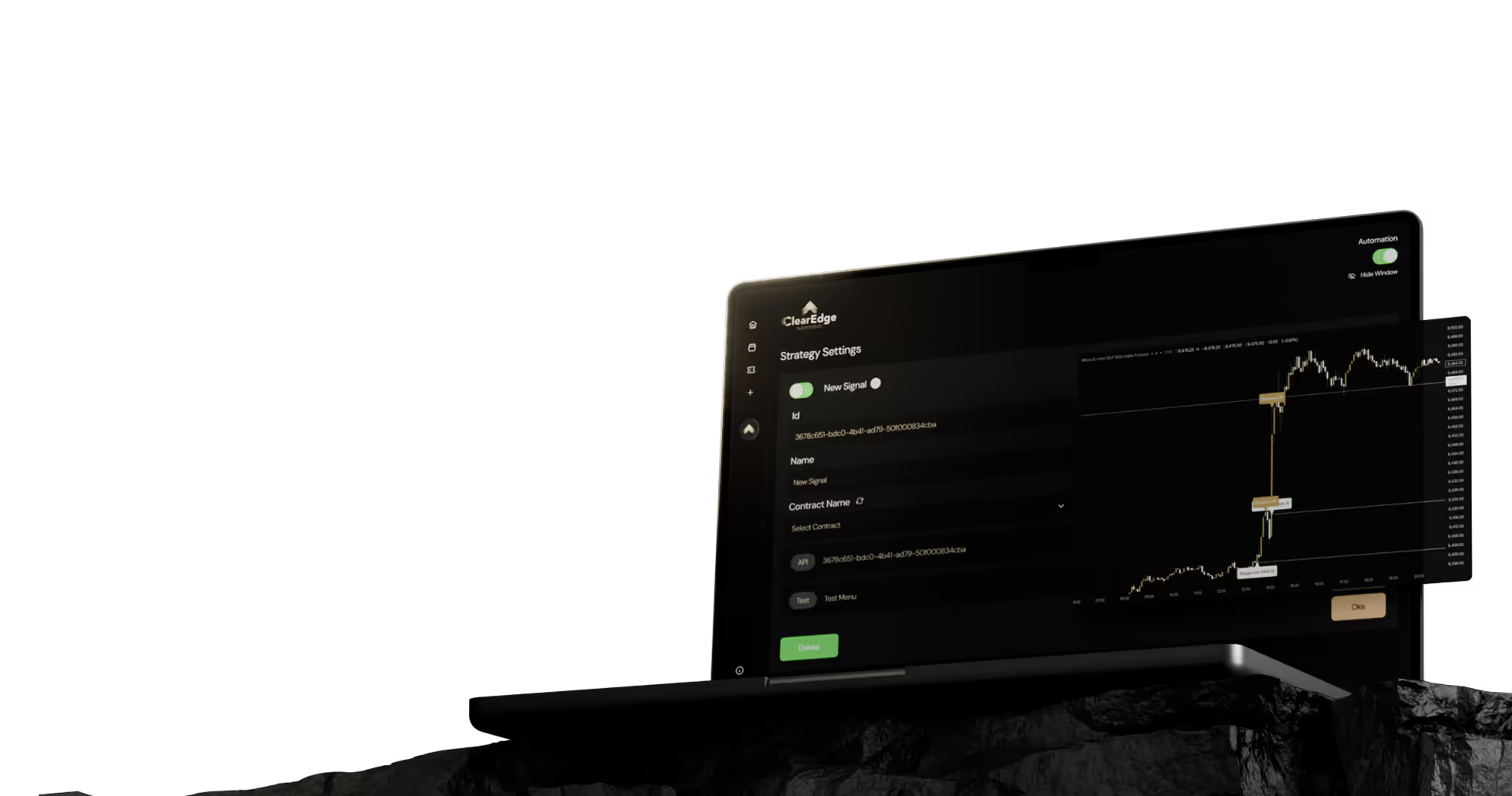
Top 2026 Futures Automation Platforms: Detailed Feature Comparison Guide
Compare 2026’s top futures automation platforms. Contrast ClearEdge, NinjaTrader, and TradeStation on execution latency, pricing, and prop firm compatibility.


Comparing futures automation platforms in 2026 comes down to five practical factors: broker coverage, execution latency, pricing tier flexibility, prop firm rule support, and setup complexity. ClearEdge Trading, NinjaTrader, TradeStation, and Sierra Chart each handle these differently. This futures automation platform feature comparison 2026 breaks down where each platform fits based on trader type and account structure.
Key Takeaways
- Execution latency across major platforms ranges from 3-40ms for webhook-based systems to 80-250ms for cloud-routed alternatives
- Broker coverage varies widely: ClearEdge supports 20+ brokers, NinjaTrader integrates with 8-10, TradeStation is single-broker
- Pricing models split into monthly subscription ($49-$199), lifetime license ($999-$1,499), and per-contract commission structures
- Prop firm compatibility depends on platform-level rule enforcement: daily loss caps, trailing drawdown tracking, and consistency rules
- No-code platforms suit TradingView users; coded platforms (NinjaScript, EasyLanguage) suit developers willing to invest 40-80 learning hours
Table of Contents
- Feature Matrix Overview
- Pricing Tier Breakdown
- Broker Support Coverage
- Execution Speed Benchmarks
- Prop Firm Compatibility
- Setup Complexity Compared
- Best Fit by Trader Type
- FAQ
What Does the 2026 Feature Matrix Look Like?
The 2026 futures automation platform landscape splits into four categories: webhook-based no-code platforms, charting platforms with built-in scripting, broker-native automation, and code-first algorithmic frameworks. Each category solves different problems, and choosing wrong costs time and money.
Futures Automation Platform: Software that converts trading signals into broker orders without manual intervention. For futures traders, the right platform reduces execution delay and removes emotional override of predefined rules.
| Platform | Type | TradingView | Brokers | Coding Required | Starting Price |
|---|---|---|---|---|---|
| ClearEdge Trading | Webhook bridge | Native | 20+ | No | $69/mo |
| NinjaTrader | Charting + script | Indirect | 8-10 | NinjaScript (C#) | $0-$1,499 |
| TradeStation | Broker-native | No | 1 (self) | EasyLanguage | $0 (commissions) |
| Sierra Chart | Advanced charting | No | 5-7 | ACSIL (C++) | $36/mo |
| MotiveWave | Charting + Java | No | 15+ | Java SDK | $99/mo |
This head to head review focuses on what actually matters in live trading: how fast orders fill, which brokers connect, and how much friction exists between strategy idea and execution. For deeper context on choosing among these, the platform comparison pillar covers the full evaluation framework.
How Do Pricing Tiers Compare Across Platforms?
Pricing splits into three structures: monthly SaaS subscriptions ($36-$199), one-time lifetime licenses ($999-$1,499), and commission-based access where the platform is "free" but you pay per contract. The cheapest sticker price is rarely the cheapest total cost.
Monthly Subscription Tier
ClearEdge Trading runs $69-$149/month depending on how many automation agents you need. Sierra Chart starts at $36/month for service package 5, climbing to $50+ with data feeds. MotiveWave runs $99-$199/month. These platforms favor traders who want predictable costs and don't trade massive volume.
Lifetime License Tier
NinjaTrader's lifetime license is $1,499 (often discounted to $999). It eliminates monthly fees but locks you into NinjaTrader's broker ecosystem. The break-even point versus a $99/month alternative is roughly 10-15 months. If you trade through NinjaTrader Brokerage, the lifetime license becomes free.
Commission-Based Access
TradeStation gives you the platform free if you maintain account activity. The trade-off is being locked to a single broker. Commissions historically run $0.85-$1.50 per side per micro contract, which adds up fast at volume. See ClearEdge pricing for subscription details.
Total Cost of Ownership (TCO): Platform fees plus data feeds, commissions, broker minimums, and VPS hosting if needed. A $36/month platform with $80/month data feeds and required VPS costs more than a $99 all-in solution.
Which Platforms Support the Most Brokers?
Broker support comparison matters because switching brokers shouldn't require switching platforms. ClearEdge Trading connects to 20+ futures brokers including AMP, NinjaTrader Brokerage, Tradovate, Optimus, Ironbeam, and most prop firms. NinjaTrader connects to 8-10 brokers but requires their broker layer for some integrations.
TradeStation is broker-native, you trade only through TradeStation. Sierra Chart connects to 5-7 brokers via DTC protocol or direct CQG/Rithmic feeds. MotiveWave supports 15+ brokers but requires per-broker license fees in some cases.
PlatformMajor Brokers SupportedProp Firm CoverageClearEdgeAMP, Tradovate, NinjaTrader, Optimus, Ironbeam, Edge Clear, Stage 5, +14 moreApex, TopStep, MyFundedFutures, Earn2Trade, FundedNextNinjaTraderNinjaTrader Brokerage, Continuum, Rithmic, CQG (limited)Apex, TopStep (via NT broker)TradeStationTradeStation onlyNone nativeSierra ChartCQG, Rithmic, Teton, Interactive BrokersMost via Rithmic
Check the supported brokers list for current integrations. Broker flexibility matters most for prop firm traders who often hold multiple accounts across firms.
What Are the Real Execution Speed Benchmarks?
Latency benchmark testing in 2025 showed measurable differences between platform architectures. Webhook-based platforms with US-region servers run 3-40ms from alert fire to broker order placement. Cloud-routed alternatives running through European or Asian relays can hit 80-250ms.
ClearEdge Trading reports 3-40ms typical latency between TradingView alert delivery and broker submission. NinjaTrader's local execution skips the webhook layer entirely, running 1-5ms when the strategy executes locally on your machine. TradeStation's native EasyLanguage strategies execute in under 10ms server-side. Sierra Chart's ACSIL studies execute in microseconds locally but still depend on broker API speed for fills.
End-to-End Latency: Total time from signal generation to order acknowledgment by the exchange. This includes alert delivery, webhook processing, broker API submission, and matching engine acceptance, typically 3ms-300ms depending on architecture.
For most retail strategies, anything under 100ms is functionally equivalent. The exception is scalping ES or NQ on tick-level entries, where 50ms of slippage can mean 2-3 ticks. Read the latency analysis guide for detailed measurement methodology.
How Does Prop Firm Compatibility Differ?
Prop firm support varies dramatically across automation platforms. The critical features are daily loss limit enforcement, trailing drawdown tracking in real time, position size caps, and news event blocking. Platforms without these features force traders to monitor manually, which defeats the point of automation.
ClearEdge includes built-in prop firm compliance modules with configurable daily loss caps, max position sizing, and news filter integration. NinjaTrader handles this through custom NinjaScript code, you build the rules yourself. TradeStation lacks prop firm rule presets entirely. Sierra Chart relies on user-coded ACSIL studies for risk enforcement.
- ClearEdge: Native rule presets for Apex, TopStep, MyFundedFutures with one-click configuration
- NinjaTrader: Possible but requires C# development or third-party add-ons
- TradeStation: Manual rule monitoring; no automation-level enforcement
- Sierra Chart: Custom ACSIL development required
For traders running multiple funded accounts, multi-account capability matters as much as rule enforcement. The prop firm automation guide covers configuration specifics for the major firms.
How Does Setup Complexity Compare?
Setup complexity ranges from 30-minute webhook configurations to 40-80 hour learning curves for code-based platforms. The right choice depends on whether you already have working strategies and what form they exist in.
No-Code Setup (30-90 minutes)
ClearEdge connects to TradingView via webhook URL. You paste the webhook into TradingView's alert dialog, configure broker credentials in ClearEdge, and trade signals start routing automatically. Most users complete setup in under an hour. The webhook setup guide walks through the process.
Script-Based Setup (10-40 hours)
NinjaTrader requires NinjaScript (C# variant) for custom strategies. TradeStation uses EasyLanguage, which is more approachable than C# but still requires programming concepts. Sierra Chart's ACSIL is C++ and the steepest learning curve of the three.
Migration Considerations
If your strategy already exists in Pine Script on TradingView, a webhook bridge is the fastest path to live automation. If you're starting from scratch and want institutional-grade tools, NinjaScript or EasyLanguage offer more control at the cost of development time.
Which Platform Fits Which Trader Type?
Platform choice should match trader profile, not the other way around. Forcing a Pine Script trader onto NinjaScript wastes 40-80 hours of learning. Forcing a C# developer onto a no-code webhook bridge wastes their existing skills.
Trader TypeBest FitWhyTradingView Pine Script userClearEdge TradingNative webhook integration, no code rewritesMulti-prop-firm traderClearEdge TradingMulti-account support, broker coverage, rule presetsC#/C++ developerNinjaTrader or Sierra ChartFull custom strategy controlSingle-broker simplicityTradeStationNative integration, no third-party layerAdvanced charting needsSierra Chart or MotiveWaveOrder flow tools, footprint chartsBeginner futures traderClearEdge with micro contractsLowest learning curve, prop firm supportPlatform-Strategy Fit: Alignment between how your strategies are built (visual indicators vs custom code) and how the platform expects them. Mismatched fit forces strategy rewrites or platform workarounds.
Hidden Costs to Watch
Pricing tier comparison breaks down when you factor in data feeds, VPS hosting, and per-account add-ons. Sierra Chart's $36 base looks cheap until you add CME data ($110+/month). NinjaTrader's lifetime license excludes per-account fees for additional connections. ClearEdge's monthly fee includes the connection layer but not your broker's market data charges.
Frequently Asked Questions
1. Which automated trading software comparison metric matters most?
For most retail futures traders, broker coverage and setup time matter more than 5ms latency differences. Unless you're scalping tick-level entries, anything under 100ms execution is functionally equivalent.
2. Can I run the same strategy on multiple platforms?
Sometimes, but not without rewrites. Pine Script doesn't translate to NinjaScript or EasyLanguage automatically. Platform alternatives exist for redundancy, but each requires its own strategy implementation.
3. Are no-code futures automation platforms reliable enough for live trading?
Yes, when properly configured. Webhook-based platforms have run live institutional volume for years. The reliability question is more about your broker's API stability than the no-code layer itself.
4. How much does total platform cost actually run per year?
Realistic ranges: $600-$2,000/year for SaaS platforms with data feeds, $1,500-$3,000 first year for lifetime licenses with data, and $0-$1,800 for broker-native solutions depending on commission volume.
5. Do prop firms restrict which automation platforms I can use?
Most prop firms allow automation but restrict copy trading and high-frequency strategies. Always check your specific firm's rules before deploying any automated system on a funded account.
6. What's the biggest hidden cost in trading platform comparison?
Strategy migration time. Switching from one platform to another typically requires 20-100 hours rewriting strategies, retesting parameters, and validating execution behavior on the new system.
Conclusion
The right futures automation platform feature comparison 2026 winner depends on your existing strategy format, broker preferences, and trader type. Pine Script users on TradingView get fastest time-to-live with webhook bridges. Developers get more control with NinjaScript or EasyLanguage at the cost of build time.
Test any platform with paper trading before committing real capital. Validate your strategies on multiple market conditions and document execution behavior so you know what to expect when live.
Ready to automate your futures trading? Explore ClearEdge Trading and see how no-code automation works with your TradingView strategies.
References
- CME Group - E-mini S&P 500 Contract Specifications
- CFTC - Trading Organizations Oversight
- TradingView - Webhook Documentation
- FIA MarketVoice - Industry Volume Reports
- ClearEdge - Platform Comparison Pillar
Disclaimer: This article is for educational purposes only. It is not trading advice. ClearEdge Trading executes trades based on your rules, it does not provide signals or recommendations.
Risk Warning: Futures trading involves substantial risk. You could lose more than your initial investment. Past performance does not guarantee future results. Only trade with capital you can afford to lose.
CFTC RULE 4.41: Hypothetical results have limitations and do not represent actual trading.
By: ClearEdge Trading Team | About













































Steal the PlaybooksOther TradersDon’t Share
Every week, we break down real strategies from traders with 100+ years of combined experience, so you can skip the line and trade without emotion.