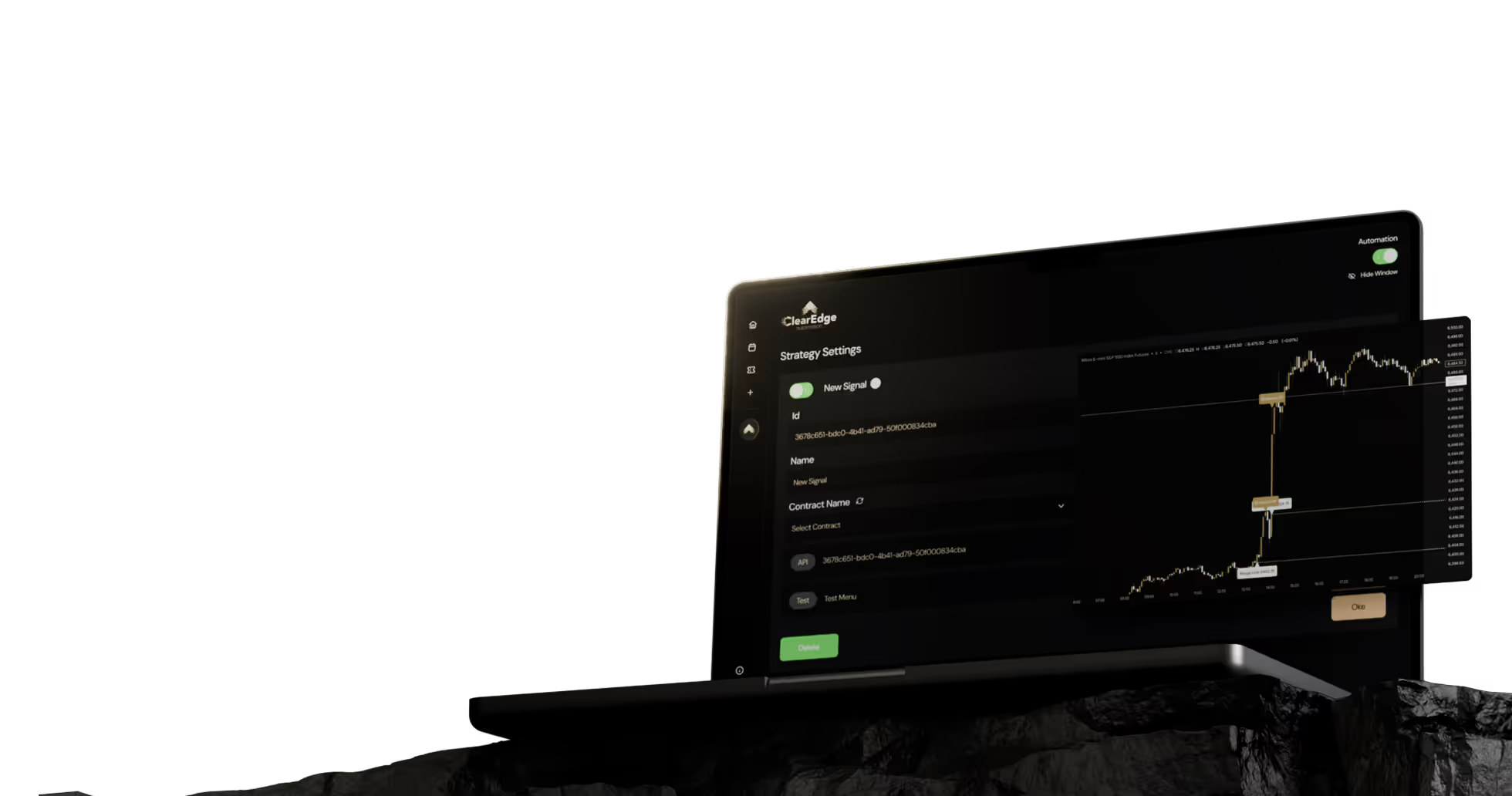
TradingView Supply and Demand Zone Automation Strategy for Futures
Automate supply and demand zones in TradingView with Pine Script. Use webhook alerts to execute futures trades instantly and filter for zone freshness and trend.


A TradingView supply demand zone automation strategy uses Pine Script indicators to identify historical price zones where buying or selling pressure concentrated, then fires webhook alerts to execute trades automatically when price revisits those zones. This approach removes manual chart-watching and lets your predefined zone-based rules run without hesitation or delay.
Key Takeaways
- Supply and demand zones differ from support/resistance because they focus on the origin of strong price moves, not just areas where price reversed
- Pine Script can detect supply and demand zones using swing high/low logic combined with volume confirmation and candle range filters
- TradingView alerts automation works by sending webhook payloads when price enters a predefined zone, triggering broker orders in 3-40ms
- Zone freshness matters: first-touch zones have higher probability than zones tested multiple times, and your automation should track touch count
- Multi-timeframe alerts improve zone quality by confirming daily or 4-hour zones on lower timeframes before executing
Table of Contents
- What Are Supply and Demand Zones?
- How Does Automated Zone Detection Work in Pine Script?
- Building a TradingView Supply Demand Zone Automation Strategy
- How to Connect Zone Alerts to Trade Execution
- What Filters Improve Zone Quality?
- Common Mistakes with Zone Automation
- Frequently Asked Questions
What Are Supply and Demand Zones?
Supply and demand zones are price areas where institutional orders previously caused a strong directional move. A demand zone forms at the base of a sharp rally. A supply zone forms at the origin of a sharp drop. When price returns to these zones, the theory is that unfilled orders may still exist there, creating another reaction.
Supply Zone: A price area where selling pressure previously overwhelmed buyers, causing a sharp move down. Traders watch for price to return to this zone as a potential shorting opportunity.Demand Zone: A price area where buying pressure previously overwhelmed sellers, pushing price sharply higher. Traders monitor these zones for potential long entries on revisits.
This is different from traditional support and resistance. Support and resistance mark where price turned around. Supply and demand zones mark where the move started. The distinction matters for automation because zone identification depends on the strength and speed of the departure move, not just the reversal point.
On ES futures (E-mini S&P 500, tick value $12.50), a demand zone might form at 5,420-5,425 if price consolidated in that range before rallying 30 points in a single session. When ES pulls back to 5,420-5,425 days later, a TradingView supply demand zone automation strategy would fire an alert and place a long order automatically.
How Does Automated Zone Detection Work in Pine Script?
Automated zone detection in Pine Script uses swing point identification combined with move-strength filters to find valid supply and demand zones. The script identifies consolidation areas that preceded large directional moves, marks those areas as zones, and monitors price for re-entry.
Here's the basic logic flow for Pine Script coding of a demand zone detector:
- Identify swing lows: Use
ta.pivotlow()to find local price bottoms over a lookback period (typically 5-20 bars) - Measure departure strength: Calculate the percentage or point move from the swing low. For ES, you might require a minimum 10-point rally within 5 bars
- Define the zone: The zone's lower boundary is the swing low. The upper boundary is the high of the consolidation candle(s) before the move
- Track zone status: Mark the zone as "fresh" (untested), "tested" (price returned once), or "broken" (price closed through it)
- Generate alert conditions: When price enters a fresh zone, trigger an alert condition that fires a webhook
The supply zone logic mirrors this but inverted: find swing highs, measure the drop strength, define the zone boundaries, and alert when price returns. Pine Script's alertcondition() function or strategy order functions handle the alert generation, which connects to your TradingView webhook setup.
Swing Point: A local high or low on a price chart where direction changed temporarily. Pine Script's ta.pivothigh() and ta.pivotlow() functions detect these programmatically using a configurable lookback window.
Building a TradingView Supply Demand Zone Automation Strategy
A complete TradingView supply demand zone automation strategy needs three components: zone identification, entry logic, and risk management rules. Each piece has to be defined precisely enough that the automation can execute without any human judgment calls.
Zone Identification Parameters
Start by deciding what qualifies as a valid zone. These parameters shape everything downstream:
- Lookback period: How many bars back to scan for swing points. Shorter (5-10 bars) catches intraday zones on 5-minute charts. Longer (15-30 bars) works better on 1-hour or daily charts
- Minimum departure move: The price move that validates a zone. For NQ futures (tick value $5.00), requiring at least a 50-point departure filters out weak zones
- Consolidation width: Maximum zone height in points or ticks. Thin zones (3-5 points on ES) give tighter entries. Wide zones increase fill probability but widen risk
- Volume confirmation: Zones formed on above-average volume tend to hold better. Use
volume > ta.sma(volume, 20)as a filter
Entry Logic
When price enters a zone, your strategy needs clear rules for when to place the order. Some approaches:
- Zone touch entry: Enter immediately when price touches the zone boundary. Fastest but riskiest
- Candle confirmation entry: Wait for a bullish/bearish engulfing or pin bar within the zone before entering. Slower but higher probability
- Limit order at zone midpoint: Pre-place a limit order at the zone's midpoint. Better fills but might miss zones where price only tags the edge
Risk Management
Every automated zone trade needs a stop loss and target. A common approach places the stop 1-2 ticks beyond the opposite side of the zone. For a demand zone on ES between 5,420 and 5,425, the stop goes at 5,419.50 or 5,419.75. Targets often aim for the next supply zone above, or a fixed risk-reward ratio like 2:1 or 3:1.
For stop loss automation, define your exits in the strategy tester or as separate alert conditions. The alert message format should include the stop and target prices in the webhook payload so your execution platform handles them automatically.
How to Connect Zone Alerts to Trade Execution
TradingView webhook setup connects your Pine Script zone alerts to an automation platform that places the actual orders with your futures broker. When the script detects price entering a demand zone, it fires a webhook containing the order details in JSON format.
A typical alert message format for a demand zone entry looks like this:
{
  "action": "buy",
  "symbol": "ES",
  "qty": 1,
  "orderType": "limit",
  "limitPrice": "{{close}}",
  "stopLoss": "5419.75",
  "takeProfit": "5440.00"
}
The webhook payload gets sent to your automation platform's endpoint URL. Platforms like ClearEdge Trading receive this payload and convert it into a broker order. The entire chain from alert to order placement typically takes 3-40ms depending on your broker connection and server proximity.
Webhook Payload: The data package sent from TradingView to an external platform when an alert fires. It contains trade instructions formatted as JSON that the receiving platform parses and executes.
One thing to watch: TradingView's alert conditions fire once per bar close by default. If you need intra-bar triggers (price touches the zone mid-candle), you'll need to use "Once Per Bar Close" vs. "Once Per Bar" vs. "Every Time" settings carefully. "Every Time" can cause duplicate orders if price bounces in and out of a zone within a single bar. Most traders use "Once Per Bar Close" for zone strategies to avoid this problem.
For details on structuring your webhook messages, see the TradingView JSON payload format guide.
What Filters Improve Zone Quality?
Raw zone detection produces too many zones. Filtering separates tradeable setups from noise. The most effective filters for a TradingView supply demand zone automation strategy focus on zone freshness, timeframe alignment, and market context.
Zone Freshness
First-touch zones outperform tested zones. Every time price revisits a zone, it absorbs some of the pending orders that created the zone in the first place. Your Pine Script should track how many times price has entered each zone and prioritize or exclusively trade fresh (zero-touch) zones. This is one of the biggest edges in zone trading and worth coding carefully.
Multi-Timeframe Confirmation
A demand zone on the daily chart carries more weight than the same zone on a 5-minute chart. Multi-timeframe alerts let you require that a lower-timeframe zone aligns with a higher-timeframe zone before the automation executes. For example, only take 15-minute demand zone entries when they sit inside a daily demand zone. Pine Script's request.security() function pulls data from higher timeframes for this confirmation.
Trend Alignment
Demand zones work better in uptrends. Supply zones work better in downtrends. A simple filter: only trade demand zones when a 50-period EMA slopes upward on the execution timeframe, and only trade supply zones when it slopes downward. This single filter can cut out a large portion of losing trades.
Time-of-Day Filter
Zone strategies on futures tend to perform differently during Regular Trading Hours (RTH) vs. Extended Trading Hours (ETH). ES futures trade from Sunday 6:00 PM to Friday 5:00 PM ET, but the RTH session (9:30 AM - 4:00 PM ET) carries the most volume. Zones formed during RTH are generally more reliable. Your automation should let you restrict trading to specific sessions. See the RTH vs. ETH automation settings guide for configuration details.
Zone Quality Checklist
FilterWhat to CheckImplementationFreshnessZero prior touchesTrack touch count in Pine Script arrayDeparture strengthStrong move away from zoneMinimum point/percentage thresholdVolumeAbove-average volume at zone formationvolume > ta.sma(volume, 20)Timeframe alignmentHTF zone confirms LTF zonerequest.security() for higher TF dataTrend directionZone aligns with trendEMA slope or price vs. moving averageSession timingZone formed during RTHTime filter in alert conditions
Common Mistakes with Zone Automation
Automating supply and demand zones introduces specific pitfalls that manual zone traders don't face. Here are the ones that cause the most problems.
1. Over-fitting zone parameters to historical data. If you tweak your departure strength, lookback period, and zone width until the strategy tester shows perfect results, you've probably curve-fitted. Use out-of-sample testing: optimize on 6 months of data, then validate on the next 3 months. The TradingView backtesting guide covers this process.
2. Ignoring zone expiration. A zone from 3 months ago may no longer be relevant. Market structure changes. Set an expiration window (e.g., zones older than 20 trading days get removed) to keep your zone library current.
3. Trading during news events without adjustment. Supply and demand zones get blown through during FOMC announcements (8x per year, 2:00 PM ET) and NFP releases (first Friday monthly, 8:30 AM ET). Your automation needs either a news filter that pauses trading around high-impact events, or wider stops that account for event volatility. Without this, a single news candle can trigger entries and stop-outs within seconds.
4. Not accounting for zone overlap. When a supply zone sits directly above a demand zone with minimal space between them, your automation might get conflicting signals. Code logic that identifies and skips overlapping zones, or prioritize the zone on the higher timeframe.
Frequently Asked Questions
1. Can Pine Script automatically draw supply and demand zones on a chart?
Yes. Pine Script's box.new() function draws rectangles on the chart representing zone boundaries. You define the zone's top, bottom, start bar, and extend it rightward until price breaks through or the zone expires.
2. How many supply and demand zones should an automated strategy track at once?
Most effective setups track 3-5 active zones per instrument per timeframe. Too many zones creates conflicting signals. Pine Script arrays can store and manage zone data, removing broken or expired zones automatically.
3. Does a TradingView supply demand zone automation strategy work on micro futures?
Yes. MES (Micro E-mini S&P, $1.25/tick) and MNQ (Micro E-mini Nasdaq, $0.50/tick) follow the same price action patterns as their full-size counterparts. Zone parameters stay the same since the price charts are identical.
4. What TradingView plan do I need for webhook-based zone automation?
TradingView Pro or higher is required for webhook alerts. The free plan doesn't support webhooks. Higher-tier plans also allow more active alerts, which matters if you're tracking zones across multiple instruments. See the TradingView alert limits guide for plan-specific details.
5. How do I avoid false zone entries during low-volume periods?
Add a volume filter that disables zone entries when current volume drops below 50% of the 20-bar average. ETH sessions on ES and NQ often have thin order books where zones form from random price spikes, not genuine institutional activity.
6. Can I combine supply demand zones with other indicator alerts?
Yes, and this is a common approach. Traders layer RSI divergence, VWAP proximity, or order flow data on top of zone entries for confirmation. Pine Script lets you combine multiple conditions into a single alertcondition() that only fires when all criteria align.
Conclusion
A TradingView supply demand zone automation strategy replaces manual chart-watching with systematic zone detection, quality filtering, and webhook-triggered execution. The core components are Pine Script coding for zone identification, alert conditions with properly formatted webhook payloads, and an automation platform integration that converts those alerts into live broker orders.
Start by paper trading your zone strategy using TradingView's strategy tester to validate zone parameters before connecting live execution. Focus on zone freshness, multi-timeframe confirmation, and proper news event filters to improve the probability that your automated entries match what you'd do manually.
Want to dig deeper? Read our complete guide to TradingView automation for more detailed setup instructions and strategies.
References
- TradingView - Pine Script Language Reference Manual
- CME Group - E-mini S&P 500 Futures Contract Specifications
- TradingView - About Webhooks
- CME Group - Introduction to Futures
Disclaimer: This article is for educational purposes only. It is not trading advice. ClearEdge Trading executes trades based on your rules, it does not provide signals or recommendations.
Risk Warning: Futures trading involves substantial risk. You could lose more than your initial investment. Past performance does not guarantee future results. Only trade with capital you can afford to lose.
CFTC RULE 4.41: Hypothetical results have limitations and do not represent actual trading.
By: ClearEdge Trading Team | About























































Steal the PlaybooksOther TradersDon’t Share
Every week, we break down real strategies from traders with 100+ years of combined experience, so you can skip the line and trade without emotion.