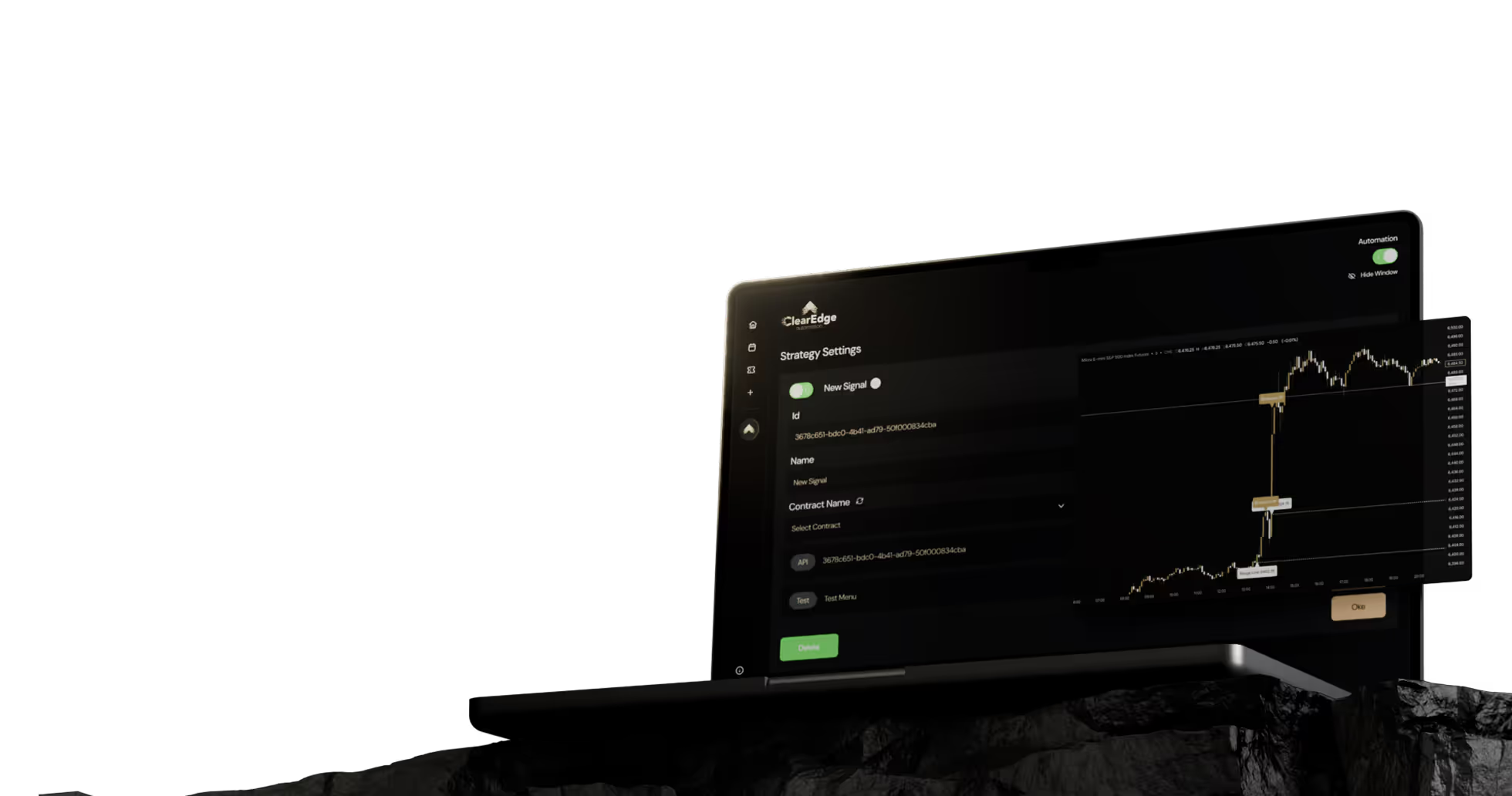
Algorithmic Trading Breakout Strategies: Automated Futures Setup Guide
Master algorithmic breakout strategies for futures trading. Automate trade execution at key levels, reduce slippage, and use volume filters to avoid false moves.


Algorithmic trading breakout strategies automate the identification and execution of trades when price breaks through defined support or resistance levels. These systems monitor key price thresholds in real-time and execute orders automatically when breakout conditions are met, removing manual delays and emotional decision-making from the trading process.
Key Takeaways
- Breakout strategies trigger trades when price moves above resistance or below support with increased volume confirmation
- Algorithmic execution reduces slippage during fast breakout moves, with typical automation speeds of 3-40ms versus seconds for manual entry
- Opening Range and volatility-based breakouts are the most automated strategies for ES, NQ, and other liquid futures contracts
- False breakouts account for 30-40% of signals in ranging markets, requiring filters like volume thresholds and ATR confirmation
Table of Contents
- What Are Algorithmic Trading Breakout Strategies?
- How Does Breakout Automation Work?
- What Are the Main Types of Breakout Strategies?
- How to Set Up Breakout Strategy Automation
- Risk Management for Automated Breakouts
- Common Mistakes in Breakout Automation
- Frequently Asked Questions
What Are Algorithmic Trading Breakout Strategies?
Breakout strategies identify when price moves beyond established support or resistance levels with enough momentum to continue in that direction. Algorithmic implementations monitor these levels continuously and execute trades automatically when breakout conditions occur, typically confirmed by volume increases or volatility expansion.
Breakout: A price movement that penetrates and closes beyond a defined support or resistance level, often signaling the start of a new trend. In futures trading, valid breakouts typically require confirmation through increased volume or momentum indicators.
The automation advantage comes from execution speed. Manual traders often hesitate at breakout points or miss the initial move entirely. Automated systems execute within milliseconds of the breakout signal, capturing more of the initial momentum move before slippage increases.
For ES and NQ futures automation, breakout strategies work well because these contracts have sufficient liquidity to absorb automated order flow without significant slippage during normal market conditions.
How Does Breakout Automation Work?
Breakout automation systems continuously monitor price action against predefined levels, triggering orders when specific conditions are met. The system calculates support and resistance zones using methods like pivot points, previous day high/low, or volatility-based channels, then watches for price to break through these levels with confirmation filters.
The typical automation workflow involves three components: detection, confirmation, and execution. Detection identifies when price reaches the breakout level. Confirmation applies filters like volume spikes (typically 150-200% of average), candlestick close beyond the level, or momentum indicator agreement. Execution sends the market or limit order to your broker through automated connection.
Webhook: An automated message sent from TradingView to your automation platform when an alert condition fires. Webhooks transmit the trade parameters (direction, quantity, order type) that your automation system uses to execute the order at your broker.
Platforms like ClearEdge Trading receive webhook alerts from TradingView indicators and convert them into broker orders. When your custom breakout indicator fires in TradingView, the webhook triggers order execution with latency typically between 3-40ms depending on broker connectivity.
The automation handles order management tasks that slow manual execution: calculating position size based on account balance, setting stop losses at predefined distances (often 1-2 ATR from entry), and placing profit targets at resistance levels or risk-reward ratios.
What Are the Main Types of Breakout Strategies?
Opening Range Breakout (ORB)
Opening Range strategies define high and low boundaries during the first 5-60 minutes of the trading session, then trade breakouts beyond these levels. The 30-minute Opening Range is most common for ES futures, establishing boundaries from 9:30-10:00 AM ET, with breakout trades triggered when price moves beyond these levels after 10:00 AM.
Automation advantages are significant for ORB strategies because the breakout moment requires immediate execution. A manual trader checking charts every few minutes might miss the breakout by 2-5 points on ES (worth $12.50 per point), while automated execution captures the move within one tick of the trigger.
Volatility Breakout
Volatility-based systems use Average True Range (ATR) or Bollinger Bands to define dynamic breakout levels that adjust to current market conditions. A common approach triggers long entries when price moves more than 1.5 ATR above the previous close, with stop losses placed 0.5-1.0 ATR below entry.
These strategies work well in automated form because volatility calculations update with each new bar, requiring constant recalculation that manual traders find tedious. The automation monitors the expanding bands and executes when price reaches the calculated threshold.
News Event Breakout
Economic releases like Non-Farm Payrolls (first Friday monthly at 8:30 AM ET) or FOMC announcements (2:00 PM ET on decision days) often trigger breakouts from pre-announcement consolidation ranges. Automated systems can be configured to activate only during scheduled event windows, executing breakout trades when price moves beyond the 5-minute pre-announcement range.
Risk is higher with news breakouts due to wider spreads and potential whipsaw moves. Conservative automation approaches wait for the first 1-2 minute candle to close beyond the range before entering, sacrificing some profit potential for reduced false breakout exposure.
Strategy TypeBest TimeframeTypical Stop DistanceWin Rate RangeOpening Range5-30 min bars0.5-1.0x range height40-50%Volatility (ATR)15-60 min bars0.5-1.0 ATR35-45%News Event1-5 min bars1.5-2.0x pre-event range30-40%Consolidation30-240 min bars0.5x consolidation height35-45%
How to Set Up Breakout Strategy Automation
Step 1: Define Your Breakout Levels
In TradingView, code your breakout detection logic using Pine Script or use existing indicators. For a simple Opening Range strategy, calculate the high and low of the first 30 minutes, then create alert conditions for when price crosses above the high or below the low. Your code should output clear signals: "LONG" when breaking above, "SHORT" when breaking below.
Step 2: Add Confirmation Filters
Include volume or momentum filters to reduce false breakouts. A common filter requires volume on the breakout candle to exceed 150% of the 20-bar average volume. Another approach waits for the candle to close beyond the breakout level rather than triggering on the initial touch.
Step 3: Configure TradingView Alerts
Create alerts in TradingView that fire when your breakout conditions are met. In the alert message field, format the webhook payload with your trade parameters: direction (long/short), quantity, order type (market/limit), and any stop/target levels. The TradingView automation guide covers webhook formatting in detail.
Step 4: Connect to Your Automation Platform
Link your TradingView alerts to your automation platform by entering the webhook URL in the TradingView alert settings. Platforms that support multiple broker integrations let you route orders to your preferred futures broker. Test the connection with a single micro contract (MES or MNQ) before running full position sizes.
Step 5: Backtest and Paper Trade
Run historical backtests in TradingView to evaluate performance across different market conditions. Pay attention to performance during ranging markets versus trending periods. Forward test on a paper trading account for at least 20-30 trades to verify the automation executes correctly and stop losses function as intended.
Backtesting: The process of testing a trading strategy against historical price data to evaluate how it would have performed in the past. For automated strategies, backtesting helps identify parameter settings and market conditions where the strategy works best, though past results do not guarantee future performance.
Risk Management for Automated Breakouts
Breakout strategies require disciplined risk management because false breakouts are common, especially in ranging market conditions. Effective automation includes hard stops on every trade, daily loss limits, and position sizing rules that limit each trade to 1-2% of account capital.
For ES futures with a $12.50 tick value, a 4-point stop loss represents $50 risk per contract. On a $10,000 account, 1% risk ($100) allows 2 contracts maximum. Your automation should calculate position size dynamically based on current account balance and stop distance.
Stop Loss Placement
Place stops beyond the breakout level plus a buffer for noise. For Opening Range breakouts, stops typically sit 0.5-1.0 times the range height on the opposite side of the breakout level. For volatility breakouts, 0.5-1.0 ATR provides reasonable stop distance while allowing the trade room to work.
Daily Loss Limits
Automated systems should include daily loss limits that halt trading after a defined drawdown threshold. For prop firm automation, this is essential—most funded accounts have 2-5% daily loss limits that result in account termination if breached. Set your automation's daily limit 10-20% tighter than the firm's hard limit to provide buffer room.
Advantages of Automated Breakouts
- Execution speed captures more of the initial breakout move before slippage increases
- Removes hesitation and emotional decision-making at critical breakout moments
- Monitors multiple instruments simultaneously for breakout opportunities
- Consistently applies entry rules and risk parameters without deviation
Limitations of Automated Breakouts
- False breakouts in ranging markets generate consecutive losses that erode capital
- Requires robust filtering to distinguish valid breakouts from noise, which may reduce opportunity count
- News events and low-liquidity periods can cause extreme slippage despite fast execution
- System failures or connectivity issues during breakout moments result in missed trades
Common Mistakes in Breakout Automation
The most frequent error is insufficient filtering, leading to overtrading in choppy market conditions. Traders see breakout signals fire in backtests and assume all signals are valid, but ranging markets produce numerous false breakouts that stop out repeatedly. Add time-of-day filters (avoid the last hour before market close when ranges compress) or trend filters (only take breakouts in the direction of the larger trend).
Another mistake is using market orders for all breakout entries. While market orders guarantee execution, they accept whatever price is available. During fast breakout moves, especially on news events, market orders can fill several ticks worse than the trigger price. Limit orders placed 1-2 ticks beyond the breakout level provide some slippage protection, though they risk missing the trade if price gaps through your limit.
Traders also commonly underestimate the impact of commissions and fees on breakout strategies. With typical win rates of 35-45%, the average winner must exceed the average loser by enough to cover trading costs. At $4-5 round-turn per ES contract, a strategy that averages 10 trades per day incurs $40-50 in daily costs. Your average winning trade needs to account for this overhead to remain profitable.
Frequently Asked Questions
1. What percentage of breakout signals are false breakouts?
In ranging market conditions, 30-40% of breakout signals fail and reverse back into the previous range. Trending markets show lower false breakout rates of 15-25%, which is why trend filters improve breakout strategy performance.
2. Can breakout strategies work on micro contracts like MES and MNQ?
Yes, micro contracts are ideal for testing and learning breakout automation. MES has a $1.25 tick value versus $12.50 for ES, allowing smaller position sizes and lower risk per trade while testing your strategy logic.
3. How much capital do you need for automated breakout trading?
Starting with $5,000-10,000 allows proper position sizing with 1-2% risk per trade on micro contracts. For standard ES or NQ contracts, $15,000-25,000 provides adequate cushion for drawdown periods while maintaining proper risk parameters.
4. Do breakout strategies work better on certain futures contracts?
Highly liquid contracts like ES, NQ, and CL work best due to tighter spreads and consistent liquidity during breakout moves. Less liquid contracts may show wider spreads during breakouts, increasing slippage beyond backtested expectations.
5. Should you use limit orders or market orders for breakout entries?
Market orders guarantee execution but accept slippage, while limit orders control entry price but risk missing the trade. A hybrid approach uses limit orders placed 1-2 ticks beyond the breakout level during normal hours, switching to market orders only for high-priority setups.
Conclusion
Algorithmic trading breakout strategies automate the detection and execution of trades when price moves beyond key support or resistance levels, offering speed advantages over manual execution. Effective automation combines clear breakout definitions, confirmation filters to reduce false signals, and disciplined risk management including stop losses and daily limits.
Start by paper trading a simple Opening Range or volatility breakout strategy on micro contracts to validate your automation setup and refine entry filters. For broader context on building complete algorithmic trading systems, explore how different strategy types integrate into a comprehensive automation approach.
Want to dig deeper? Read our complete guide to algorithmic trading for more detailed setup instructions and strategies.
References
- CME Group - E-mini S&P 500 Futures Contract Specifications
- TradingView - About Webhooks Documentation
- CME Group - Understanding Opening Range Breakout
- CFTC - Commodity Exchange Act Regulations
Disclaimer: This article is for educational and informational purposes only. It does not constitute trading advice, investment advice, or any recommendation to buy or sell futures contracts. ClearEdge Trading is a software platform that executes trades based on your predefined rules—it does not provide trading signals, strategies, or personalized recommendations.
Risk Warning: Futures trading involves substantial risk of loss and is not suitable for all investors. You could lose more than your initial investment. Past performance of any trading system, methodology, or strategy is not indicative of future results. Before trading futures, you should carefully consider your financial situation and risk tolerance. Only trade with capital you can afford to lose.
CFTC RULE 4.41: HYPOTHETICAL OR SIMULATED PERFORMANCE RESULTS HAVE CERTAIN LIMITATIONS. UNLIKE AN ACTUAL PERFORMANCE RECORD, SIMULATED RESULTS DO NOT REPRESENT ACTUAL TRADING. ALSO, SINCE THE TRADES HAVE NOT BEEN EXECUTED, THE RESULTS MAY HAVE UNDER-OR-OVER COMPENSATED FOR THE IMPACT, IF ANY, OF CERTAIN MARKET FACTORS, SUCH AS LACK OF LIQUIDITY.
By: ClearEdge Trading Team | 29+ Years CME Floor Trading Experience | About























































Steal the PlaybooksOther TradersDon’t Share
Every week, we break down real strategies from traders with 100+ years of combined experience, so you can skip the line and trade without emotion.