How Automation Stops Revenge Trading In Futures Markets
End the destructive cycle of revenge trading with rule-based automation. Remove emotions from execution and protect your account with enforced daily loss limits.


Revenge trading occurs when traders impulsively place trades to recover losses, often leading to even greater losses. Automation stops revenge trading by removing emotional decision-making from the execution process—trades only execute when predefined conditions are met, regardless of recent wins or losses. By implementing rule-based automation, traders eliminate the psychological impulse to "get even" and maintain discipline even after drawdowns.
Key Takeaways
- Revenge trading stems from loss aversion—traders risk 2-3x more capital trying to recover losses than they would on normal trades
- Automation enforces predefined rules that execute only when strategy conditions are met, blocking impulse trades
- Daily loss limits in automated systems hard-stop trading after drawdown thresholds, preventing cascade losses
- Systematic approaches show 40-60% fewer emotional trading errors compared to manual execution, according to behavioral finance research
Table of Contents
- What Is Revenge Trading?
- The Psychology Behind Revenge Trading
- How Automation Stops Revenge Trading
- Setting Up Automated Rules to Prevent Revenge Trading
- Real-World Example: Automated Risk Controls in Action
- Frequently Asked Questions
- Conclusion
What Is Revenge Trading?
Revenge trading is the act of placing impulsive trades immediately after a loss in an attempt to quickly recover the lost capital. These trades typically ignore the trader's established strategy, risk parameters, and market conditions. Revenge trading is one of the most destructive behavioral patterns in futures trading, often turning small losses into account-destroying drawdowns.
Revenge Trading: Emotionally-driven trades placed to recover recent losses, characterized by increased position sizes, ignored stop losses, and abandoned trading plans. This behavior violates disciplined risk management and typically accelerates account losses.
The pattern typically follows this sequence: a trader takes a legitimate stop loss, feels frustration or anger about the loss, immediately enters another trade with larger size or less favorable setup, and compounds the original loss. Research in behavioral finance shows traders experiencing recent losses make decisions 2-3 times faster than their baseline, reducing analytical quality.
For futures traders, revenge trading is particularly dangerous due to leverage. A standard ES futures contract controls approximately $200,000 in notional value. One or two revenge trades with doubled position size can eliminate weeks of disciplined profits within minutes.
The Psychology Behind Revenge Trading
Loss aversion drives revenge trading—the psychological principle that losses feel approximately twice as painful as equivalent gains feel pleasurable. When traders experience a loss, their brain's emotional centers activate more strongly than analytical regions, creating an urgent impulse to "fix" the loss immediately rather than accept it as part of normal trading variance.
Daniel Kahneman's research on behavioral finance and trading psychology demonstrates that traders make systematically different decisions when framed as "recovering losses" versus "pursuing gains." The same trader who carefully manages 1-2% risk per trade may suddenly risk 5-10% when trying to recover from a drawdown.
Trading anxiety intensifies this pattern during volatile market conditions. A trader who loses $500 on an ES trade during FOMC announcements experiences both financial loss and ego threat—their analysis was wrong at a critical moment. This combination triggers fight-or-flight responses that override systematic decision-making.
The impulse to revenge trade also connects to intermittent reinforcement. Occasionally, a revenge trade does recover the loss, which powerfully reinforces the behavior despite its long-term negative expectancy. This creates a gambling-like pattern where occasional "wins" encourage continued destructive behavior.
How Automation Stops Revenge Trading
Automation eliminates revenge trading by creating an execution barrier between emotional impulses and actual order placement. When trades execute only through predefined rules triggered by TradingView alerts or algorithmic conditions, there's no mechanism for impulse trades to reach your broker—the system simply won't execute orders that don't meet your programmed criteria.
Rule-based systems enforce trading discipline through several mechanisms. First, they require trade entry conditions to be defined before market open, when emotional state is neutral. Second, they eliminate the physical ability to place discretionary trades during moments of frustration. Third, they maintain consistent position sizing regardless of recent performance.
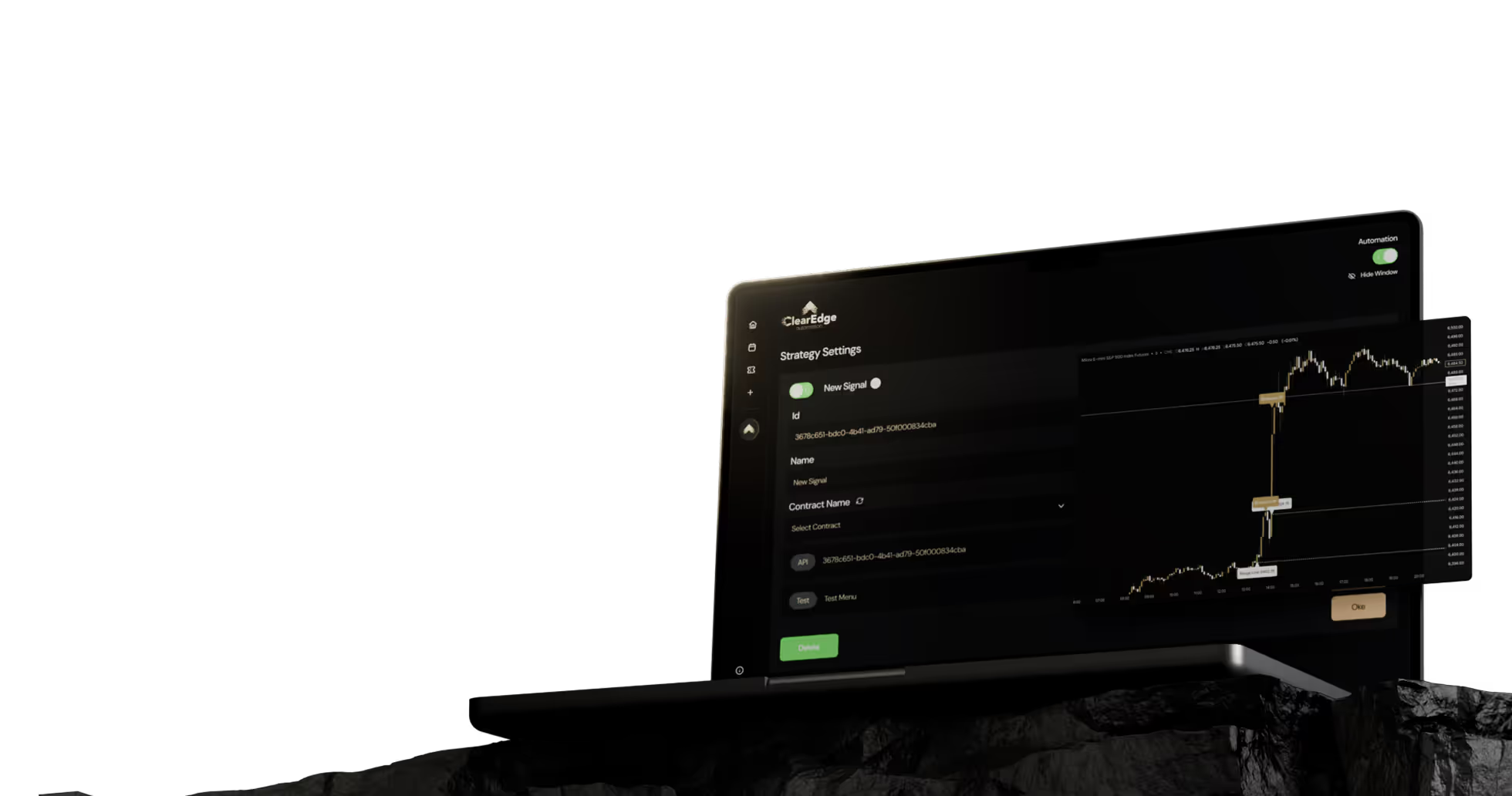
Platforms like ClearEdge Trading convert TradingView strategy alerts into broker orders, executing only when your indicator conditions trigger. If your Opening Range Breakout strategy doesn't signal an entry, no trade occurs—even if you just took a loss and feel the urge to "do something."
Systematic Approach: A trading methodology where all decisions follow predefined rules tested before live implementation. Systematic trading removes real-time discretion, ensuring trades execute based on strategy logic rather than current emotional state.
Daily loss limits add an additional layer of protection. When automated systems hit a predefined drawdown threshold—commonly 2-3% for retail accounts or specific dollar amounts for prop firm traders—they stop all trading for the day. This hard stop prevents the cascade pattern where one loss leads to multiple revenge trades and accelerating drawdown.
FactorManual ExecutionAutomated ExecutionDecision Speed After Loss2-3 seconds (impulsive)N/A (no discretionary trades)Position Size ConsistencyVaries with emotional stateFixed by programmed rulesDaily Loss Limit AdherenceRequires willpower to stopSystem enforced, no overrideTrade Entry CriteriaCan be ignored when emotionalMust be met for execution
Setting Up Automated Rules to Prevent Revenge Trading
Effective automation setup requires defining specific trade entry conditions, risk parameters, and hard stops before going live. Start by documenting your trading plan in concrete terms that can be programmed: exact indicator values, time-of-day filters, volatility thresholds, and position sizing formulas.
For TradingView-based automation, build your strategy using Pine Script or existing indicators, then configure alert conditions that trigger only when all your criteria are met. A typical Opening Range Breakout setup might require: market open occurred, 30-minute range established, price breaks range by at least 2 ticks, volume exceeds 20-period average, and no major economic events scheduled within 2 hours.
Revenge Trading Prevention Checklist
- ☐ Define maximum daily loss limit (typically 2-3% of account for retail, specific dollar amount for prop firms)
- ☐ Set maximum trades per day to prevent overtrading after losses
- ☐ Program fixed position sizing—same contract quantity regardless of recent performance
- ☐ Configure time-of-day filters to avoid trading during your emotionally vulnerable periods
- ☐ Implement minimum time between trades (15-30 minutes prevents rapid revenge trading)
- ☐ Test rules in paper trading for minimum 30 days before live capital
Risk controls should include both per-trade and per-day limits. For ES futures trading, a conservative approach uses $100-150 risk per contract with a $500 daily loss limit. When the daily limit is hit, the system stops accepting new signals until the next trading session. Check supported brokers to confirm your broker integrates with automation platforms for these risk controls.
Position sizing must remain constant regardless of recent wins or losses. Many revenge trading episodes start when traders double their position size after a loss—instead of the usual 1 ES contract, they trade 2 or 3 to "make it back faster." Automation prevents this by executing only the programmed contract quantity.
Real-World Example: Automated Risk Controls in Action
Consider a trader using an Opening Range Breakout strategy on ES futures with the following automated parameters: 1 contract per trade, $125 stop loss, $250 profit target, maximum 3 trades per day, $400 daily loss limit. On a volatile morning during CPI release, the strategy triggers two consecutive losing trades within the first hour—total loss of $250.
Without automation, this scenario creates prime conditions for revenge trading. The trader feels frustrated, sees ES moving rapidly, and experiences the urge to "catch the next move" with 2 contracts to recover quickly. With automation, the system simply waits for the next valid signal. If a third signal triggers and also loses (total $375 loss), the system approaches but hasn't hit the $400 daily limit, allowing one more trade if conditions align. If that fourth trade would push losses past $400, the system blocks execution entirely.
The key difference: emotions don't influence execution. The trader may still feel frustration, but those feelings can't translate into account-damaging trades. The system enforces the trading plan that was designed during calm, analytical conditions—not the impulsive decisions that emerge during drawdown stress.
For prop firm traders following rules like those at TopStep or Apex, automated daily loss limits are essential. A typical prop account might have a $1,000 daily loss limit. One revenge trading episode placing 5 NQ contracts instead of 1 can hit that limit within minutes if the trade goes against you by 10 points ($250 loss × 5 contracts = $1,250 loss, exceeding the daily limit and failing the challenge).
Frequently Asked Questions
1. Can automation completely eliminate revenge trading?
Automation eliminates the ability to execute revenge trades by blocking discretionary orders, but it doesn't eliminate the emotional impulse to revenge trade. You may still feel frustration after losses, but the automated system prevents those emotions from reaching your broker as actual orders.
2. What happens if I try to override my automated system after a loss?
Most automation platforms require you to disable automation entirely to place manual trades. This creates a deliberate friction point—you must consciously choose to abandon your systematic approach. Some traders implement "cooling off" rules requiring 24-hour wait periods before disabling automation to prevent impulsive overrides.
3. How do I set appropriate daily loss limits?
Conservative daily loss limits range from 2-3% of account equity for retail traders, or specific dollar amounts ($500-1,000) for smaller accounts. Prop firm traders should set limits 20-30% below their firm's maximum to provide buffer room. Test your strategy's historical drawdown patterns to ensure normal variance doesn't trigger limits too frequently.
4. Does automation prevent all emotional trading mistakes?
Automation prevents execution-level emotional mistakes like revenge trading, overtrading, and position sizing errors. However, emotions can still influence strategy selection, parameter choices, and the decision to disable automation. Complete trading discipline requires both systematic execution and psychological awareness.
5. How long should I paper trade automated rules before going live?
Test automated strategies for minimum 30 days or 50 trades in paper trading, whichever comes first. This validates both technical functionality and psychological comfort with letting the system execute without intervention. Many traders find the psychological adjustment to automation harder than the technical setup.
Conclusion
Revenge trading destroys more trading accounts than poor strategy selection or lack of market knowledge. Automation stops this pattern by creating an execution barrier between emotional impulses and actual trades—your system executes only when predefined conditions are met, regardless of recent losses or psychological state. Daily loss limits, fixed position sizing, and rule-based entry criteria enforce the disciplined approach designed during calm analysis, not the impulsive decisions that emerge during drawdown stress.
Start by documenting your complete trading plan in programmable terms, implement it in paper trading for minimum 30 days, and transition to live automation only after validating both performance and your psychological comfort with systematic execution.
Want to explore how automation enforces trading discipline across different psychological challenges? Read our complete guide to trading psychology automation for comprehensive strategies on removing emotions from futures trading.
References
- Kahneman, Daniel. "Thinking, Fast and Slow." Behavioral economics and loss aversion research. Nobel Prize
- CME Group. "E-mini S&P 500 Futures Contract Specs." CME Group
- TradingView. "Pine Script Documentation - Strategy Testing." TradingView
- CFTC. "Risk Disclosure for Futures and Options." CFTC.gov
Disclaimer: This article is for educational purposes only. It is not trading advice. ClearEdge Trading executes trades based on your rules—it does not provide signals or recommendations.
Risk Warning: Futures trading involves substantial risk. You could lose more than your initial investment. Past performance does not guarantee future results. Only trade with capital you can afford to lose.
CFTC RULE 4.41: Hypothetical results have limitations and do not represent actual trading.
By: ClearEdge Trading Team | About























































Steal the PlaybooksOther TradersDon’t Share
Every week, we break down real strategies from traders with 100+ years of combined experience, so you can skip the line and trade without emotion.