Cheapest Futures Automation Platform 2026: Best Value Pricing Guide
Scale your 2026 trading with the best value futures automation. Compare $50 no-code plans, hidden data costs, and reliable tools for retail and prop firm traders.


The cheapest futures automation platform in 2026 is typically a no-code service in the $50-$99/month range that connects TradingView alerts to your broker without requiring a separate charting subscription on top. Total cost depends on platform fees, TradingView plan, broker commissions, and data feeds. Cost-per-broker support and execution reliability often matter more than headline price.
Key Takeaways
- Entry-tier futures automation platforms range from roughly $29 to $99 per month in 2026, with most usable plans clustering near $50-$79.
- Headline price excludes TradingView ($14.95-$59.95/month), broker data fees ($1-$15/month for non-pro retail), and exchange fees per contract.
- Cheapest by sticker is not always cheapest by outcome. Latency, fill quality, and broker coverage change the real cost per trade.
- For prop firm traders, platforms supporting Tradovate, Rithmic, and major prop firms in one subscription deliver the best dollar-per-feature ratio.
- Free tiers usually cap webhooks, brokers, or active strategies. Paid entry plans are where actual cost comparison begins.
Table of Contents
- Monthly Cost Ranking
- Hidden Costs Beyond the Sticker Price
- Value Tier: Cheap vs Worth It
- Broker Support Per Dollar
- Prop Firm Compatibility on Budget Plans
- Common Mistakes When Picking on Price
- Frequently Asked Questions
What Is the Cheapest Futures Automation Platform in 2026?
The cheapest futures automation platform 2026 traders typically choose falls between $50 and $99 per month for a fully usable plan with TradingView webhook support, multi-broker connectivity, and live trading enabled. Entry plans below $50 exist but often limit active strategies, webhook count, or broker selection. The "cheapest" plan that actually works for daily ES, NQ, GC, or CL automation is rarely the lowest-priced one.
Futures automation platform: Software that converts trading signals (usually TradingView alerts via webhooks) into live broker orders without manual clicking. It matters because manual execution delays cost ticks on every fill, especially during fast markets like FOMC or NFP.
Here is a side-by-side look at common 2026 entry-tier pricing across the no-code automation category. Prices reflect publicly listed plans and are subject to change.
Platform TypeEntry PlanWebhooksBrokers SupportedLive TradingNo-code automation (budget)$29-$49/moLimited (1-3 strategies)1-2Often paper-only on lowest tierNo-code automation (mid)$59-$99/moUnlimited or high cap5-20+YesCoded platforms (NinjaTrader, etc.)$0-$60/mo lease + add-onsN/A (native API)Tied to platformYesCustom-built (Python + broker API)$0 software + VPS ~$20-$40Self-builtWhatever you codeYes
The cheapest sticker price often comes from custom-coded setups, but those require Python skills, ongoing maintenance, and a VPS. For non-coders, the practical cheapest futures automation platform 2026 entry point is a no-code service in the $50-$79 range.
What Hidden Costs Show Up Beyond the Monthly Fee?
Headline platform pricing usually excludes four cost layers: TradingView subscriptions, broker data fees, exchange fees, and commissions. Adding these together often doubles the real monthly cost.
- TradingView plan: Webhook alerts require Essential ($14.95/mo) at minimum. Most automated traders use Plus ($29.95) or Premium ($59.95) for more alerts and intraday timeframes.
- Broker market data: Non-pro retail data for CME futures runs roughly $1-$15/month per exchange, depending on broker.
- Exchange/clearing/NFA fees: Around $1.50-$2.50 per side per contract on most retail futures brokers.
- Commissions: $0.25-$1.50 per side per contract depending on broker tier.
- VPS (optional): $15-$40/month if you want 24/7 uptime independent of your home internet.
All-in cost: The total monthly outlay for automation, including platform, charting, data, and connectivity. It matters because two platforms with identical sticker prices can differ by $80+/month once you add required services.
A trader running a $59/month automation platform plus TradingView Plus ($29.95) plus a Tradovate plan with bundled data is realistically at $90-$110/month before commissions. A trader on a $29/month "budget" platform that requires a separate charting subscription and adds VPS may end up at $100+ after the dust settles. For more on this, see our hidden costs of switching automation platforms breakdown.
Cheap vs Worth It: Where the Value Tier Lives
The value tier in 2026 sits at roughly $59-$99/month for no-code platforms that include TradingView webhook support, multiple broker integrations, and live trading without strategy caps. Below $50, you typically lose a feature that matters: live execution, a needed broker, or unlimited webhooks.
A useful way to evaluate value is dollars-per-broker-supported plus dollars-per-active-strategy. A $79/month plan supporting 20+ brokers and unlimited strategies has a far better ratio than a $39/month plan locked to one broker and three strategies.
TierPrice/moTypical Trade-offBest ForFree$0Paper only, low webhook capsTesting webhooks, learningBudget$29-$49Few brokers, strategy capsSingle-broker traders with simple setupsValue$59-$99Best price-to-feature ratioMost retail and prop firm tradersPro$150+Multi-account, advanced risk toolsMulti-account, signal providers, scaling traders
For a deeper look at evaluating platforms beyond price, the futures automation platform comparison guide walks through the full feature matrix.
How Does Broker Support Per Dollar Compare?
Broker support per dollar is one of the strongest ways to rank cheapest futures automation platform 2026 contenders. A platform charging $79 and supporting Tradovate, Rithmic, AMP, NinjaTrader Brokerage, Interactive Brokers, and major prop firms delivers more usable connectivity than a $49 plan locked to one or two.
Common futures brokers traders want covered:
- Tradovate (popular for prop firms and commission-free plans)
- Rithmic (used by AMP, Apex, Topstep, and many CTAs)
- NinjaTrader Brokerage
- Interactive Brokers (TWS API)
- TradeStation
- CQG-connected brokers
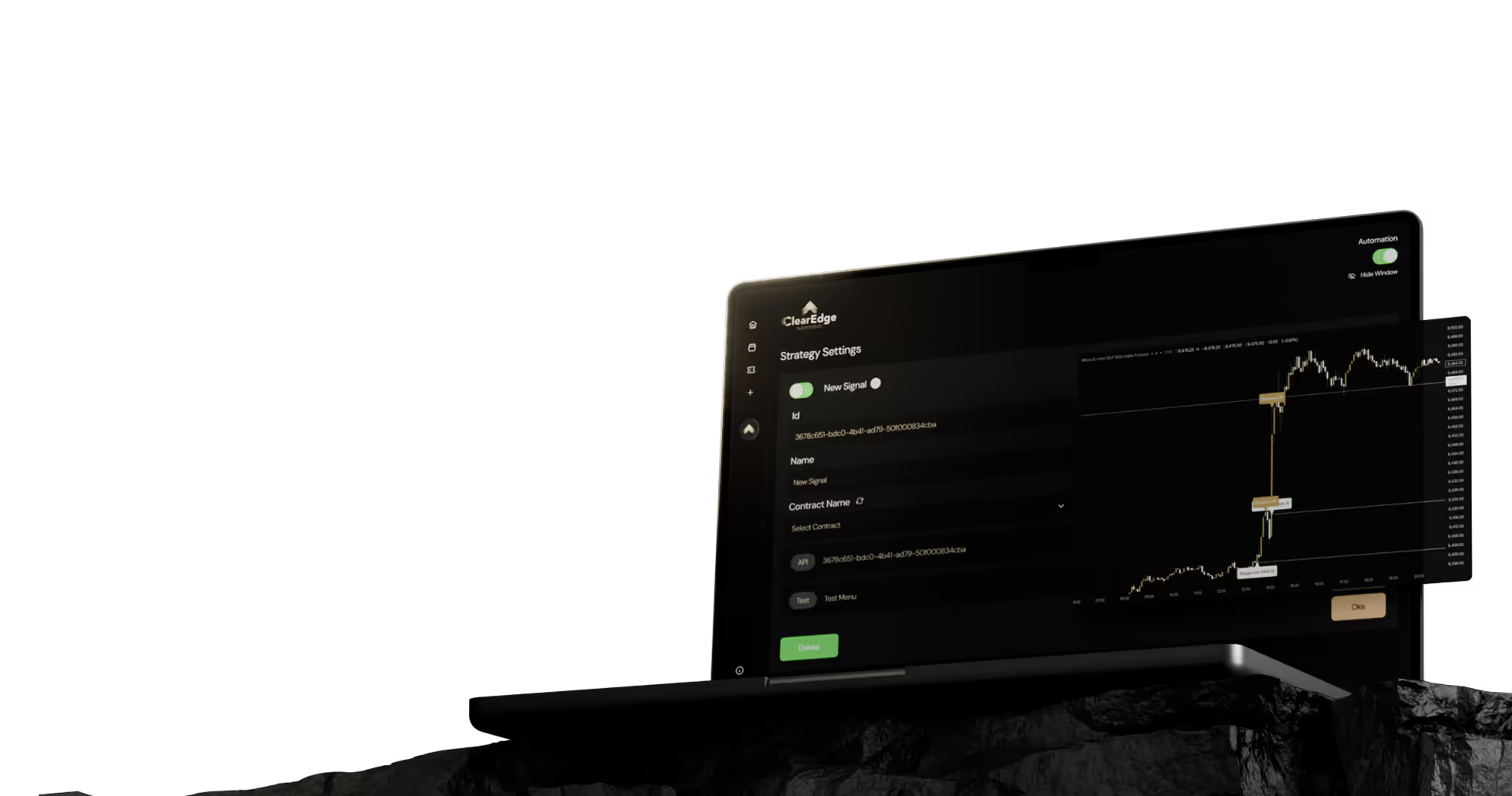
Platforms like ClearEdge connect TradingView alerts to 20+ broker integrations from one subscription, which collapses what used to require multiple tools into a single fee. For a list of brokers supported through a single connection, see supported brokers.
Webhook integration: A method where TradingView sends a JSON message to an automation platform when an alert fires, triggering a broker order. It matters because webhook reliability and routing speed determine whether your strategy executes at the price you backtested.
Are Cheap Platforms Compatible With Prop Firms?
Most budget platforms support major prop firms (Apex, Topstep, TradeDay, MyFundedFutures), but compatibility depends on whether the platform routes through Rithmic or Tradovate, the two main prop firm data providers. Prop firm traders should verify routing before subscribing, not after.
Key prop firm rules that automation must respect:
- Daily loss limits (typically 2-5% of account size)
- Trailing drawdown (3-6% from peak balance)
- Max position size by account size
- Consistency rules (no single day over 30-40% of total profit)
- News trading restrictions (varies by firm)
If your platform cannot enforce a hard daily loss stop or a trailing drawdown calculation in real time, the cheap monthly fee becomes expensive the first time you blow an evaluation. The prop firm automation guide covers rule compliance in detail, and the platform compatibility guide covers which platforms route to which firms.
Common Mistakes When Choosing on Price Alone
Three mistakes show up repeatedly when traders pick the absolute cheapest option:
- Ignoring latency. A $29 platform with 500ms+ webhook-to-order latency can cost more in slippage per week than the price difference to a faster $79 platform. ES at 1 tick of slippage per trade across 20 trades is $250.
- Picking a platform that does not support your broker. Switching brokers later means re-onboarding, data fees, and possibly losing prop firm progress.
- Skipping paper trading on the cheap plan. Some budget tiers disable live trading entirely. Read the plan limits, not just the price.
- Forgetting TradingView costs. The cheapest automation plan still needs at least TradingView Essential for webhook alerts.
Frequently Asked Questions
1. What is the absolute cheapest way to automate futures trading in 2026?
The cheapest viable path is a custom Python script using a broker API on a $20/month VPS, which has near-zero software cost but requires coding skills and ongoing maintenance. For non-coders, no-code platforms in the $50-$79/month range are the cheapest practical option.
2. Can I automate futures trading for free?
Free tiers exist on some platforms but typically restrict you to paper trading, a small number of webhooks, or a single broker. Free is fine for testing webhook connectivity, but live automation almost always requires a paid plan plus a paid TradingView subscription.
3. Is the cheapest futures automation platform 2026 also the best for prop firms?
Not usually. Prop firm trading needs hard daily loss enforcement, trailing drawdown tracking, and reliable Rithmic or Tradovate routing, features that mid-tier ($59-$99) plans handle better than budget plans. Cheap is fine for personal accounts; prop firms reward reliability over price.
4. How much does TradingView add to the total cost?
TradingView Essential is $14.95/month and is the minimum plan that supports webhook alerts. Most automated traders run Plus ($29.95) or Premium ($59.95) for more alerts and intraday timeframes.
5. Do I need a VPS for the cheapest setup?
A VPS is optional for most cloud-based no-code platforms because the platform itself runs in the cloud. A VPS becomes necessary for desktop platforms like NinjaTrader or for custom Python bots that need to run continuously without your home computer.
6. What is the real all-in monthly cost for a typical automated futures trader?
A realistic all-in for a single-account retail trader runs $90-$130/month: automation platform ($59-$79), TradingView Plus ($29.95), and broker data ($0-$15). Commissions and exchange fees are per-contract on top of that.
Conclusion
The cheapest futures automation platform 2026 by sticker price often is not the cheapest by outcome once TradingView, broker data, latency, and broker coverage are factored in. The value tier near $59-$99/month tends to deliver the best dollar-per-feature ratio for most retail and prop firm traders.
Before subscribing, run paper trades on the plan you are considering, confirm your broker is supported, and add up the all-in monthly cost. Do your own research and testing before trading live.
Ready to compare automation costs against features? View ClearEdge pricing and check supported brokers to confirm compatibility with your setup.
References
- CME Group. "E-mini S&P 500 Contract Specifications." cmegroup.com
- TradingView. "Pricing and Plans." tradingview.com
- CFTC. "Futures and Options Basics." cftc.gov
- NFA. "Investor Resources." nfa.futures.org
- Futures Industry Association. "Annual Volume Survey." fia.org
Disclaimer: This article is for educational and informational purposes only. It does not constitute trading advice, investment advice, or any recommendation to buy or sell futures contracts. ClearEdge Trading is a software platform that executes trades based on your predefined rules, it does not provide trading signals, strategies, or personalized recommendations.
Risk Warning: Futures trading involves substantial risk of loss and is not suitable for all investors. You could lose more than your initial investment. Past performance does not guarantee future results. Only trade with capital you can afford to lose.
CFTC RULE 4.41: Hypothetical or simulated performance results have certain limitations. Unlike an actual performance record, simulated results do not represent actual trading.
By: ClearEdge Trading Team | 29+ Years CME Floor Trading Experience | About














































Steal the PlaybooksOther TradersDon’t Share
Every week, we break down real strategies from traders with 100+ years of combined experience, so you can skip the line and trade without emotion.