How Herd Mentality Trading Automation Enables Independent Execution
Stop chasing the crowd and master independent execution. Automation removes herd mentality from your trading, ensuring decisions are based on data, not FOMO.


Herd mentality trading automation enables independent execution by removing crowd psychology from trading decisions. When markets panic or surge on collective emotion, automated systems execute based on predefined rules rather than following what other traders are doing. This separation between crowd behavior and trade execution helps traders stick to their own analysis instead of chasing consensus moves that often reverse.
Key Takeaways
- Herd mentality causes traders to abandon their own strategies and follow crowd behavior, often entering trades late and exiting at the worst times
- Automated systems execute independently of market sentiment because they respond only to predefined technical or rules-based triggers
- Research from the CFA Institute shows that behavioral biases like herd behavior account for a significant portion of retail trading losses
- Combining automation with a structured trading journal helps identify when crowd psychology previously influenced your manual decisions
- Independent execution through automation doesn't eliminate all risk, but it removes the specific risk of impulsive consensus-chasing
Table of Contents
- What Is Herd Mentality in Trading?
- Why Do Traders Follow the Crowd?
- How Does Automation Enable Independent Execution?
- What Cognitive Biases Drive Herd Behavior in Futures Markets?
- Building an Automated System That Ignores the Crowd
- Common Mistakes When Fighting Herd Mentality
- Frequently Asked Questions
- Conclusion
What Is Herd Mentality in Trading?
Herd mentality in trading is the tendency to mimic what other market participants are doing instead of following your own analysis. You see a sharp move, notice everyone on social media piling in, and suddenly your carefully planned strategy feels wrong. So you abandon it and chase the crowd.
Herd Mentality (Crowd Psychology): A behavioral pattern where individuals follow the actions of a larger group, often overriding their own independent analysis. In futures trading, this shows up as panic selling during drawdowns or FOMO buying during rallies.
This pattern repeats constantly in futures markets. When ES futures drop 50 points in a session, the instinct to sell everything feels overwhelming. When NQ rips higher on a tech earnings beat, the urge to go long even without a setup is hard to resist. The crowd creates a gravitational pull on your decision-making.
Here's the thing about herd behavior: it's not irrational in everyday life. Following the group kept humans alive for thousands of years. But in trading, the crowd is often wrong at exactly the moments when the pressure to join them is strongest. Market tops form when everyone is bullish. Bottoms form when everyone is panicking. Following the herd means you're frequently late to moves and positioned wrong for reversals.
A 2019 study published in the Journal of Behavioral Finance found that retail traders who exhibited strong herding behavior underperformed independent traders by an average of 3.4% annually [1]. That performance gap comes directly from poor timing driven by crowd psychology rather than strategy.
Why Do Traders Follow the Crowd?
Traders follow the crowd because the emotional cost of being wrong alone feels worse than being wrong with everyone else. This isn't a character flaw. It's hardwired into human psychology, and it intensifies when money is on the line.
Several specific mechanisms drive this behavior in futures markets:
Social proof under uncertainty. When you're unsure about a trade, seeing others take it reduces your uncertainty. If thousands of traders are buying CL futures after an OPEC announcement, your brain interprets that as validation. The problem is that social proof tells you nothing about whether the trade has a positive expected value from your entry point.
Fear of missing out (FOMO trading). Watching a move happen without you triggers loss aversion, the psychological pain of missing a gain. According to behavioral finance research, this pain of missing out can be nearly as intense as the pain of an actual loss [2]. So you enter late, with poor risk-reward, just to stop the discomfort of watching from the sidelines.
FOMO Trading: Entering trades driven by fear of missing a profitable move rather than by a valid setup or signal. FOMO entries typically have poor risk-reward ratios because the move has already occurred.
Information cascades. When enough traders act on the same narrative, it creates a self-reinforcing loop. Price moves in the direction of the herd, which appears to confirm the narrative, which attracts more followers. This cascade continues until it runs out of new buyers or sellers, then reverses sharply. Traders who followed the crowd get trapped.
Overconfidence after winning streaks. When recent trades have worked out, traders become overconfident and more susceptible to crowd behavior because they believe their judgment is strong. Ironically, this is exactly when discipline matters most. Winning streaks followed by herd-driven overconfidence often precede the largest drawdowns.
The combined effect of these biases is that manual traders constantly fight their own psychology. Every trade requires resisting the pull of what everyone else is doing. That mental energy creates trading fatigue that degrades decision quality throughout the session.
How Does Automation Enable Independent Execution?
Automation enables independent execution by creating a fixed barrier between crowd psychology and trade placement. An automated system doesn't know what other traders are doing, doesn't read social media, doesn't feel the urgency of a fast-moving market, and can't be pressured into abandoning its rules.
When you build automation around your trading strategy, here's what actually changes:
Your rules execute regardless of market sentiment. If your system is designed to short ES futures when a specific TradingView indicator fires at a resistance level, it takes that short even if every trader on Twitter is screaming about a breakout. The system doesn't care about consensus. It follows the rules you defined when you were calm and thinking clearly.
Entry and exit timing stays consistent. Manual traders following the herd typically enter late (after the crowd has already moved price) and exit early (when fear of reversal kicks in) or too late (when the crowd reversal has already started). Automated systems enter and exit at the exact conditions you specified. Consistency in timing is where much of the edge lives for strategies that work.
Position sizing remains disciplined. Herd mentality doesn't just affect direction. It affects size. During euphoric markets, manual traders often increase position sizes beyond their plan. During panics, they cut size or skip trades entirely. Automated position sizing stays fixed to your predetermined risk parameters regardless of how the crowd is behaving.
Independent Execution: Trade placement based solely on predefined rules and signals rather than on observed behavior of other market participants. Automation enforces independent execution by removing the human decision point where crowd influence enters.
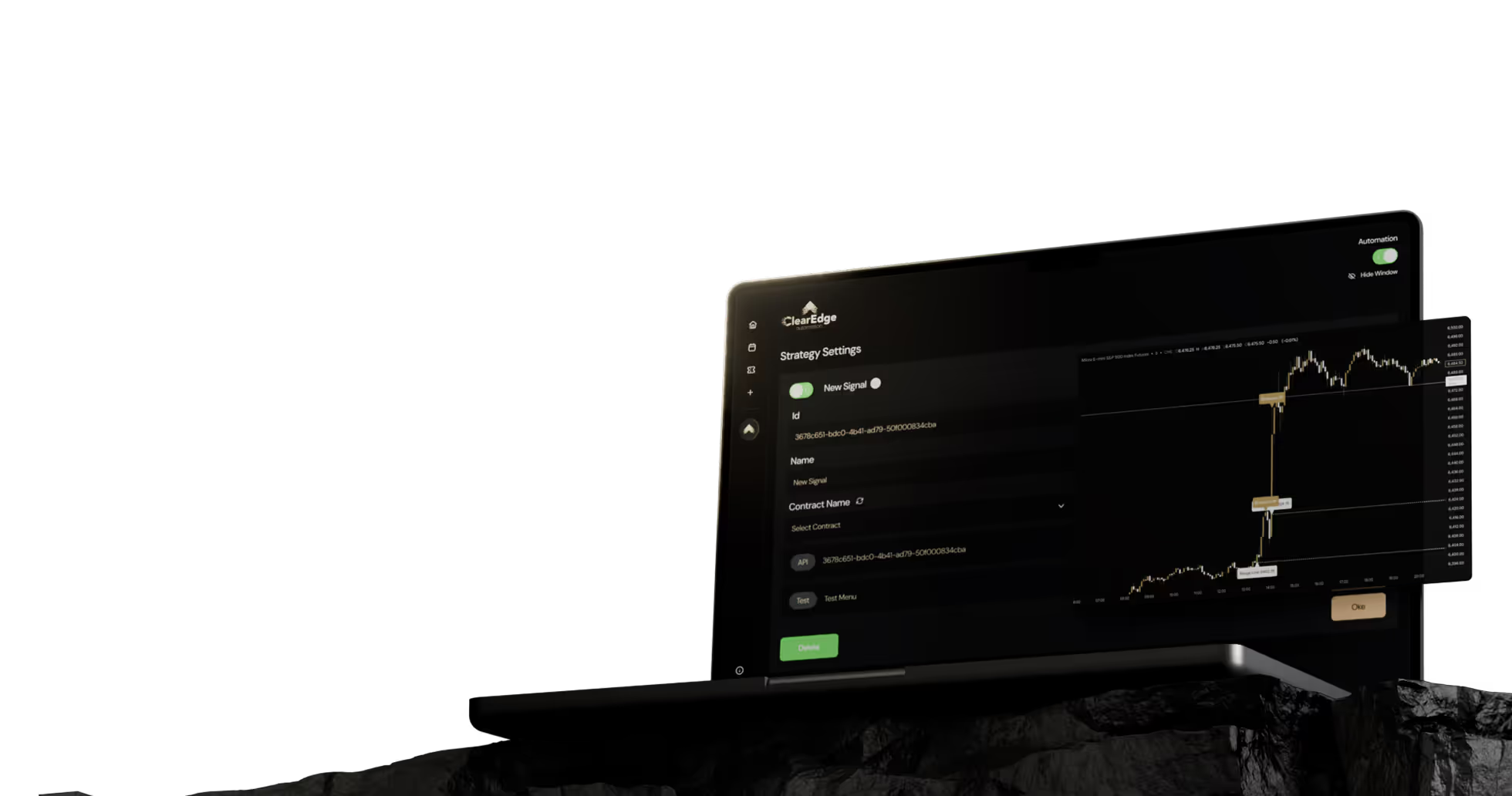
Platforms like ClearEdge Trading connect TradingView alerts to your broker, which means your strategy fires based on chart conditions, not market sentiment or crowd noise. The webhook triggers, the order goes out. There's no moment where you look at what others are doing and second-guess the signal.
That said, automation doesn't make bad strategies good. If your underlying rules are flawed, automation just executes the flaws consistently. The value is specifically in removing the herd-driven deviations from a strategy that has a genuine edge. As covered in our trading psychology automation guide, the goal is to remove emotions from trading decisions, not to remove thinking from strategy design.
What Cognitive Biases Drive Herd Behavior in Futures Markets?
Herd behavior in futures markets is driven by a cluster of cognitive biases that compound each other. Understanding each bias helps you design automation rules that specifically counteract them.
Loss aversion. Daniel Kahneman and Amos Tversky's prospect theory research showed that losses feel roughly twice as painful as equivalent gains feel good [3]. In a herding context, this means the fear of being the only person losing while the crowd profits creates disproportionate emotional pressure. Loss aversion makes traders abandon contrarian positions too early when the crowd moves against them, even when their analysis supports holding.
Recency bias. Traders overweight recent market events when making decisions. If the last three FOMC announcements triggered rallies, recency bias makes you expect the fourth will too, especially if everyone else expects it. Automation doesn't care about the last three results. It evaluates the current setup against your rules.
Confirmation bias. Once you've noticed the crowd leaning one direction, you start filtering information to confirm that direction. Bearish data gets dismissed. Bullish signals get amplified. Confirmation bias in trading narrows your information processing exactly when you need broad analysis most.
Anchoring to crowd consensus. Market commentators, social media, and even chat rooms create anchor points that influence your expectations. If the consensus target for NQ is 22,000, that number becomes your reference point even if your own analysis suggests otherwise. Anchoring to crowd-generated numbers pulls your independent analysis toward the herd.
Revenge trading after herd-driven losses. When following the crowd leads to a loss, the next impulse is often revenge trading to recover quickly. This leads to larger positions, looser stops, and more impulsive entries, all driven by the emotional aftermath of the original herd-following mistake. Automation with daily loss limits prevents this escalation cycle.
BiasHow It Triggers Herd BehaviorHow Automation Counteracts ItLoss aversionFear of missing crowd profitsExecutes rules regardless of what others are doingRecency biasAssumes recent crowd moves will repeatEvaluates only current market conditions vs. rulesConfirmation biasFilters info to match crowd directionUses objective indicator triggers, no filteringFOMOChases moves already underwayOnly enters at predefined signal conditionsRevenge tradingEscalates after herd-driven lossesDaily loss limits and position caps prevent spirals
Building an Automated System That Ignores the Crowd
Building automation for independent execution means designing rules that are completely self-contained, relying only on price data, indicators, and time-based conditions rather than sentiment or crowd behavior signals.
Step 1: Define entries using objective criteria only. Your entry signals should be based on things your system can measure directly: price levels, indicator crossovers, volume thresholds, or time-based triggers like the opening range. Avoid incorporating sentiment indicators unless they're quantified and backtested. "The market feels bullish" is not a rule. "RSI crosses above 30 on the 15-minute chart" is a rule.
Step 2: Set position sizes before the session. Decide position sizing based on account size and risk tolerance, not on how confident you feel about a particular trade. A fixed risk per trade (commonly 1-2% of account equity) prevents the tendency to size up when the crowd confirms your bias. This is where automated position sizing rules provide real protection.
Step 3: Build hard stops and targets into the automation. Every trade should have a stop loss and take profit level defined before entry. These should be based on market structure (support/resistance, ATR multiples, tick-based targets) rather than how the trade "feels" once you're in it. When GC futures spike $20 on a news event and the crowd is piling in, your automated stop still sits where your analysis placed it.
Step 4: Add daily loss limits. Daily loss limits are your circuit breaker against revenge trading after herd-driven mistakes. If you hit your maximum daily loss, the system stops trading. No exceptions. No "one more trade to make it back."
Step 5: Journal and review for herd influence. Keep a trading journal that specifically tracks whether manual overrides or deviations from your automated rules were influenced by crowd behavior. Over time, this record shows you exactly how much herd mentality costs you compared to pure systematic execution. Many traders are surprised by the data. Stress management becomes easier when you can see in black and white that your automated rules outperform your emotional overrides.
Trading Journal: A systematic record of trades including entry/exit reasoning, emotional state, and whether rules were followed. For traders combating herd mentality, journals reveal how often crowd psychology drove deviations from their plan.
Common Mistakes When Fighting Herd Mentality
Overriding automation during volatile sessions. The moments when you most want to override your system (sharp selloffs, parabolic rallies, news-driven chaos) are exactly when the system's independence provides the most value. Traders who pause automation during FOMC announcements because "this time is different" are reintroducing the herd influence their system was built to avoid. If your system shouldn't trade FOMC, build that rule into the automation itself rather than making it a manual decision.
Confusing contrarianism with independence. Independent execution doesn't mean always trading against the crowd. It means your decisions don't reference what the crowd is doing at all. Automatically fading every crowd move is just another form of herd dependency, you're still letting the crowd determine your behavior. True independent trading reacts to your signals, period.
Adding sentiment indicators without testing. Some traders add social media sentiment feeds or put/call ratios as inputs to their automation, hoping to "beat" the herd by reading it. These indicators can work, but only with rigorous backtesting. Untested sentiment inputs often just smuggle herd behavior back into your automated system through a more sophisticated-looking channel.
Ignoring the psychological adjustment period. Switching from manual to automated trading requires a mindset shift. You'll feel uncomfortable watching your system not trade when the crowd is active, or trading when the crowd is fearful. This discomfort is normal and fades with experience, but many traders abandon automation before they adjust. Patience in trading extends to patience with the automation process itself.
Frequently Asked Questions
1. How does herd mentality trading automation ensure independent execution?
Automated systems execute trades based only on predefined technical rules and conditions, with no input from market sentiment or crowd behavior. The system can't see what other traders are doing, so it's structurally incapable of following the herd.
2. Can automation completely eliminate herd mentality from my trading?
Automation eliminates herd influence from trade execution, but you can still introduce crowd bias during strategy design or by overriding the system manually. The discipline to let automation run without interference is the remaining psychological challenge.
3. What futures markets are most affected by herd behavior?
High-volume, high-visibility contracts like ES and NQ futures tend to show the strongest herd effects because they attract the most retail attention and social media commentary. Less-followed markets may have different herd dynamics driven more by institutional flows.
4. Does independent automated execution work during news events like FOMC or NFP?
It can, but news events create unique conditions (wide spreads, slippage, gaps) that may require separate rule sets. Many traders configure their automation to either pause during major news or use adjusted position sizes and wider stops.
5. How do I know if herd mentality is affecting my trading results?
Compare your actual trade results against what your rules would have produced without manual intervention. If your manual overrides consistently underperform the systematic signals, crowd psychology is likely a factor. A structured trading journal makes this comparison straightforward.
6. Is it possible to use crowd sentiment data in an automated system without falling into herd behavior?
Yes, but only if the sentiment data is quantified, backtested, and treated as one input among many rather than the primary driver. The distinction is between systematically measured sentiment (like the VIX or put/call ratio) and subjectively felt crowd pressure.
Conclusion
Herd mentality trading automation and independent execution work together by placing a structural barrier between crowd psychology and your order flow. Automated systems don't feel social pressure, don't experience FOMO, and don't abandon rules when the crowd moves against them. That independence is where consistent execution comes from.
If you're trading futures manually and suspect that crowd behavior is costing you money, start by journaling your overrides and comparing them against what your rules would have done. Then consider automating the rules that consistently outperform your discretionary decisions. Paper trade the automated version first to build confidence in the system before committing real capital.
Want to dig deeper? Read our complete guide to trading psychology automation for more on how automation addresses emotional trading patterns, or explore ClearEdge Trading's features to see how no-code automation connects to your TradingView strategies.
References
- Journal of Behavioral Finance - Herding Behavior and Trading Performance
- CFA Institute - Behavioral Finance: The Second Generation
- Kahneman, D. & Tversky, A. - Prospect Theory: An Analysis of Decision Under Risk
- CME Group - Introduction to Futures
- CFTC - Futures Market Basics
Disclaimer: This article is for educational purposes only. It is not trading advice. ClearEdge Trading executes trades based on your rules; it does not provide signals or recommendations.
Risk Warning: Futures trading involves substantial risk. You could lose more than your initial investment. Past performance does not guarantee future results. Only trade with capital you can afford to lose.
CFTC RULE 4.41: Hypothetical results have limitations and do not represent actual trading. Simulated results may not account for the impact of certain market factors such as lack of liquidity.
By: ClearEdge Trading Team | 29+ Years CME Floor Trading Experience | About Us























































Steal the PlaybooksOther TradersDon’t Share
Every week, we break down real strategies from traders with 100+ years of combined experience, so you can skip the line and trade without emotion.