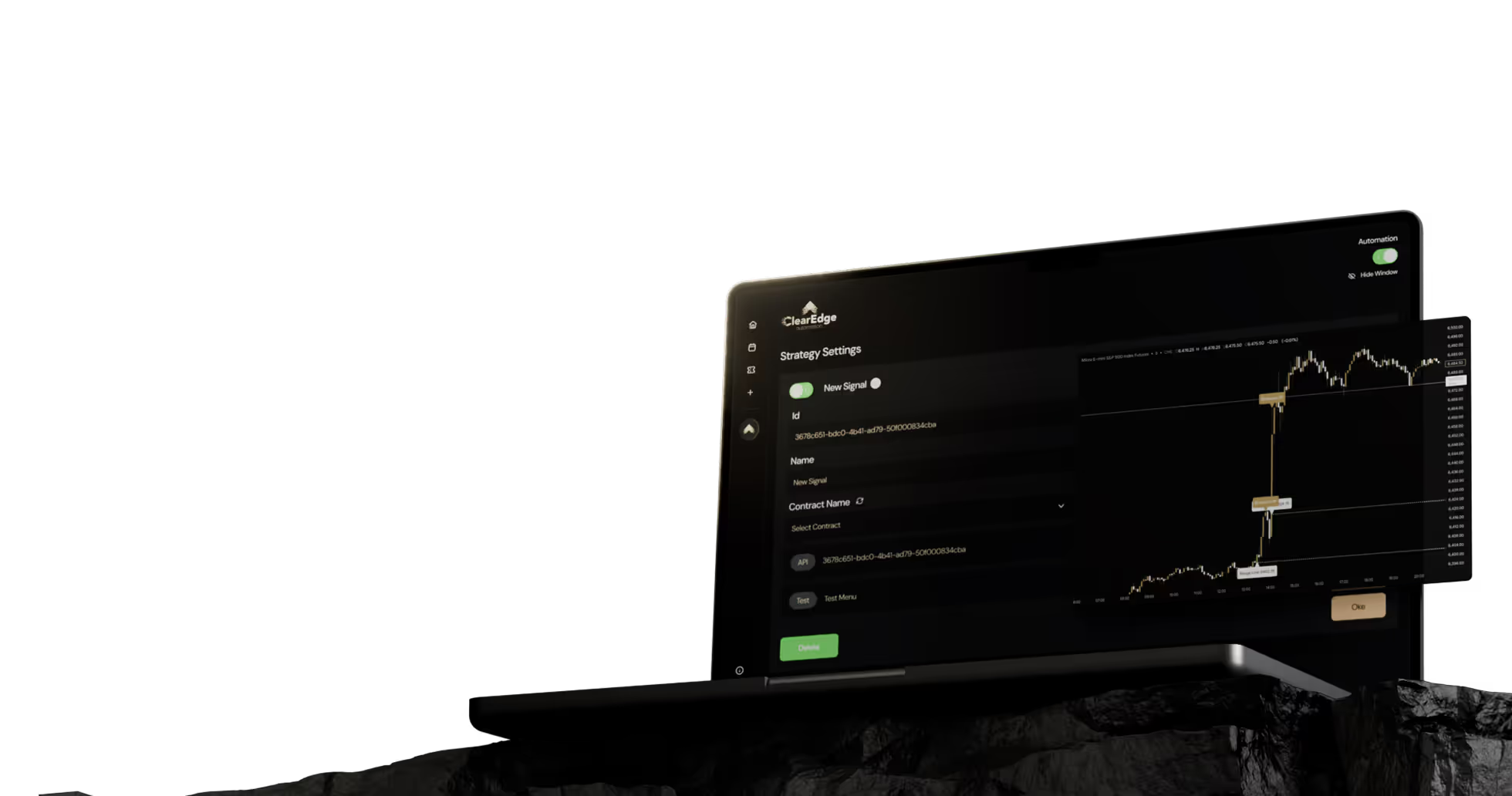
Prop Firm Automation Compliance Monitoring Dashboard: Avoid Rule Violations
Stop losing funded accounts to rule violations. A real-time compliance dashboard tracks drawdown, daily loss limits, and consistency rules to protect you.


A prop firm automation compliance monitoring dashboard is a centralized interface that tracks your automated trading system's adherence to prop firm rules in real time. It displays metrics like daily loss limits, trailing drawdown, consistency ratios, and position sizes so you can catch violations before they happen. Building or configuring one properly can mean the difference between keeping a funded account and losing it.
Key Takeaways
- A compliance monitoring dashboard tracks daily loss limits, trailing drawdown, consistency rules, and position sizes in one place, giving you real-time visibility into rule adherence.
- Most prop firm rule violations happen because traders lack real-time awareness of where they stand relative to firm thresholds, not because their strategy is flawed.
- Automated alerts tied to 70-80% of your daily loss limit or drawdown threshold give you a buffer zone to shut down trading before a violation occurs.
- Tracking consistency metrics daily (not weekly) prevents the common mistake of concentrating too much profit in a single session.
- Dashboards that log every trade with timestamps and rule-state snapshots make it easier to diagnose what went wrong after a close call.
Table of Contents
- What Is a Prop Firm Automation Compliance Monitoring Dashboard?
- Why Manual Rule Tracking Fails at Scale
- What Metrics Should Your Dashboard Track?
- How to Build or Configure a Compliance Dashboard
- Setting Alert Thresholds That Actually Protect You
- Common Dashboard Mistakes That Cause Rule Violations
- Frequently Asked Questions
- Conclusion
What Is a Prop Firm Automation Compliance Monitoring Dashboard?
A prop firm automation compliance monitoring dashboard is a real-time interface that aggregates your account data, open positions, and trade history against the specific rules your prop firm enforces. It shows you, at a glance, how close you are to hitting any rule boundary. Think of it as the instrument panel in a cockpit: you need to see airspeed, altitude, and fuel simultaneously, not one at a time.
Compliance Monitoring Dashboard: A real-time display that compares your current account state (P&L, drawdown, position count, trading days) against prop firm rule limits. It helps automated and semi-automated traders avoid rule violations that would cost them their funded account.
Most prop firms publish their rules clearly: daily loss limits of 2-5%, trailing drawdown caps of 3-6%, consistency rules that prevent any single day from exceeding 30-40% of total profits, and news trading restrictions around events like FOMC or NFP. The problem isn't knowing the rules. The problem is knowing where you stand relative to those rules at any given moment during a live trading session.
When you're running a prop firm trading bot or any form of funded account automation, the system executes trades fast. A string of losing trades during a volatile CPI release can eat through 3% of your account in minutes. Without a dashboard updating in real time, you won't know you've breached your daily loss limit until it's too late.
Why Manual Rule Tracking Fails at Scale
Manual rule tracking breaks down the moment you manage more than one prop firm account or run more than one strategy. The math isn't hard on any single rule in isolation. But tracking a trailing drawdown that resets on new equity highs, while simultaneously watching a consistency rule that looks at profit distribution across days, while also respecting position size limits and news blackout windows, creates a cognitive load that compounds errors.
According to data from multiple prop firm communities, the most common reason traders lose funded accounts isn't a bad strategy. It's a rule violation they didn't see coming. A 2025 survey by MyForexFunds (before its restructuring) found that roughly 40% of account failures came from drawdown breaches, not from strategies that simply didn't work [1]. The strategy made money overall, but a single bad day exceeded the daily loss limit.
Trailing Drawdown: A maximum loss threshold that moves upward with your account's high-water mark but never moves down. If your account peaks at $53,000 with a $3,000 trailing drawdown, your floor is $50,000. If the account later peaks at $55,000, the floor rises to $52,000. This makes it progressively tighter as you profit.
When you're running multiple prop firm accounts with automation, the problem multiplies. Each account has its own drawdown state, its own daily P&L, its own consistency clock. A dashboard that consolidates all of this into one view is the difference between organized trading and guesswork.
What Metrics Should Your Compliance Monitoring Dashboard Track?
Your dashboard needs to track every rule your prop firm enforces, updated in real time or near-real time. Here's what that looks like for most firms:
MetricWhat It TracksTypical ThresholdUpdate FrequencyDaily P&LNet profit/loss for current session-2% to -5% of starting balanceEvery tradeTrailing DrawdownDistance from equity high to current equity-3% to -6% from peakEvery tick (ideally)Max Position SizeCurrent open contracts vs. allowed maxVaries by firm and account sizeEvery tradeConsistency RatioBest single-day profit vs. total profitNo day > 30-40% of totalEnd of dayMinimum Trading DaysDays traded vs. required minimum5-10 days typicallyDailyNews Window StatusWhether trading is allowed right nowOften restricted ±2 min around major releasesReal timeProfit Target ProgressCurrent profit vs. evaluation target6-10% typicallyEvery tradePayout EligibilityWhether all conditions for withdrawal are metVaries by payout scheduleDaily
The trailing drawdown metric deserves extra attention. It's the rule that catches the most traders off-guard because it's dynamic. A static daily loss limit is straightforward: you started the day at $50,000, and you can't go below $49,000. But a trailing drawdown moves with you. If you're up $1,000 intraday and then give it all back, you've effectively used $1,000 of your drawdown buffer without the day's P&L looking particularly bad. Your trailing drawdown automation needs to account for intraday high-water marks, not just end-of-day balances.
Consistency Rule: A prop firm rule requiring that no single trading day accounts for more than a set percentage (typically 30-40%) of your total profits. This prevents traders from passing evaluations with one lucky day and encourages repeatable performance.
For the consistency rule, your dashboard should display both the current ratio and a projection. If you're on day 3 of an evaluation with $2,000 in total profit and $900 came from day 1, that's a 45% concentration. You need to see that number and know you need more profitable days to dilute it below the threshold before the evaluation phase ends.
How to Build or Configure a Prop Firm Automation Compliance Monitoring Dashboard
You have three main paths to get a working compliance monitoring dashboard: use your prop firm's built-in tools, configure features within your automation platform, or build a custom solution using spreadsheets or lightweight code. Each has tradeoffs.
Option 1: Prop Firm Native Dashboards
Most established prop firms (FTMO, Topstep, Apex Trader Funding, etc.) provide account dashboards that show your current drawdown, daily P&L, and trading day count. These are useful but have a lag problem. Many update every few minutes rather than in real time, and they don't integrate with your automation system. If your prop firm trading bot places 15 trades per hour, a dashboard that updates every 5 minutes can be dangerously behind.
Option 2: Automation Platform Compliance Features
Some automation platforms include built-in daily loss limit enforcement and drawdown tracking. These are more useful because they operate at the execution layer. When your system hits 80% of the daily loss limit, the platform can pause trading automatically. ClearEdge Trading, for instance, includes risk management controls that can enforce position limits and daily loss caps at the execution level, which means the rule gets enforced before the trade goes out, not after.
Option 3: Custom Dashboard
For traders managing multiple accounts or using FTMO automation alongside other firms, a custom dashboard built with Google Sheets, a simple Python script, or a tool like Grafana can pull trade data from your broker's API and calculate compliance metrics in real time. This approach requires more setup effort but gives you full control over what gets tracked and how alerts are triggered.
Minimum Viable Dashboard Checklist
- Real-time daily P&L with color-coded warning at 70% and 90% of daily loss limit
- Trailing drawdown calculator that tracks intraday equity peaks
- Open position counter with hard limit display
- Calendar widget showing news blackout windows
- Trading day counter with minimum day requirement
- Consistency ratio tracker with per-day profit breakdown
- Trade log with timestamps for audit trail
Setting Alert Thresholds That Actually Protect You
The point of a compliance monitoring dashboard isn't just to display numbers. It's to trigger protective actions before you hit a rule boundary. Setting alert thresholds at the rule limit itself is useless because by the time you see the alert, you've already violated the rule. You need buffer zones.
Here's a framework that works for most prop firm rules automation setups:
Alert LevelThresholdActionYellow (Warning)60-70% of limitReduce position size by 50%Orange (Caution)80% of limitClose open positions, switch to smallest allowed sizeRed (Critical)90% of limitHalt all new trades, flatten positions
For a $50,000 account with a $2,500 daily loss limit (5%), your yellow alert fires at -$1,500, orange at -$2,000, and red at -$2,250. That red threshold gives you $250 of buffer, which matters when you're trading ES futures where a single tick is $12.50 and slippage during fast markets can add several ticks per trade.
The alerts should be automated, not just visual. If your prop firm automation compliance monitoring dashboard only shows you a red banner, you still have to manually shut things down. The better approach is to connect your alerts to your execution system so the red level automatically flattens positions and disables the webhook. Platforms that support automated daily loss limit enforcement handle this at the infrastructure level.
Daily Loss Limit: The maximum amount a trader can lose in a single trading day before being required to stop. In prop firm contexts, breaching this limit typically results in account termination or a failed evaluation. Common thresholds range from 2-5% of account balance.
Common Dashboard Mistakes That Cause Rule Violations
Even traders who build or configure a compliance dashboard make errors that undermine its purpose. Here are the ones that come up most often:
1. Tracking end-of-day balances instead of intraday peaks. Trailing drawdown at most firms tracks from your intraday equity high, not your closing balance. If your account hit $52,000 during the session but closed at $50,500, your drawdown floor moved up to $52,000 minus the drawdown allowance. Dashboards that only pull daily close data miss this entirely. See our drawdown rules compliance guide for more on this distinction.
2. Not accounting for commissions and fees in P&L calculations. Your dashboard might show you're at -$2,400 on a $2,500 daily loss limit, but if commissions add another $150 across your trades that day, you've already breached it. Always calculate P&L inclusive of commissions.
3. Ignoring the consistency rule until the end of the evaluation phase. Traders focus on profit targets and drawdown limits but forget to monitor profit distribution. By day 8 of a 10-day evaluation, if 45% of your profit came from day 2, you may not have enough remaining days to dilute that concentration below the consistency threshold.
4. Running the dashboard on a different data feed than your automation. If your prop firm trading bot uses one data source and your dashboard pulls from another, discrepancies in P&L calculations can mask your real position. Use the same broker account data for both.
Frequently Asked Questions
1. Can I use a spreadsheet as a prop firm compliance monitoring dashboard?
Yes, Google Sheets or Excel connected to your broker's API via a script can work for basic rule tracking. The limitation is update speed: spreadsheet-based dashboards typically refresh every 30-60 seconds, which may not be fast enough during volatile markets like CPI or NFP releases.
2. Do most prop firms provide their own compliance dashboards?
Most firms offer account dashboards showing drawdown and P&L, but they often update with a delay and don't integrate with your automation system. For real-time rule tracking tied to automated execution, you typically need a third-party solution or platform-level risk controls.
3. How does trailing drawdown tracking differ from daily loss limit tracking?
Daily loss limits reset each day and measure from your starting balance. Trailing drawdown is cumulative across the entire evaluation or funded period and moves upward with your account's peak equity but never moves down, making it progressively tighter as you profit.
4. What happens if my dashboard shows I'm close to a rule limit during an open trade?
Your automation should have pre-configured rules to reduce size or flatten positions when approaching thresholds. Waiting until a trade closes to check compliance is too late because the breach occurs the moment your equity crosses the line, not when you close the position.
5. Should I build separate dashboards for each prop firm account?
If you're managing multiple accounts, a single consolidated dashboard with per-account tabs or panels is more practical than separate tools. Each account section needs its own rule parameters since firms like FTMO and Topstep have different thresholds and rule structures.
6. How often should a compliance dashboard update during live trading?
For daily loss limits and trailing drawdown, every trade execution (or every few seconds during open positions) is the standard. Consistency rule metrics and trading day counts can update at end of day since they don't change intraday.
Conclusion
A prop firm automation compliance monitoring dashboard isn't optional if you're running automated strategies on funded accounts. It's the layer between your execution system and account termination. The traders who keep funded accounts long-term are the ones who treat rule tracking with the same rigor they apply to strategy development.
Start with the metrics your specific firm enforces, set alert thresholds at 70%, 80%, and 90% of each limit, and connect those alerts to automated protective actions. For a broader view of how automation fits into prop firm trading, read the complete prop firm automation guide.
Want to dig deeper? Read our complete guide to prop firm automation for more detailed setup instructions and strategies.
References
- CFTC - Proprietary Trading Firm Advisory
- CME Group - Understanding Futures Margins
- NFA - Risk Management for Trading Firms
- Investopedia - Drawdown Definition and Measurement
Disclaimer: This article is for educational purposes only. It is not trading advice. ClearEdge Trading executes trades based on your rules; it does not provide signals or recommendations.
Risk Warning: Futures trading involves substantial risk. You could lose more than your initial investment. Past performance does not guarantee future results. Only trade with capital you can afford to lose.
CFTC RULE 4.41: Hypothetical results have limitations and do not represent actual trading.
By: ClearEdge Trading Team | About























































Steal the PlaybooksOther TradersDon’t Share
Every week, we break down real strategies from traders with 100+ years of combined experience, so you can skip the line and trade without emotion.