Prop Firm Daily Loss Limit Automation Settings Guide
Protect your funded account by automating prop firm daily loss limits. Configure buffer zones and risk parameters to prevent violations and manage trailing rules.


Prop firm daily loss limit automation settings are risk management parameters configured in your trading automation platform to enforce the maximum daily loss threshold required by proprietary trading firms, typically 2-5% of account balance. These settings automatically halt trading when your daily loss approaches or reaches the firm's limit, protecting you from rule violations that would disqualify you from funded account evaluations or result in account termination.
Key Takeaways
- Daily loss limits for prop firms typically range from 2-5% of starting balance, with most firms using $1,000-$2,500 limits on $50,000 accounts
- Automation settings should trigger 10-20% before the actual limit to account for slippage and pending orders
- Trailing vs. static daily loss calculations require different automation configurations—verify your firm's specific rule type
- Emergency stop-loss settings at the platform level provide backup protection if individual trade stops fail
Table of Contents
- What Are Prop Firm Daily Loss Limits?
- Why Automation Settings Matter for Daily Loss Limits
- How to Configure Daily Loss Limit Automation
- Static vs. Trailing Daily Loss Calculations
- Setting Appropriate Buffer Zones
- Testing Your Daily Loss Limit Settings
- Common Configuration Mistakes to Avoid
- Frequently Asked Questions
What Are Prop Firm Daily Loss Limits?
A daily loss limit is the maximum amount a trader can lose in a single trading day before violating prop firm rules. Most proprietary trading firms set this limit at 2-5% of the initial account balance, regardless of current equity. For example, a $50,000 evaluation account with a 5% daily loss limit means you cannot lose more than $2,500 in any single day.
Daily Loss Limit: The maximum permissible loss amount within a single trading day (typically calculated from midnight to midnight exchange time or from the start of your trading session). Exceeding this threshold results in immediate evaluation failure or funded account termination.
The calculation method varies by firm. Some use static calculations based on starting balance, while others employ trailing calculations based on the day's highest equity point. Understanding your specific firm's methodology is critical before configuring automation settings.
Common daily loss limits across major prop firms include FTMO at $2,500 on $50,000 accounts (5%), TopstepTrader at $1,000-$2,000 depending on account size, and The5ers at 4% of starting balance. These thresholds apply during both evaluation phases and funded trading.
Why Automation Settings Matter for Daily Loss Limits
Manual monitoring of daily loss limits creates risk during fast-moving markets when emotions run high. Automation removes the hesitation and calculation errors that occur when traders approach their daily limit. By the time you manually calculate your loss and decide to stop, you may have already violated the rule.
Execution speed becomes critical during losing streaks. If you're down $2,300 on a $2,500 limit and enter another trade, market slippage of 2-3 ticks on ES futures ($25-$37.50) could push you over the threshold before you can react. Prop firm automation platforms calculate losses in real-time and prevent new positions when you approach the limit.
The psychological benefit matters as much as the technical protection. Knowing your automation will enforce the limit lets you focus on trade execution rather than constantly calculating remaining room. This reduces the temptation to take "one more trade" to recover losses.
Monitoring MethodReaction TimeAccuracyEmotional ImpactManual tracking15-60 secondsProne to calculation errorsHigh stress, poor decisionsBroker platform alerts5-15 secondsDepends on configurationRequires discipline to stopAutomation platformImmediate (milliseconds)Precise real-time calculationRemoves emotion from decision
How to Configure Daily Loss Limit Automation
Configure your daily loss limit settings before you take any live trades. The process involves setting your firm's specific threshold, choosing buffer zones, and testing the automation in simulation mode. Most platforms require you to input the dollar amount rather than a percentage.
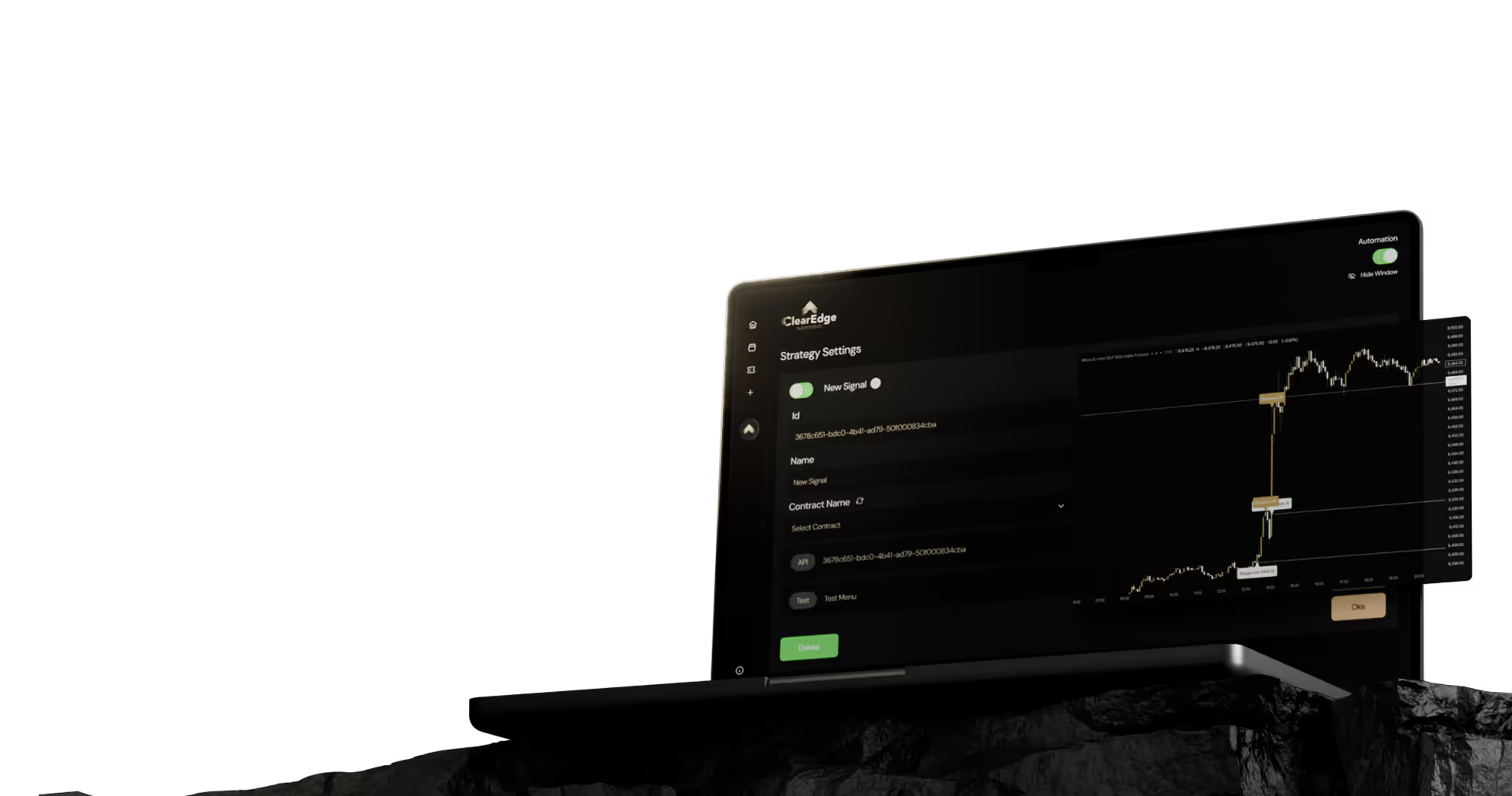
First, identify your prop firm's exact daily loss limit in dollar terms. A $50,000 account with a 5% limit equals $2,500. Enter this value in your automation platform's risk settings section. Platforms like ClearEdge Trading include dedicated prop firm rule templates that pre-configure these values for major firms.
Buffer Zone: A safety margin set below the actual daily loss limit where automation begins restricting or halting trading activity. A 10-20% buffer is standard practice to account for slippage and pending order fills.
Second, set your buffer zone. If your limit is $2,500, configure the automation to stop trading at $2,250-$2,375 (10-15% buffer). This accounts for the time between when a stop loss is triggered and when it actually fills, which can be 1-5 ticks depending on market conditions.
Third, specify whether the calculation should be static (from starting balance) or trailing (from daily high). Your prop firm's rules documentation will clarify which method they use. Most firms use static calculations, but verify before configuring.
Daily Loss Limit Configuration Checklist
- ☐ Confirm exact daily loss limit dollar amount from prop firm rules
- ☐ Determine if calculation is static or trailing
- ☐ Set automation stop threshold 10-20% before actual limit
- ☐ Configure emergency position flattening if threshold is reached
- ☐ Enable real-time P&L tracking and alert notifications
- ☐ Test settings in simulation mode for 5-10 trading days
- ☐ Verify all pending orders cancel when limit is approached
Static vs. Trailing Daily Loss Calculations
Static daily loss limits calculate from your starting balance at the beginning of the trading day. If you start with $50,000 and have a $2,500 limit, you hit the threshold when your account reaches $47,500, regardless of whether you were up $1,000 earlier in the day. Trailing daily loss limits calculate from the highest equity point reached during the day.
With a trailing calculation, if your account grows to $51,000 during the day, then a $2,500 trailing daily loss limit means you cannot drop below $48,500 ($51,000 - $2,500). This "locks in" some of your gains and can trigger violations even when you're still profitable for the day. FTMO and several other major firms use trailing calculations, which require more sophisticated automation.
Your automation settings must match the firm's calculation method exactly. Configuring for static when the firm uses trailing creates a false sense of security. You might think you have $500 of room remaining, but the firm's system shows you already violated the rule.
For trailing calculations, your automation platform needs to track intraday equity peaks and recalculate the threshold continuously. Automated trading platforms designed for prop firm compliance include this functionality, updating the stop threshold every time your account reaches a new daily high.
ScenarioStatic Limit ($2,500)Trailing Limit ($2,500)Start: $50,000 → Peak: $51,500 → Current: $49,500Loss: $500 (safe)Loss: $2,000 from peak (safe)Start: $50,000 → Peak: $51,000 → Current: $48,000Loss: $2,000 (safe)Loss: $3,000 from peak (VIOLATION)Start: $50,000 → No profit → Current: $47,400Loss: $2,600 (VIOLATION)Loss: $2,600 (VIOLATION)
Setting Appropriate Buffer Zones
Buffer zones protect against the execution gap between when your automation triggers a stop and when that stop actually fills. In volatile markets during economic announcements, slippage of 5-10 ticks on liquid contracts like ES is possible. That represents $62.50-$125 per contract, which matters when you're close to your daily limit.
A standard buffer zone ranges from 10-20% of your daily loss limit. On a $2,500 limit, configure your automation to halt trading at $2,250 (10% buffer) or $2,125 (15% buffer). Traders who use larger position sizes or trade during high-volatility sessions should use wider buffers. If you typically trade 3-5 ES contracts, a 15-20% buffer provides better protection.
The buffer should also account for multiple simultaneous positions. If you run strategies on ES and NQ at the same time, both positions could hit stops nearly simultaneously. Two 2-contract positions experiencing 5 ticks of slippage each represents $125 of additional loss beyond your calculated threshold.
Wider Buffer Advantages
- Better protection against slippage during volatility
- Accommodates multiple simultaneous positions
- Reduces violation risk during fast markets
- Allows for pending order fills
Wider Buffer Limitations
- Reduces effective trading room by 15-20%
- May stop you out prematurely on recoverable days
- Limits aggressive position sizing strategies
- Can trigger false stops on calculation delays
Testing Your Daily Loss Limit Settings
Test your daily loss limit automation in simulation mode before risking evaluation fees. Most automation platforms offer replay mode or paper trading that simulates real market conditions. Run your system for at least 5-10 trading days, deliberately creating scenarios where you approach the daily limit.
Create test scenarios that push boundaries. Enter positions that would violate the limit if they all hit stops. Verify that your automation prevents new entries when you're within the buffer zone. Check that all pending orders cancel automatically when the threshold triggers.
Pay special attention to how the system handles open positions when you approach the limit. Some platforms close all positions immediately, while others prevent new trades but let existing positions run. Know which behavior your configuration produces, and verify it matches your prop firm's rules about position management at threshold points.
Document each test with screenshots showing the P&L at the time automation triggered, the exact threshold setting, and how the system responded. This documentation proves valuable if you ever need to dispute a violation with your prop firm.
Common Configuration Mistakes to Avoid
The most frequent mistake is setting the limit at exactly the firm's threshold with no buffer. Traders configure $2,500 when that's the maximum allowed, then exceed it due to slippage. Always set your automation trigger 10-20% below the actual limit.
Another common error is forgetting to account for commissions and fees in the daily loss calculation. If your prop firm includes commissions in the daily loss (most do), and you pay $4.50 round-turn per contract, twenty trades means $90 in fees that count toward your limit. Configure your automation to track total P&L including all costs.
Traders also misconfigure static versus trailing calculations. Using static settings when your firm employs trailing calculations creates a dangerous blind spot. You think you have room to trade, but the firm's system already flagged a violation.
Finally, many traders fail to test how their automation handles end-of-day rollover. If you hold positions overnight and the platform resets the daily loss calculation at midnight, verify that your open position's unrealized P&L carries forward correctly into the next day's calculation.
Frequently Asked Questions
1. What happens if I hit my daily loss limit during the evaluation phase?
Hitting the daily loss limit results in immediate evaluation failure with most prop firms. Your account is terminated, and you must purchase a new evaluation challenge if you want to try again. Some firms allow one-time resets for a fee, but daily loss violations typically do not qualify for this option.
2. Do daily loss limits reset at midnight exchange time or when I start trading?
Most prop firms reset daily loss limits at midnight exchange time (typically 5:00 PM ET for CME futures). This reset occurs regardless of whether you're holding positions or actively trading. Some firms use a session-based reset tied to when you open your first trade, so verify your specific firm's policy.
3. Should I set different buffer zones for volatile market days versus normal days?
Yes, adjusting buffers based on market conditions is prudent. On FOMC days or during major economic releases, increase your buffer from 10% to 15-20% to account for wider spreads and increased slippage. Most automation platforms allow you to create event-specific profiles that activate automatically.
4. How do I configure daily loss limits when trading multiple prop firm accounts simultaneously?
Configure each account's daily loss limit independently in your automation platform. Platforms like ClearEdge Trading support multi-account management with separate risk parameters per account. Set alerts to notify you when any single account approaches its threshold, preventing you from violating one while focused on another.
5. Can I manually override the daily loss limit automation if I believe I can recover?
While most platforms allow manual overrides, doing so defeats the purpose of automation and significantly increases violation risk. The emotional state that makes you want to override is exactly when you need the protection most. If you frequently feel the need to override, your position sizing or strategy needs adjustment rather than your automation settings.
Conclusion
Configuring proper daily loss limit automation settings is non-negotiable for prop firm trading success. Set your thresholds 10-20% below the firm's actual limit, match the calculation method (static vs. trailing) exactly, and test thoroughly in simulation before going live. These settings remove emotion from risk management and protect your evaluation investment.
Start by documenting your specific prop firm's rules, then configure your automation platform with appropriate buffers. Test your settings across various market conditions to verify they function correctly before risking real capital.
Automate your prop firm risk management. View ClearEdge Pricing →
References
- CME Group. "E-mini S&P 500 Futures Contract Specs." https://www.cmegroup.com/markets/equities/sp/e-mini-sandp500.html
- CFTC. "Risk Disclosure Statement for Futures and Options." https://www.cftc.gov/ConsumerProtection/EducationCenter/RiskDisclosureStatement
- Futures Industry Association. "Algorithmic Trading in Futures Markets." https://www.fia.org/resources/algorithmic-trading-futures-markets
- NFA. "Investor Advisory: Trading in Volatile Markets." https://www.nfa.futures.org/investors/investor-advisory-trading-volatile-markets
Disclaimer: This article is for educational purposes only. It is not trading advice. ClearEdge Trading executes trades based on your rules—it does not provide signals or recommendations.
Risk Warning: Futures trading involves substantial risk. You could lose more than your initial investment. Past performance does not guarantee future results. Only trade with capital you can afford to lose.
CFTC RULE 4.41: Hypothetical results have limitations and do not represent actual trading.
By: ClearEdge Trading Team | About























































Steal the PlaybooksOther TradersDon’t Share
Every week, we break down real strategies from traders with 100+ years of combined experience, so you can skip the line and trade without emotion.