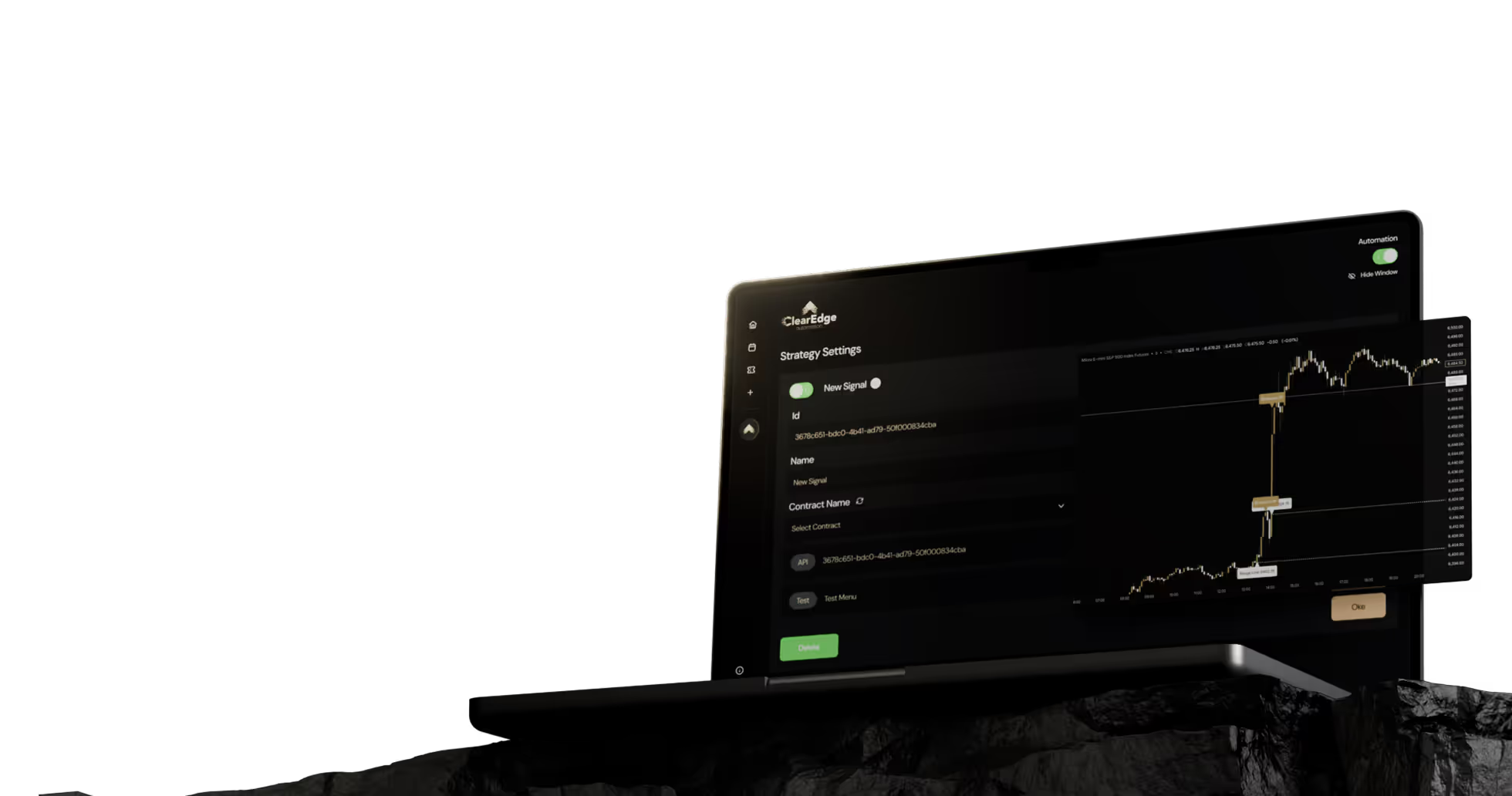
RSI Automated Futures Trading: Overbought And Oversold Strategies
Automate Relative Strength Index signals to trade futures with precision. Calibrate RSI overbought and oversold levels for ES and NQ to remove execution delays.


RSI automated futures trading using overbought and oversold strategies involves programming your system to generate buy or sell signals when the Relative Strength Index crosses predefined thresholds, typically 70 (overbought) and 30 (oversold). Automating these RSI signals removes hesitation from entries and exits, letting your predefined rules execute consistently across ES, NQ, GC, and CL futures contracts without manual intervention.
Key Takeaways
- Standard RSI overbought/oversold levels (70/30) often need adjustment for futures markets. Many traders use 80/20 for trending instruments like NQ and 65/35 for range-bound sessions.
- Automating RSI signals through TradingView alerts and webhook execution eliminates the 2-5 second manual reaction delay that causes missed entries and worse fills.
- RSI divergence detection paired with overbought/oversold readings improves signal quality compared to single-threshold triggers alone.
- Backtesting RSI automated strategies across at least 500 trades and multiple market conditions is necessary before deploying real capital.
- Combining RSI with one confirming indicator (such as volume or a moving average) reduces false signals by roughly 20-40% depending on the instrument and timeframe.
Table of Contents
- What Is RSI Overbought/Oversold Trading in Futures?
- How Does RSI Automated Futures Trading Work?
- Which RSI Settings Work Best for Different Futures Contracts?
- Building an RSI Overbought Oversold Strategy for Automation
- How to Confirm RSI Signals Before Automating Entries
- Common RSI Automation Mistakes to Avoid
- Frequently Asked Questions
- Conclusion
What Is RSI Overbought/Oversold Trading in Futures?
The Relative Strength Index (RSI) is a momentum oscillator that measures the speed and magnitude of recent price changes on a scale from 0 to 100. When RSI rises above 70, the instrument is considered overbought and may be due for a pullback. When it drops below 30, it is considered oversold and may be primed for a bounce. In an RSI automated futures trading overbought oversold strategy, your system monitors these levels and executes trades without waiting for you to click a button.
RSI (Relative Strength Index): A momentum indicator developed by J. Welles Wilder Jr. in 1978 that calculates the ratio of recent gains to recent losses over a lookback period, typically 14 bars. Futures traders use it to identify potential reversal zones where price may have moved too far, too fast.
Here's the thing about RSI in futures specifically: futures contracts like ES and NQ can stay overbought or oversold far longer than equities because of leverage, overnight sessions, and macro-driven momentum. A stock RSI strategy ported directly to ES futures will often produce poor results. The overbought oversold thresholds, the lookback period, and the exit logic all need calibration for the specific contract you're trading.
Overbought: A condition where RSI exceeds a set upper threshold (commonly 70), suggesting buying momentum may be exhausted. In futures, this does not guarantee a reversal; strong trends can keep RSI elevated for extended periods.Oversold: A condition where RSI drops below a set lower threshold (commonly 30), suggesting selling pressure may be exhausted. Oversold readings during economic data releases like NFP or CPI can persist as new information drives directional moves.
RSI automated trading works best in range-bound or mean-reverting conditions. During strong trends, such as post-FOMC announcements or during earnings season, overbought and oversold signals frequently produce losing trades because the trend simply keeps pushing through the threshold. Recognizing this limitation upfront is what separates useful RSI automation from a strategy that bleeds money during trending markets.
How Does RSI Automated Futures Trading Work?
RSI automated futures trading connects your RSI indicator conditions on a charting platform to actual order execution at your broker, with no manual steps in between. You define the RSI thresholds, the entry logic, and the risk parameters. When conditions are met, the system fires a trade automatically.
The typical automation flow looks like this:
- Define RSI conditions in TradingView. Set your RSI period (e.g., 14), overbought level (e.g., 70), and oversold level (e.g., 30). Create alert conditions that trigger when RSI crosses these thresholds.
- Configure TradingView alerts with webhook payloads. The alert sends a JSON message containing the trade action (buy/sell), contract symbol, quantity, and any bracket order parameters.
- Route the webhook to your automation platform. Platforms like ClearEdge Trading receive the webhook and translate it into a broker order. Execution latency typically runs 3-40ms depending on the broker connection.
- The broker executes the order. Your stop loss, take profit, and position sizing are handled automatically based on your predefined rules.
The speed advantage matters most during fast-moving sessions. When RSI on a 1-minute NQ chart crosses below 30 during the cash open at 9:30 AM ET, the window for a quality fill might last only seconds. Manual traders often hesitate, second-guess, or fat-finger orders. Automation removes all of that. For more detail on the webhook connection process, the TradingView automation guide walks through the full setup.
Webhook: An HTTP callback that sends data from one application to another when a specific event occurs. In futures automation, TradingView sends a webhook to your execution platform when an alert fires, triggering trade placement.
Which RSI Settings Work Best for Different Futures Contracts?
Default RSI settings (14-period, 70/30 thresholds) are a starting point, not a solution. Each futures contract has different volatility characteristics, average daily ranges, and behavioral patterns that affect how RSI performs. Adjusting settings per instrument improves signal quality.
ContractSuggested RSI PeriodOverbought LevelOversold LevelNotesES (E-mini S&P 500)147030Standard settings work reasonably well due to ES's balanced mean-reversion tendencies during RTHNQ (E-mini Nasdaq)10-1475-8020-25NQ trends harder than ES. Wider thresholds reduce false overbought signals during momentum runs.GC (Gold)14-217030Longer lookback smooths out noise from geopolitical spikes. Gold respects RSI extremes better during London/NY overlap.CL (Crude Oil)9-147525CL is volatile. Shorter lookback catches faster moves. Wider thresholds filter out inventory report noise.MES (Micro E-mini S&P)147030Same price action as ES. Tick value is $1.25 vs $12.50, so risk per trade is 1/10th. Good for testing RSI strategies.
These are starting points based on general instrument behavior. Your specific timeframe matters too. A 5-minute chart RSI behaves differently than a 1-hour chart RSI on the same contract. Shorter timeframes generate more signals but with lower win rates. Longer timeframes produce fewer, higher-quality signals but require wider stops because each bar covers more price movement.
Backtesting across at least 6-12 months of data, including both trending and range-bound periods, is the only reliable way to find settings that work for your specific approach. For instrument-specific automation settings, the futures instrument automation guide covers ES, NQ, GC, and CL in detail.
Building an RSI Overbought Oversold Strategy for Automation
A complete RSI automated futures trading overbought oversold strategy requires more than just threshold triggers. You need entry rules, exit rules, filters, and risk controls that all work together as a system. Here's a practical framework.
Entry Rules
The simplest approach is a threshold cross entry: go long when RSI crosses above 30 from below (exiting oversold), and go short when RSI crosses below 70 from above (exiting overbought). Note the direction of the cross matters. Entering when RSI first touches 30 is early; entering when it crosses back above 30 means momentum has shifted. Most automated indicator trading strategies use the cross rather than the touch for this reason.
Exit Rules
RSI exits can be either threshold-based or fixed. Threshold-based exits close a long position when RSI reaches 50 or 60 (midline or approaching overbought territory). Fixed exits use a predetermined stop loss and take profit in ticks or points. For ES futures, a common setup uses a 2-point stop ($100 per contract) and a 4-point target ($200 per contract), creating a 1:2 risk-reward ratio at $12.50 per tick.
Session Filter
RSI signals during overnight/electronic trading hours (ETH) behave differently than during regular trading hours (RTH, 9:30 AM-4:00 PM ET for equity index futures). Overnight RSI readings occur on thinner volume and wider spreads. Many traders restrict RSI automation to RTH only, or use different thresholds for each session. The RTH vs ETH automation settings guide explains how to configure session-specific rules.
Risk Controls
Every automated RSI strategy needs hard risk limits. Set a maximum daily loss limit (e.g., $500 per contract for ES) that shuts off trading for the day. Set a maximum number of consecutive trades (e.g., 3-5) to prevent runaway losses during conditions where RSI signals keep failing. These risk parameters protect your account when market conditions don't suit the strategy. Platforms with built-in risk controls, like ClearEdge Trading's automation features, can enforce these limits automatically.
Mean Reversion: A trading concept based on the idea that prices tend to return toward their average over time. RSI overbought/oversold strategies are fundamentally mean-reversion approaches, betting that extreme readings will revert. This works well in ranging markets but fails in strong trends.
How to Confirm RSI Signals Before Automating Entries
A standalone RSI signal is often not enough. Signal confirmation through additional indicators or price action filters reduces false signals and improves the overall accuracy of your RSI automated trading system. The goal is to add one or two confirming conditions without over-complicating the logic.
RSI Divergence Detection
RSI divergence occurs when price makes a new high but RSI makes a lower high (bearish divergence), or price makes a new low but RSI makes a higher low (bullish divergence). Divergence suggests momentum is weakening even though price is still moving. When divergence coincides with overbought or oversold readings, the signal carries more weight. Automating divergence detection requires Pine Script logic that compares swing highs/lows on both the price chart and the RSI indicator.
Divergence: A condition where price and an indicator move in opposite directions. Bullish divergence (price makes lower lows while RSI makes higher lows) suggests selling pressure is fading. Bearish divergence (price makes higher highs while RSI makes lower highs) suggests buying pressure is weakening.
Volume Confirmation
An RSI oversold reading on declining volume suggests selling is exhausting itself. An RSI oversold reading on increasing volume suggests the selloff has more room to run. Adding a volume filter, such as requiring volume below its 20-period average for long entries from oversold, helps filter out signals where the move still has momentum behind it.
Moving Average Filter
A straightforward multi-indicator strategy combines RSI with a longer-term moving average. For example: only take RSI oversold long signals when price is above the 200-period simple moving average. This keeps you trading in the direction of the larger trend and avoids buying dips in a bear market. This approach merges momentum indicators with trend strength analysis. For more on combining indicators, the algorithmic trading guide covers multi-indicator strategies in depth.
Confirmation Checklist
- RSI crosses threshold in the desired direction (not just touches it)
- At least one confirming factor present (divergence, volume, or trend filter)
- No major economic event within 30 minutes (FOMC, NFP, CPI releases cause erratic RSI behavior)
- Current session matches your tested conditions (RTH vs ETH)
- Daily loss limit not yet reached
Common RSI Automation Mistakes to Avoid
Even well-designed RSI overbought oversold strategies fail when traders make avoidable implementation errors. Here are the most common problems.
1. Using default settings without testing. The 14-period RSI with 70/30 thresholds is a textbook default, not an optimized configuration. Different contracts, timeframes, and market regimes require different settings. Backtest your specific combination before going live. The backtesting guide for automated futures strategies covers the process step by step.
2. Trading RSI overbought/oversold during trends. RSI can stay above 70 for days during a strong uptrend. Shorting every time RSI hits 70 in a bull market is a fast way to lose money. Add a trend filter or switch to a trend-following strategy when momentum indicators show sustained directional movement.
3. Over-optimizing on historical data. Finding RSI settings that produce 90% win rates on past data usually means you've curve-fitted to noise. Robust RSI strategies work across multiple time periods and market conditions with reasonable (not perfect) performance. If your backtest results look too good, they probably are.
4. Ignoring slippage and execution costs. A strategy that makes 2 ticks per trade on a backtest might lose money live after accounting for 0.5-1 tick of slippage per side and commission costs. For ES at $12.50 per tick, 1 tick of slippage on a round trip is $25. Build at least 1 tick of slippage per side into your backtest assumptions.
5. No daily loss limit. RSI strategies fail during specific market conditions (trending days, high-volatility news events). Without a hard stop for the day, a string of losing trades can wipe out weeks of gains in a single session. Set a maximum daily loss and enforce it through your automated daily loss limit settings.
Frequently Asked Questions
1. What RSI period works best for automated futures trading?
There is no single best RSI period for all futures contracts. A 14-period RSI is the standard starting point, but volatile instruments like CL often perform better with a 9-period lookback, while less volatile instruments like GC may benefit from 14-21 periods. Backtest your specific contract and timeframe combination.
2. Can RSI overbought oversold strategies work in trending markets?
Standard RSI overbought/oversold strategies struggle in trending markets because RSI can remain elevated or depressed for extended periods. Adding a trend filter, such as a 200-period moving average, helps by only taking overbought signals in downtrends and oversold signals in uptrends.
3. How do I automate RSI signals from TradingView?
Create an alert in TradingView based on your RSI crossing condition, configure a webhook URL pointing to your automation platform, and include a JSON payload specifying the trade action, symbol, and quantity. The platform receives the webhook and routes the order to your broker.
4. Should I use RSI alone or combine it with other indicators?
Combining RSI with one confirming indicator, such as a moving average trend filter or volume filter, generally improves results compared to RSI alone. Avoid adding more than two confirming indicators, as this creates overly complex logic that's difficult to backtest reliably.
5. What is RSI divergence and how do I automate it?
RSI divergence occurs when price and RSI move in opposite directions, signaling weakening momentum. Automating divergence detection requires custom Pine Script that identifies swing highs and lows on both price and RSI, then compares them to flag divergence conditions as alert triggers.
6. How much slippage should I expect with automated RSI futures trading?
Expect 0.25 to 1 tick of slippage per side on liquid contracts like ES and NQ during regular trading hours. Slippage increases during news events and overnight sessions. Build at least 1 tick of slippage per side into backtest assumptions to get realistic performance expectations.
Conclusion
An RSI automated futures trading overbought oversold strategy can be a consistent approach to capturing mean-reversion moves, provided you calibrate your settings per contract, add at least one confirming filter, and enforce strict risk controls. The strategy works best in range-bound conditions and requires a trend filter or shutdown during strong directional moves.
Start by paper trading your RSI setup on micro futures (MES or MNQ) to validate performance without risking real capital. Track at least 100 trades across different market conditions before moving to live execution. For a broader view of how RSI fits within other automated indicator trading strategies, explore the complete algorithmic trading guide.
Want to dig deeper? Read our guide to indicator-based algorithmic trading strategies for more approaches to automating oscillators and momentum indicators in futures markets.
References
- CME Group - E-mini S&P 500 Futures Contract Specifications
- Investopedia - Relative Strength Index (RSI) Indicator Explained
- TradingView - Relative Strength Index (RSI) Documentation
- CFTC - Customer Advisory on Automated Trading
Disclaimer: This article is for educational purposes only. It is not trading advice. ClearEdge Trading executes trades based on your rules; it does not provide signals or recommendations.
Risk Warning: Futures trading involves substantial risk. You could lose more than your initial investment. Past performance does not guarantee future results. Only trade with capital you can afford to lose.
CFTC RULE 4.41: Hypothetical results have limitations and do not represent actual trading. Simulated results may over- or under-compensate for market factors such as lack of liquidity.
By: ClearEdge Trading Team | About























































Steal the PlaybooksOther TradersDon’t Share
Every week, we break down real strategies from traders with 100+ years of combined experience, so you can skip the line and trade without emotion.