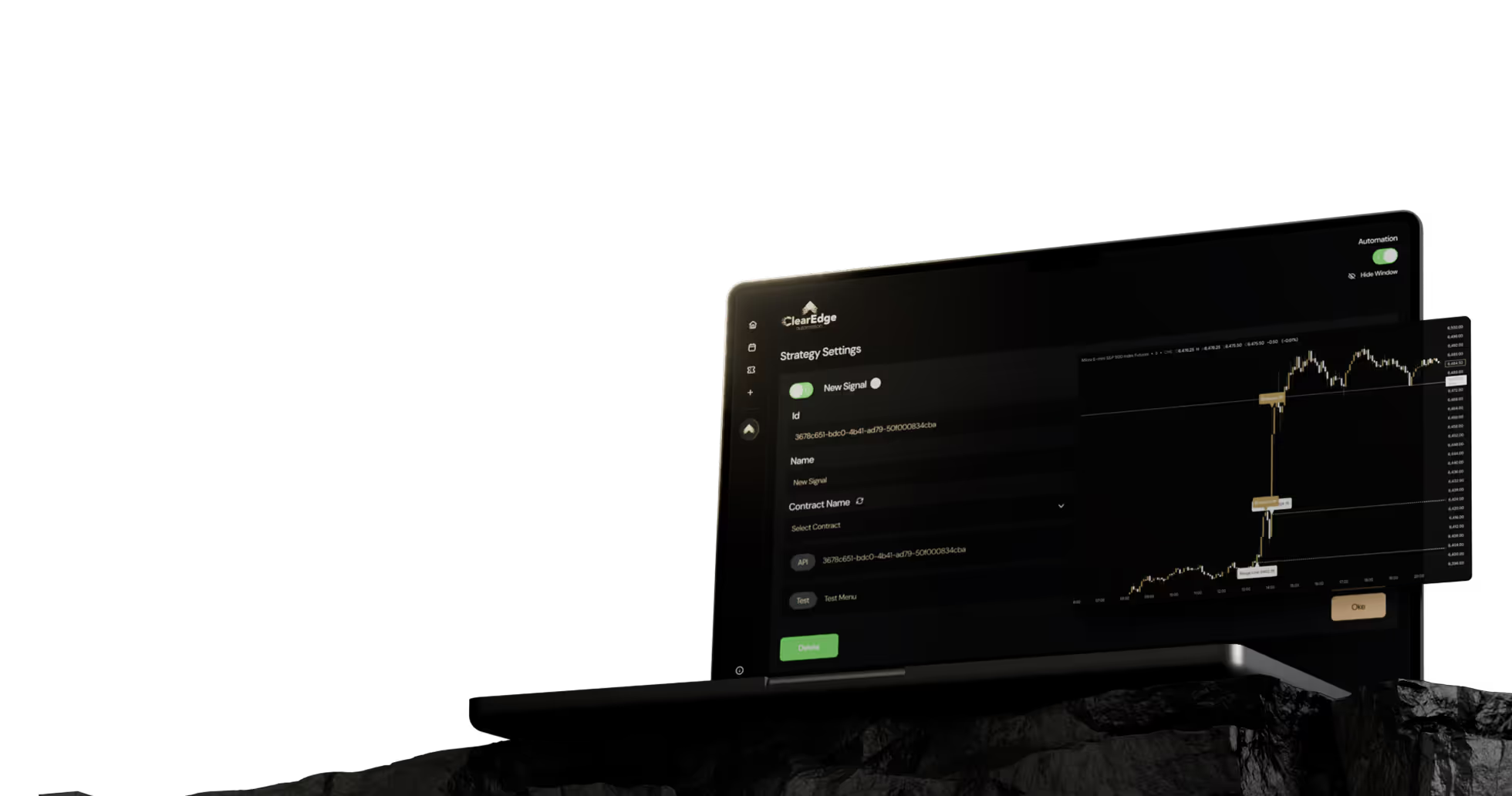
Master Tradovate Futures Automation With API Webhook Integration
Bridge TradingView alerts with the Tradovate API to automate your futures trading. Learn to configure webhooks, OAuth2 tokens, and cloud-based order execution.


Tradovate offers cloud-based futures trading with API and webhook integration for automation. This guide walks through connecting TradingView alerts to Tradovate's API, configuring webhook payloads, and setting up automated order execution. Tradovate's browser-based platform and REST/WebSocket API make it a practical choice for traders who want to automate futures strategies without installing desktop software.
Key Takeaways
- Tradovate provides REST and WebSocket APIs for automated futures order execution, with cloud-native architecture that eliminates desktop software dependencies
- Webhook integration requires a TradingView Pro plan or higher, a properly formatted JSON payload, and a middleware layer or automation platform to route alerts to Tradovate's API
- API access on Tradovate uses OAuth2 authentication with access tokens that expire and must be refreshed programmatically
- Cloud-based execution through Tradovate means your automation can run from any device, but latency depends on your middleware server location relative to Tradovate's data centers
Table of Contents
- What Is Tradovate Futures Automation?
- How Does the Tradovate API Work?
- Webhook Integration Setup: TradingView to Tradovate
- API Authentication and Token Management
- Order Routing and Execution Configuration
- Why Cloud Trading Matters for Automation
- Common Issues and How to Fix Them
- Frequently Asked Questions
- Conclusion
What Is Tradovate Futures Automation?
Tradovate futures automation is the process of using Tradovate's API to execute futures trades automatically based on external signals, typically from TradingView alerts sent via webhooks. Unlike desktop-only platforms, Tradovate runs entirely in the cloud, which means your broker connection doesn't depend on keeping a local application open.
Tradovate, now owned by NinjaTrader Group after their 2024 acquisition, operates as a futures commission merchant (FCM) registered with the CFTC and NFA. It supports trading across CME, CBOT, NYMEX, and COMEX exchanges, covering contracts like ES, NQ, GC, and CL. The platform charges commission rates starting around $0.79 per side for micro contracts, though rates vary by account type and volume.
API (Application Programming Interface): A set of rules that lets two software applications communicate. In trading, an API allows external programs to place orders, check positions, and pull account data from your broker without manual interaction.
The Tradovate futures automation API webhook integration guide you're reading covers the full connection chain: TradingView generates an alert, sends a webhook to your middleware or automation platform, which then authenticates with Tradovate's API and submits the order. Each link in that chain needs to work reliably, and the setup has some quirks worth understanding before you go live.
How Does the Tradovate API Work?
Tradovate provides two API protocols: a REST API for request-response operations like placing orders, and a WebSocket API for real-time streaming of market data and order updates. Both connect through Tradovate's cloud infrastructure, so there's no local server to maintain on your end.
The REST API handles most automation tasks. You send HTTP requests to endpoints like /order/placeorder or /position/list, and Tradovate responds with JSON data confirming the action or returning account information. The WebSocket API is more useful if you need live price feeds or real-time fill notifications pushed to your application without constant polling.
REST API: A web-based interface where you send standard HTTP requests (GET, POST, PUT, DELETE) to specific URLs and receive structured data back. Most broker API integrations for automated trading use REST APIs for order placement.
Tradovate maintains separate environments for testing and live trading. The demo environment uses demo.tradovateapi.com, while live trading goes through live.tradovateapi.com. Always test your full webhook-to-order pipeline in demo first. The demo API behaves identically to live, so if it works there, it should work in production. Here's the thing though: demo fills are simulated and won't reflect real slippage or partial fills, so treat demo results as a connectivity test rather than a performance benchmark.
API TypeBase URL (Live)Use CaseConnectionRESTlive.tradovateapi.com/v1Order placement, account queries, position managementHTTP request/responseWebSocketlive.tradovateapi.com/v1/websocketReal-time market data, order status streamingPersistent connectionREST (Demo)demo.tradovateapi.com/v1Testing and validationHTTP request/response
For more on how broker API connections fit into the broader automation picture, the broker integration for futures automation platforms article covers the general architecture.
Webhook Integration Setup: TradingView to Tradovate
Connecting TradingView webhooks to Tradovate requires a middleware layer because TradingView can't send requests directly to Tradovate's authenticated API. You need something in between that receives the webhook, authenticates with Tradovate, and forwards the order.
Here's the signal flow:
- TradingView alert fires based on your indicator or strategy conditions
- Webhook sends a JSON payload to your middleware URL (this could be a custom server, a cloud function, or an automation platform like ClearEdge Trading)
- Middleware parses the payload, extracts the trade parameters (symbol, direction, quantity, order type)
- Middleware authenticates with Tradovate's API using your stored credentials and OAuth2 token
- Middleware submits the order via Tradovate's REST API
- Tradovate confirms execution and returns fill data
Webhook: An automated HTTP POST request sent from one application to another when a specific event occurs. TradingView sends webhooks when alert conditions trigger, delivering a message payload to a URL you specify.
TradingView Webhook Payload Format
Your TradingView alert message needs to contain enough information for your middleware to construct a valid Tradovate order. A typical JSON payload looks like this:
{
  "action": "buy",
  "symbol": "ESZ5",
  "quantity": 1,
  "orderType": "Market",
  "account": "your_account_id"
}
The exact fields depend on your middleware's parsing logic. Some traders include stop loss and take profit levels in the payload. Others handle bracket orders on the middleware side. The TradingView JSON payload format guide covers message formatting in detail.
TradingView webhooks require a Pro, Pro+, or Premium plan. The free plan doesn't support webhooks at all. The TradingView Pro vs Premium comparison for automation breaks down which plan tier you actually need.
API Authentication and Token Management
Tradovate uses OAuth2 authentication, meaning you exchange your credentials for an access token, then include that token in every API request. Tokens expire, so your middleware needs to handle refresh logic automatically or your automation will stop working mid-session.
The authentication flow works like this:
- Send a POST request to
/auth/accesstokenrequestwith your username, password, device ID, and API key - Tradovate returns an access token, a refresh token (called an
mdAccessTokenfor market data), and an expiration time - Include the access token in the
Authorizationheader of subsequent requests - Before the token expires, use the refresh endpoint to get a new one without re-entering credentials
OAuth2: An authentication protocol that uses temporary tokens instead of sending your username and password with every request. It reduces security risk because tokens can be revoked and expire automatically.
A common mistake: hardcoding the access token and forgetting it expires. Your middleware needs a token refresh loop that runs on a timer or catches 401 (unauthorized) responses and re-authenticates before retrying the failed request. If you skip this, your automation will work fine for a few hours and then silently stop placing orders.
You'll need to request API access from Tradovate separately from your trading account. Log into the Tradovate Trader application, navigate to account settings, and generate an API key. Keep your API key and credentials secure. The webhook security best practices guide covers protecting your automation credentials.
Order Routing and Execution Configuration
Tradovate's API supports market orders, limit orders, stop orders, and bracket orders (OCO). For most webhook-triggered automation, market orders are simplest but carry slippage risk. Limit orders give price control but may not fill during fast moves.
When placing an order through the API, you specify these parameters:
ParameterDescriptionExampleaccountSpecYour account username"yourUsername"accountIdNumeric account identifier12345actionBuy or Sell"Buy"symbolContract symbol with expiration"ESZ5"orderQtyNumber of contracts2orderTypeMarket, Limit, Stop, StopLimit"Market"priceRequired for Limit/StopLimit5450.00
One detail that trips up new users: Tradovate contract symbols include the expiration code. ES isn't enough; you need ESZ5 for December 2025, ESH6 for March 2026, and so on. Your middleware should handle contract rollover logic, or you'll try to trade an expired symbol and get rejected. For rollover handling, see the ES futures contract rollover automation guide.
Execution quality on Tradovate depends on the order type and market conditions. Market orders during regular trading hours (RTH) on liquid contracts like ES typically fill within milliseconds. Extended hours or thin markets like overnight gold sessions will see wider spreads and more slippage. Adjust your automation parameters accordingly.
Why Cloud Trading Matters for Automation
Tradovate's cloud-native architecture means your trading account, charts, and order management all run on Tradovate's servers rather than your local machine. For automation, this has practical implications for reliability and latency.
With desktop-based brokers, your automation breaks if your computer restarts, loses internet, or crashes. Cloud platforms reduce this risk because the broker-side infrastructure stays running regardless of your local machine's status. However, your middleware or automation platform still needs to be available to receive webhooks and forward orders. If your middleware runs on your laptop and you close it, the chain breaks even though Tradovate is cloud-based.
This is why many traders pair Tradovate with either a VPS (virtual private server) for custom middleware or a cloud-based automation platform. No-code platforms like ClearEdge Trading handle the middleware layer in the cloud, so there's no local dependency at all. The cloud vs desktop futures automation guide compares both approaches in detail.
Latency matters but in a specific way. The time from TradingView alert to Tradovate order submission depends on three hops: TradingView to middleware (typically 100-500ms), middleware processing (10-50ms), and middleware to Tradovate API (20-100ms). Total round-trip usually lands between 200ms and 700ms. For scalping strategies on NQ where a single tick is $5.00, that latency can mean one tick of slippage. For swing trading or even intraday strategies with wider targets, it's negligible.
Common Issues and How to Fix Them
Most Tradovate automation failures come from authentication expiration, incorrect contract symbols, or webhook formatting errors. Here are the problems traders hit most often and how to solve them.
Token Expiration Kills Orders Silently
If your middleware doesn't refresh the OAuth2 token before it expires, Tradovate returns a 401 error and your order never executes. The fix is building automatic token refresh into your middleware. Check the token expiration timestamp on every request and refresh proactively when it's within 5 minutes of expiring.
Wrong Contract Symbol Format
Sending "ES" instead of "ESZ5" results in an invalid symbol error. Your middleware needs to know the current front-month contract and handle quarterly rollovers. Some traders hardcode the symbol and update it manually each quarter. Others build rollover logic that switches symbols automatically based on the expiration calendar.
Webhook Payload Parsing Failures
TradingView sends the alert message as a plain text body in the webhook POST request. If your middleware expects JSON but the payload isn't properly formatted, parsing fails and no order goes out. Always validate your JSON format in TradingView's alert message field. A misplaced comma or missing quote breaks the whole thing. The fix TradingView webhook not working guide walks through debugging steps.
Account Not Authorized for API Trading
Having a Tradovate account doesn't automatically mean API access is enabled. You need to request an API key through your account settings. If you try to authenticate without an API key, you'll get credentials errors even though your username and password are correct.
Frequently Asked Questions
1. Does Tradovate charge extra for API access?
Tradovate does not charge a separate fee for API access as of 2025. API trading uses the same commission structure as manual trading. You do need to request API credentials separately from your trading account setup.
2. Can I connect TradingView directly to Tradovate without middleware?
No. TradingView webhooks send unauthenticated HTTP POST requests, and Tradovate's API requires OAuth2 authentication. You need middleware, whether custom code, a cloud function, or an automation platform, to bridge the two.
3. What TradingView plan do I need for webhook automation?
You need TradingView Pro ($14.95/month billed annually) at minimum. The free and Basic plans don't support webhook URLs in alerts. Pro+ and Premium offer more simultaneous alerts, which matters if you automate multiple strategies.
4. How fast is order execution through the Tradovate API?
The API itself processes orders in under 50ms typically. Total latency from TradingView alert to fill is usually 200-700ms depending on middleware speed, network conditions, and market liquidity. This is fast enough for most intraday strategies but not competitive for high-frequency approaches.
5. Does Tradovate support bracket orders through the API?
Yes. Tradovate's API supports OCO (one-cancels-other) bracket orders where you can attach a stop loss and take profit to your entry order in a single API call. This is handled through the /order/placeOSO endpoint.
Conclusion
Setting up Tradovate futures automation with API webhook integration requires understanding three components: TradingView alert configuration, middleware that handles authentication and order routing, and Tradovate's REST API endpoints. The cloud-native architecture removes desktop dependency, but you still need reliable middleware to complete the automation chain.
Start by testing the entire pipeline in Tradovate's demo environment before risking real capital. Validate your webhook payloads, confirm token refresh logic works, and verify correct contract symbol formatting. For a broader view of how broker API connections fit into your trading infrastructure, read our broker integration for futures automation platforms guide.
Want to skip the custom middleware and connect TradingView to Tradovate with a no-code setup? Check ClearEdge Trading's supported brokers to see how the platform handles webhook routing and API authentication automatically.
References
- Tradovate - Official Futures Trading Platform
- Tradovate API Documentation
- TradingView - About Webhooks
- CME Group - E-mini S&P 500 Contract Specifications
Disclaimer: This article is for educational purposes only. It is not trading advice. ClearEdge Trading executes trades based on your rules; it does not provide signals or recommendations.
Risk Warning: Futures trading involves substantial risk. You could lose more than your initial investment. Past performance does not guarantee future results. Only trade with capital you can afford to lose.
CFTC RULE 4.41: Hypothetical results have limitations and do not represent actual trading.
By: ClearEdge Trading Team | About























































Steal the PlaybooksOther TradersDon’t Share
Every week, we break down real strategies from traders with 100+ years of combined experience, so you can skip the line and trade without emotion.