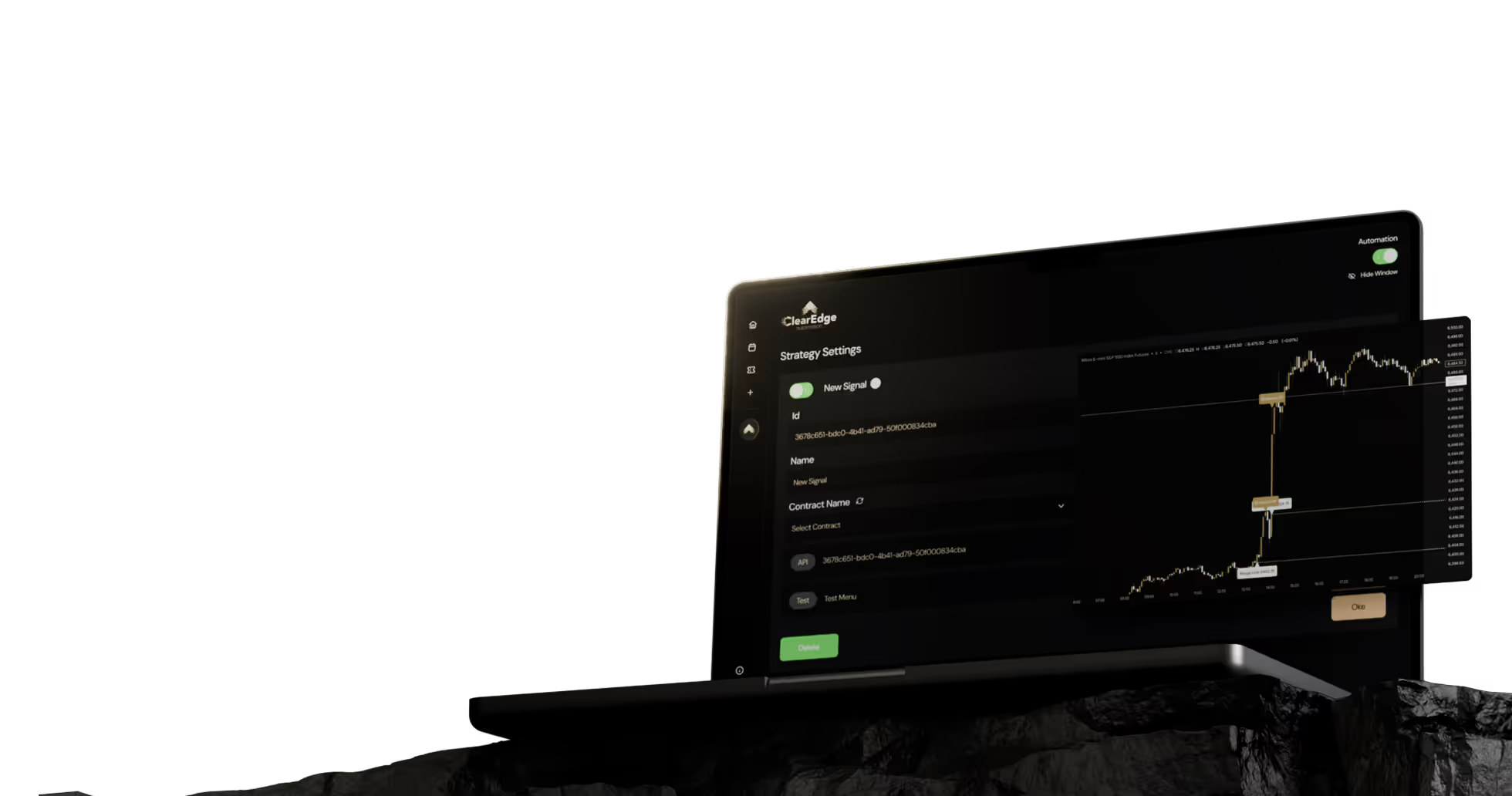
First Futures Trade: A Step-By-Step Beginner Setup Guide
Take the guesswork out of your first futures trade. This guide covers broker setup, margin rules, and trading Micro E-mini contracts with confidence.


Your first futures trade involves choosing a broker, funding your account, understanding contract specifications, and placing an order through your trading platform. This step-by-step beginner setup guide walks through account creation, margin requirements, order types, and risk controls so you can move from paper trading to placing your first live futures trade with confidence.
Key Takeaways
- Open and fund a futures brokerage account with at least enough to cover initial margin plus a buffer (Micro E-mini S&P 500 accounts can start around $1,000-$2,000)
- Paper trade for a minimum of 2-4 weeks before risking real money to learn order mechanics and platform navigation
- Understand contract specifications (tick size, tick value, margin) for whichever instrument you trade before placing your first order
- Use a trading plan with predefined entry, stop-loss, and profit target before every trade to manage risk tolerance
- Start with Micro contracts (MES or MNQ) to keep risk small while learning how futures markets work
Table of Contents
- What Do You Need Before Your First Futures Trade?
- Step 1: Choosing a Broker and Setting Up Your Account
- Step 2: Practice with a Demo Account First
- Step 3: Understanding Contract Specifications
- Step 4: Placing Your First Futures Order
- Step 5: Setting Up Basic Risk Controls
- What to Do After Your First Trade
- Frequently Asked Questions
- Conclusion
What Do You Need Before Your First Futures Trade?
Before placing your first futures trade, you need three things: a funded brokerage account approved for futures, a basic understanding of margin and leverage, and a written trading plan. Most beginners skip at least one of these and regret it.
Futures trading for beginners can feel overwhelming because there are moving pieces that stock trading doesn't have. You're dealing with contract expirations, margin requirements that change, and leverage that can amplify both wins and losses. The good news is that the actual mechanics of placing a trade are straightforward once you understand the setup.
Here's the thing about your first futures trade: the goal isn't to make money. It's to execute the process correctly. Entry, stop-loss, target, position size. Get that right, and profits come from repetition and refinement over time.
Futures Contract: A standardized agreement to buy or sell a specific commodity or financial instrument at a predetermined price on a set future date. Futures trade on regulated exchanges like the CME Group, and each contract has defined specifications for size, tick value, and expiration.
Step 1: Choosing a Broker and Setting Up Your Account
Your account setup starts with selecting a futures broker that fits your experience level, budget, and platform preferences. Not all brokers are equal when it comes to commissions, margin rates, platform quality, and available instruments.
What to Look for in a Futures Broker
Focus on these factors when comparing brokers:
- Commission rates: Typically $0.25-$1.50 per side per contract for Micro futures, $1.00-$4.00 for standard contracts
- Intraday margin requirements: Some brokers offer reduced day-trading margins as low as $50-$500 per Micro contract
- Platform quality: Does it connect to the charting tools you want to use? TradingView compatibility matters if you plan to use alerts or eventually automate
- Customer support: When something goes wrong at 2 AM during overnight trading, you want someone to pick up the phone
- Account minimums: Range from $0-$2,000 depending on the broker
Popular futures brokers for beginners include AMP Futures, NinjaTrader, TradeStation, and Interactive Brokers. Each has trade-offs. AMP tends to have lower commissions. NinjaTrader offers a strong charting platform. TradeStation and Interactive Brokers provide broader market access. You can check supported futures brokers to see which ones integrate with automation platforms if that's something you want to explore later.
Account Application Process
Expect the application to take 1-3 business days. You'll provide personal identification, financial information, and acknowledge risk disclosures. The broker will ask about your trading experience and net worth because the NFA (National Futures Association) requires this [1]. Be honest. They're not gatekeeping. They're making sure you understand what you're getting into.
Once approved, fund your account via wire transfer or ACH. Wire transfers typically clear the same day. ACH takes 2-4 business days.
Margin (Futures): The deposit your broker requires to open and maintain a futures position. Unlike stock margin, this isn't a loan. It's a performance bond. Initial margin is what you need to open a position. Maintenance margin is the minimum balance to keep it open.
Step 2: Practice with a Demo Account First
Paper trading on a demo account lets you practice order placement, learn platform navigation, and test your trading plan without financial risk. Skip this step at your own peril. Most brokers offer free trading simulators that mirror live market conditions.
Here's what to do during your paper trading phase:
- Week 1: Learn the platform. Place market orders, limit orders, and stop orders. Get comfortable canceling and modifying orders
- Week 2: Follow your trading plan. Track entries, exits, and results in a journal
- Weeks 3-4: Refine your approach. Adjust position size, stop placement, and timing based on what you learn
A common mistake is treating demo trading casually because there's no money at stake. Trade your simulator exactly like you'd trade live. Same position sizes, same rules, same discipline. The habits you build here carry over.
For a more comprehensive guide on paper trading platforms, see the automation platform paper trading features guide.
Paper Trading: Simulated trading using virtual money to practice strategies and platform mechanics without financial risk. Most futures brokers offer demo accounts with real-time or slightly delayed market data.
Step 3: Understanding Contract Specifications
Every futures contract has defined specifications that determine how much money each price movement is worth, how much margin you need, and when the contract expires. You need to know these numbers before placing any trade.
Beginner-Friendly Contracts
Micro futures are where most beginners should start. They're 1/10th the size of standard E-mini contracts, which means smaller margin requirements and smaller risk per tick.
ContractSymbolTick SizeTick ValueApprox. Day MarginMicro E-mini S&P 500MES0.25$1.25$50-$500Micro E-mini NasdaqMNQ0.25$0.50$50-$500E-mini S&P 500ES0.25$12.50$500-$6,000E-mini NasdaqNQ0.25$5.00$500-$8,000
Day margin varies significantly by broker. Overnight (exchange) margins are considerably higher. Check your broker's current rates.
If MES moves 4 points against you (16 ticks), that's a $20 loss on one contract. The same move on ES would be $200. That difference matters when you're learning. For detailed specs on specific instruments, the futures instrument automation guide covers ES, NQ, GC, and CL in depth.
Leverage (Futures): The ability to control a large contract value with a relatively small margin deposit. A single ES contract controls roughly $275,000 of S&P 500 exposure with maybe $12,000 in overnight margin. This amplifies both gains and losses, which is why risk management is non-negotiable.
Step 4: How Do You Place Your First Futures Order?
Placing your first futures order means selecting an instrument, choosing an order type, specifying quantity and direction (long or short), and clicking submit. The mechanical process takes seconds. The preparation should take much longer.
Order Types You Need to Know
Three order types cover 90% of what beginners need:
- Market order: Executes immediately at the best available price. Use for entries when you need to get in now. Expect minor slippage during fast markets
- Limit order: Executes only at your specified price or better. Use when you want a specific entry price and are willing to miss the trade if price doesn't reach it
- Stop order (stop-loss): Becomes a market order when price reaches your stop level. Use to exit losing positions automatically. This is your safety net
First Trade Step by Step
- Select your instrument: Choose MES or MNQ for your first trade. Find the active contract month (the front month with the most volume)
- Determine direction: Based on your trading plan and analysis, decide whether to go long (buy) or short (sell)
- Set position size: Start with 1 contract. Seriously. One
- Place your entry order: Either a market order for immediate execution or a limit order at your target entry price
- Set your stop-loss immediately: Before the trade even fills if possible. Most platforms let you attach a stop-loss to your entry order as a bracket or OCO (one-cancels-other)
- Set your profit target: Attach a limit order at your target exit price
- Monitor the trade: Let your plan work. Don't move your stop unless your plan specifically calls for it
For a broader walkthrough of connecting platforms and getting trades automated, see the step-by-step futures automation guide.
Bracket Order: An entry order bundled with a stop-loss and profit target. When the entry fills, both exit orders go live. When one exit fills, the other cancels automatically. This is the safest way for beginners to manage trades because it removes the need to manually place exits under pressure.
Step 5: Setting Up Basic Risk Controls
Risk management is what separates traders who survive from those who blow their accounts. Before your first live trade, define your maximum loss per trade and maximum loss per day, then build those limits into your trading plan.
Risk Tolerance Checklist
- Per-trade risk: Limit to 1-2% of your account balance. On a $2,000 account trading 1 MES contract, that's a $20-$40 maximum loss (16-32 ticks)
- Daily loss limit: Set a hard stop for the day. If you lose 3-5% of your account in one session, shut it down. Walk away
- Maximum contracts: Start with 1. Don't add size until you're consistently profitable over at least 30-50 trades
- No trading during major news events (initially): Events like FOMC announcements, NFP, and CPI releases create volatility that can blow through stops. Avoid them while learning [2]
Some traders eventually automate these risk controls. Platforms like ClearEdge Trading can enforce daily loss limits and position sizing rules automatically, which removes the temptation to override your plan when emotions run high. But manual risk management works fine when you're starting out. The tool matters less than the discipline.
For more on the psychology of sticking to your rules, the trading psychology guide covers common emotional traps and how to handle them.
What to Do After Your First Trade
After your first trade closes, the real work begins. Record everything in a trading journal: entry price, exit price, position size, the reason you took the trade, what the market looked like, and how you felt during the trade.
That last part matters more than you'd expect. Your emotional state during early trades reveals patterns. Did you move your stop? Did you exit early because the profit felt "good enough"? Did you freeze when price moved against you? These are data points, not failures.
Review your journal weekly. After 20-30 trades, you'll start seeing which setups work and which don't. That's your futures trading journal becoming a strategy development tool.
Some beginners also find it useful to learn about getting started with futures automation early in their education, even if they continue trading manually. Understanding how algorithmic trading works gives you a framework for thinking about rules-based execution. The algorithmic trading beginners guide is a good starting point for that.
Frequently Asked Questions
1. How much money do I need for my first futures trade?
You can open some futures accounts with as little as $100-$500, though $1,000-$2,000 gives you more breathing room with Micro contracts. Your broker's intraday margin requirement for MES can be as low as $50 per contract, but trading with just the minimum margin leaves no room for normal price fluctuations.
2. Should I start with paper trading or go straight to live trading?
Start with paper trading for at least 2-4 weeks. A demo account lets you learn platform mechanics, order types, and trade management without risking real capital. Transition to live trading only after you can consistently follow your trading plan in the simulator.
3. What is the best futures contract for beginners?
Micro E-mini S&P 500 (MES) is the most popular starting point because it has high liquidity, tight spreads, and a tick value of just $1.25. Micro E-mini Nasdaq (MNQ) is another option with a $0.50 tick value, though it tends to move more aggressively.
4. What's the difference between margin for futures and margin for stocks?
Stock margin is a loan from your broker. Futures margin is a performance bond or good-faith deposit. You're not borrowing money to trade futures. You're posting collateral to guarantee you can cover potential losses on the contract.
5. Can I lose more than my account balance trading futures?
Yes. If the market moves sharply past your stop-loss (due to gaps or extreme volatility), you can lose more than your deposited funds and owe your broker the difference. This is why position sizing and stop-losses are not optional. They're survival tools.
Conclusion
Your first futures trade step by step involves choosing a broker, funding your account, learning contract specifications on a demo account, and placing a bracket order with predefined risk limits. The process is mechanical, but the discipline behind it determines long-term success.
Start small with Micro contracts, paper trade until you're comfortable, and never risk more than 1-2% per trade. For a broader view of futures trading education and how to start futures trading with a structured approach, read the complete beginner's guide to automated futures trading.
Want to dig deeper into futures trading for beginners? Read our complete beginner's guide to automated futures trading for more detailed setup instructions and strategies.
References
- NFA - Futures Account Opening Requirements
- CME Group - Introduction to Futures
- CME Group - Micro E-mini S&P 500 Contract Specifications
- CFTC - Futures Trading Glossary
Disclaimer: This article is for educational purposes only. It is not trading advice. ClearEdge Trading executes trades based on your rules; it does not provide signals or recommendations.
Risk Warning: Futures trading involves substantial risk. You could lose more than your initial investment. Past performance does not guarantee future results. Only trade with capital you can afford to lose.
CFTC RULE 4.41: Hypothetical results have limitations and do not represent actual trading.
By: ClearEdge Trading Team | About























































Steal the PlaybooksOther TradersDon’t Share
Every week, we break down real strategies from traders with 100+ years of combined experience, so you can skip the line and trade without emotion.