Algorithmic Trading For Beginners Complete 2026 Guide
Start algorithmic trading with no-code tools and TradingView webhooks. Learn to automate futures strategies, manage risk, and trade with minimal capital today.


Algorithmic trading for beginners involves using computer programs to automatically execute trades based on predefined rules and conditions. Instead of manually placing each order, traders set up strategies that trigger buy and sell orders when specific criteria are met—such as price levels, technical indicators, or time-based conditions. This approach removes emotional decision-making and enables faster execution than manual trading, making it accessible to retail traders through platforms that connect to brokers and charting software like TradingView.
Key Takeaways
- Algorithmic trading automates order execution based on your predefined rules, eliminating the need to manually click buy and sell buttons
- Retail traders can start with no-code platforms that connect TradingView alerts directly to futures brokers without programming knowledge
- Execution speeds of 3-40 milliseconds help reduce slippage during fast-moving market conditions compared to manual order entry
- Starting capital requirements vary by instrument—Micro E-mini contracts (MES/MNQ) require as little as $50-100 margin per contract
- Risk controls like daily loss limits and maximum position sizes are essential to protect accounts from automation errors or adverse market moves
Table of Contents
- What Is Algorithmic Trading and How Does It Work?
- Who Can Use Algorithmic Trading in 2026?
- How Do Algorithmic Trading Systems Execute Trades?
- What Are the Main Types of Algorithmic Trading Strategies?
- Do You Need to Code for Algorithmic Trading?
- How Much Capital Do You Need for Algo Trading?
- What Are the Risks of Algorithmic Trading?
- How to Get Started with Algorithmic Trading Today
- Frequently Asked Questions
What Is Algorithmic Trading and How Does It Work?
Algorithmic trading uses computer programs to automatically place trades when specific market conditions occur. A trader defines the rules—such as "buy when the 50-period moving average crosses above the 200-period moving average"—and the system monitors the market and executes the trade without human intervention. This differs from manual trading, where you watch charts and click buttons yourself.
Algorithmic Trading: The use of automated systems to execute trades based on predefined rules, including entry conditions, exit conditions, and risk parameters. This removes the delay and emotional factors that affect manual trade execution.
The process involves three main components: strategy development, signal generation, and order execution. You first develop a trading strategy with clear entry and exit rules. When market conditions meet your criteria, the system generates a signal. The automation platform then converts that signal into an actual order sent to your broker, typically within milliseconds.
For futures traders, algorithmic trading has become more accessible through platforms that integrate with charting software like TradingView. According to the Futures Industry Association, algorithmic trading accounts for approximately 70% of futures volume as of 2024, though retail traders represent a smaller portion of that percentage. The main advantage for individual traders isn't matching institutional speed—it's consistency and removing hesitation during execution.
Who Can Use Algorithmic Trading in 2026?
Retail traders with funded brokerage accounts can use algorithmic trading through accessible platforms that don't require institutional infrastructure. You need a futures broker account, a charting platform or signal source, and an automation platform to connect them. The barriers that once limited algo trading to large institutions—expensive infrastructure, direct exchange connections, and complex programming—have largely disappeared for retail participants.
Common user profiles include day traders automating Opening Range strategies, swing traders executing end-of-day signals, and prop firm traders who need consistent rule-following to pass evaluation challenges. No specific certification is required to use automated trading systems for your own account. However, brokers typically require you to acknowledge the risks of automated trading and may have minimum account balances ranging from $500 to $2,500 depending on the instruments you trade.
Traders pursuing funded accounts through proprietary trading firms often find automation particularly valuable. Many prop firms have strict rules about daily loss limits and drawdown thresholds. Automated systems can enforce these limits precisely, stopping trading when thresholds are approached. For more on this application, see our prop firm automation guide.
How Do Algorithmic Trading Systems Execute Trades?
Algorithmic trading systems execute trades through a three-step process: signal generation, order routing, and broker execution. When your predefined conditions are met—such as a price crossing a specific level or an indicator reaching a threshold—the system generates a trading signal. This signal is then formatted as an order with specific parameters (contract, quantity, order type, price limits) and routed to your broker's API. The broker receives the order and places it on the exchange, typically completing the entire process in 3-40 milliseconds depending on your connection quality.
API (Application Programming Interface): A set of protocols that allows one software application to communicate with another. In trading automation, APIs enable your automation platform to send orders directly to your broker's systems without manual input.
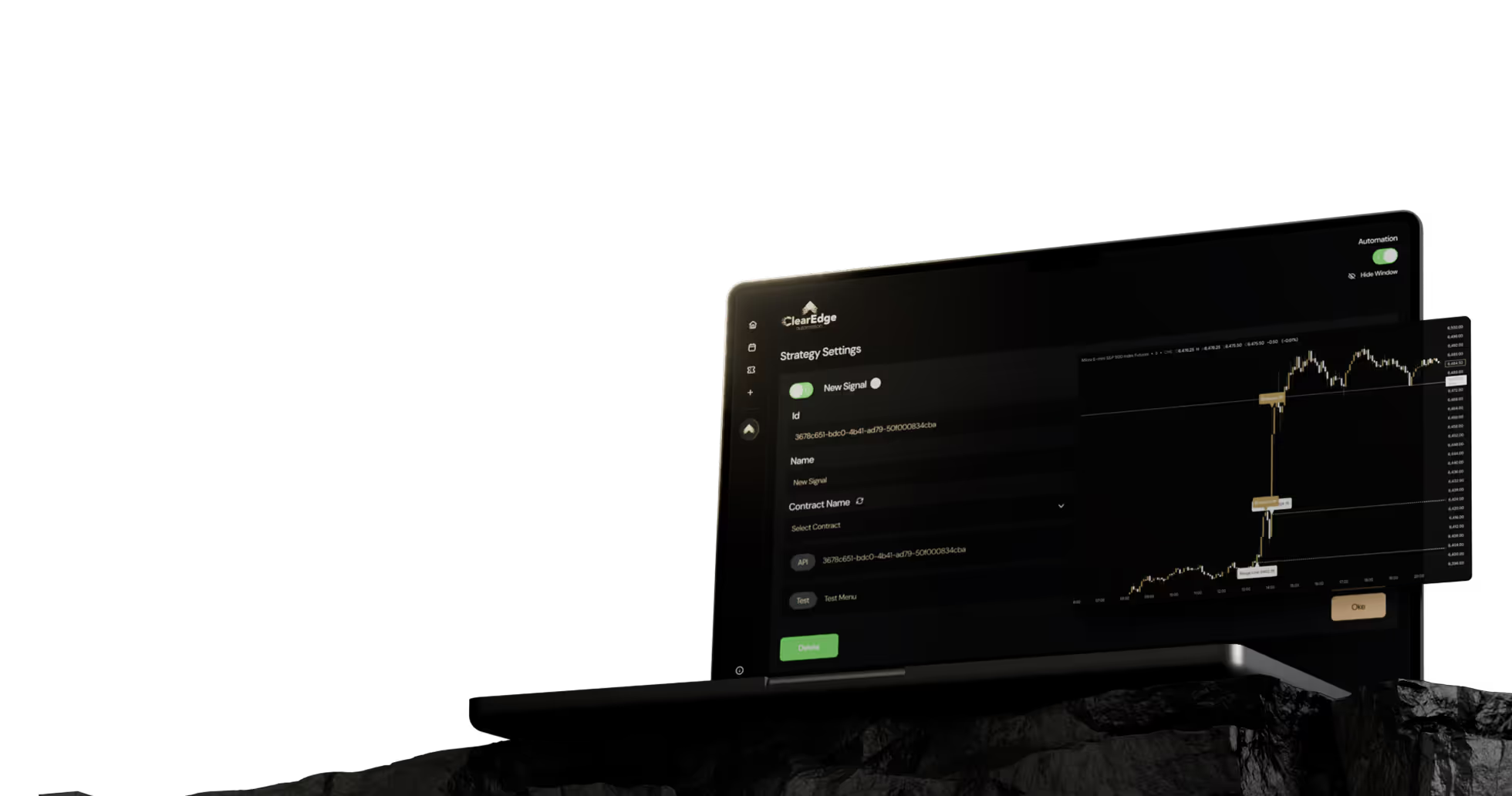
For TradingView users, the execution chain works through webhooks. When a TradingView alert fires, it sends a webhook message containing your trade parameters to your automation platform. Platforms like ClearEdge Trading receive this webhook, validate the parameters, and convert it into a broker-specific API call. The broker then executes the order on the CME Globex platform or other relevant exchange.
Order types matter significantly in automated execution. Market orders execute immediately at the best available price but may experience slippage during volatile periods. Limit orders specify your maximum buy price or minimum sell price, providing price protection but risking non-execution if the market moves away. Most futures automation platforms support market orders, limit orders, stop orders, and stop-limit orders. ES and NQ futures typically maintain tight spreads of 0.25-0.50 points during regular hours, making market orders viable for most automated strategies.
Order Type Execution Speed Price Control Best Use Case Market Order Immediate None Liquid markets, priority on entry Limit Order Conditional Full Range-bound markets, precise entries Stop Order Immediate after trigger None after trigger Breakout strategies Stop-Limit Conditional after trigger Full Breakouts with slippage protection
What Are the Main Types of Algorithmic Trading Strategies?
The main algorithmic trading strategies for retail futures traders fall into four categories: trend-following, mean reversion, breakout, and time-based strategies. Trend-following strategies use moving average crossovers or directional indicators to enter trades in the direction of momentum. Mean reversion strategies identify overbought or oversold conditions and trade against the current move, expecting price to return to average levels. Breakout strategies trigger when price moves beyond defined support or resistance levels. Time-based strategies execute at specific times, such as Opening Range or Initial Balance approaches.
Trend-following remains the most common automated approach for beginners because trends provide clear directional signals. A simple example: buy when the 9-period exponential moving average crosses above the 21-period EMA, exit when it crosses below. This strategy type works across multiple timeframes and instruments, though performance varies by market conditions. Trending markets favor these strategies, while choppy or range-bound markets often produce false signals and losses.
Opening Range: The high and low prices established during the first 30-60 minutes of the trading session. Many automated strategies trade breakouts above or below this range, anticipating directional moves after the opening period establishes initial boundaries.
Mean reversion strategies require more precision because they trade against momentum. These approaches typically use indicators like RSI (Relative Strength Index) or Bollinger Bands to identify extreme conditions. For example, a mean reversion system might sell ES when RSI reaches 70 or above and buy when RSI drops to 30 or below. The challenge with automating mean reversion is that trends can extend further than expected, causing drawdowns before the anticipated reversal occurs.
For futures-specific strategies and instrument considerations, review our futures instrument automation guide covering ES, NQ, GC, and CL contract characteristics.
Do You Need to Code for Algorithmic Trading?
You don't need programming skills to start algorithmic trading in 2026. No-code platforms allow traders to automate strategies using visual interfaces, TradingView alerts, or third-party indicator signals. If you can set up an alert in TradingView with webhook functionality, you can automate trade execution without writing a single line of code. This accessibility has opened algorithmic trading to traders who focus on market analysis and strategy development rather than software engineering.
The no-code approach works through alert-based automation. You create your strategy logic in TradingView using built-in indicators or third-party scripts. When conditions are met, TradingView fires an alert containing your trade parameters. Your automation platform receives this alert and executes the specified order. The entire technical infrastructure is handled by the platforms—you just configure the connections and define your rules. For detailed setup instructions, see our TradingView automation guide.
That said, coding ability expands your options significantly. Python has become the standard language for custom strategy development, with libraries like Backtrader, Zipline, and QuantConnect providing frameworks for backtesting and execution. Pine Script, TradingView's native language, allows you to build custom indicators and strategy logic directly in the charting platform. Traders who learn basic programming can test more complex conditions, optimize parameters systematically, and troubleshoot execution issues more effectively.
No-Code Advantages
- Immediate implementation without learning programming
- Lower technical complexity and troubleshooting burden
- Focus remains on market analysis and strategy logic
- Faster setup for standard strategy types
No-Code Limitations
- Restricted to platform-supported conditions and order types
- Limited ability to customize execution logic
- Dependency on third-party indicator developers
- Harder to implement complex multi-condition strategies
How Much Capital Do You Need for Algo Trading?
Minimum capital requirements for algorithmic futures trading range from $500 to $5,000 depending on the contracts you trade and your broker's requirements. Micro E-mini contracts (MES and MNQ) have the lowest barriers, with typical margin requirements of $50-100 per contract as of 2026. Standard E-mini contracts (ES and NQ) require approximately $500-1,500 in margin per contract. However, margin requirements represent the bare minimum—you need additional capital to handle drawdowns and avoid margin calls during losing periods.
A practical starting point for automated futures trading is $2,500-5,000 when trading Micro contracts, or $10,000-15,000 for standard E-mini contracts. This provides enough buffer to withstand normal drawdown periods without risking account depletion. For example, if your strategy has shown maximum drawdowns of 15% during backtesting, a $5,000 account gives you $750 of drawdown capacity—roughly 15 losing trades at $50 per trade on MES, or 7-8 losing trades at $100 per trade.
Margin Requirement: The minimum amount of capital your broker requires to open and maintain a futures position. This is typically 3-10% of the contract's notional value and varies by contract type, volatility, and broker policies. Contract Typical Margin Tick Value Recommended Minimum MES (Micro S&P) $50-100 $1.25 $2,500 MNQ (Micro Nasdaq) $50-100 $0.50 $2,500 ES (E-mini S&P) $500-700 $12.50 $10,000 NQ (E-mini Nasdaq) $700-1,500 $5.00 $15,000
Beyond account funding, consider software costs. Most no-code automation platforms charge monthly subscription fees ranging from $50 to $300 depending on features and broker connections. TradingView requires a Pro plan ($14.95/month) or higher to use webhook functionality in alerts. Data fees from your broker may add another $10-50/month. Factor these recurring costs into your capital planning—a trader needs enough capital to cover both trading drawdowns and platform expenses during the strategy development phase.
What Are the Risks of Algorithmic Trading?
The primary risks of algorithmic trading include technical failures, strategy overfitting, execution errors, and amplified losses during unexpected market conditions. Technical failures occur when internet connections drop, APIs go offline, or platforms experience downtime—potentially leaving positions unmanaged during critical moments. Strategy overfitting happens when traders optimize parameters based on historical data in ways that don't reflect actual market behavior, creating systems that look good in backtesting but fail in live trading. Execution errors result from incorrect order formatting, position sizing mistakes, or logic flaws that cause the system to behave differently than intended.
Market risk becomes amplified under automation because systems continue executing without judgment during abnormal conditions. A manual trader might pause during unusual volatility, but an automated system keeps trading unless specifically programmed to recognize and respond to such conditions. For example, during the March 2020 volatility, automated systems without volatility filters experienced significantly larger drawdowns than historical testing suggested. The speed advantage of automation works both directions—losses can accumulate quickly when conditions move against your strategy.
Overfitting: The practice of optimizing a trading strategy's parameters so closely to historical data that the system captures random noise rather than genuine market patterns. Overfitted strategies typically show excellent backtest results but poor live performance.
Psychological risks persist even with automation. Traders often interfere with automated systems during drawdown periods, turning them off at the worst possible times or manually overriding trades. This "automation anxiety" defeats the purpose of systematic trading. Additionally, over-leveraging becomes easier with automation because the system can execute larger position sizes without the psychological friction of manual entry. A trader risking 2% per trade manually might inadvertently program 5% risk, dramatically increasing account volatility.
Risk Management Checklist for Algo Trading
- ☐ Set maximum daily loss limits (typically 2-5% of account)
- ☐ Implement maximum position size controls
- ☐ Use stop losses on every trade without exception
- ☐ Test strategies on paper trading before going live
- ☐ Monitor systems daily for execution accuracy
- ☐ Maintain separate capital for testing versus live trading
- ☐ Have backup plans for technical failures (broker phone access)
- ☐ Document your strategy rules and review execution logs weekly
Regulatory and account risks also exist. Prop firm traders using automation must ensure their systems comply with firm rules about consistency, daily limits, and restricted trading times. Violating these rules—even unintentionally through automation errors—can result in account termination. For broker accounts, Pattern Day Trading rules don't apply to futures, but margin calls can occur if automated trading depletes your account below maintenance requirements. For guidance on managing these specific constraints, see trading psychology automation.
How to Get Started with Algorithmic Trading Today
Start algorithmic trading by first paper trading a strategy manually to verify its logic before automating. Select one simple strategy—such as an Opening Range breakout or moving average crossover—and trade it manually for 20-30 instances to understand its behavior in different market conditions. Document entry and exit rules precisely, noting exact conditions that trigger trades. This manual phase helps you identify practical issues that aren't obvious when just looking at indicators on a chart.
Once your strategy shows consistent application in paper trading, set up the automation infrastructure. You need three components: a broker account that supports API access (check supported brokers), a TradingView account with Pro plan or higher for webhooks, and an automation platform to connect them. Most platforms offer trial periods or demo accounts to test the connection flow without risking capital. Configure your strategy in TradingView with alert conditions matching your documented rules, then create webhook alerts that send trade parameters to your automation platform.
Begin live automated trading with minimum position sizes and strict daily loss limits. For Micro E-mini contracts, start with single-contract positions and a $50-100 daily loss limit. Run the system for at least 30 trades before evaluating performance—smaller sample sizes don't provide meaningful data. Compare live results to your paper trading results, looking for discrepancies in fill prices, execution timing, or win rates. Significant differences suggest issues with your automation setup or assumptions about execution quality.
Algo Trading Startup Sequence
- ☐ Define one simple strategy with clear entry and exit rules
- ☐ Paper trade manually for 20-30 trades to verify logic
- ☐ Document exact rules in a written strategy specification
- ☐ Set up broker account with API access enabled
- ☐ Configure TradingView Pro with your strategy indicators and alerts
- ☐ Connect automation platform and test with demo account
- ☐ Run paper automation for 10-15 trades to verify execution
- ☐ Go live with minimum size and tight daily loss limits
- ☐ Collect 30+ live trades before making strategy adjustments
Avoid common beginner mistakes: running multiple strategies simultaneously before proving one strategy works, increasing position size after short winning streaks, and constantly adjusting parameters based on recent results. Focus on execution consistency and system reliability before optimizing for performance. For comprehensive setup instructions and platform configuration, review our automated futures trading guide.
Frequently Asked Questions
1. Can I start algorithmic trading with no programming experience?
Yes, no-code platforms allow you to automate strategies using TradingView alerts and webhook connections without writing code. You configure your strategy logic in TradingView, set up alerts with trade parameters, and the automation platform handles execution when alerts fire.
2. How much money can you make with algorithmic trading?
Returns vary dramatically based on strategy, market conditions, and risk management—there are no guaranteed profits in algorithmic trading. Professional systematic traders often target 10-30% annual returns with controlled drawdowns, while individual results range from significant losses to occasional outperformance depending on strategy quality and discipline.
3. What is the best time frame for automated futures trading?
Intraday timeframes of 5-15 minutes work well for most retail automated strategies because they provide enough signals for meaningful testing while avoiding the noise of shorter timeframes. Day trading eliminates overnight risk but requires monitoring during market hours, while longer timeframes reduce trade frequency and testing opportunities.
4. Do automated trading systems work during news events?
Most retail automated systems struggle during high-impact news releases like FOMC announcements or Non-Farm Payrolls due to increased volatility and spread widening. Many traders program their systems to pause trading 15-30 minutes before and after scheduled economic releases to avoid unpredictable price action.
5. How do I know if my automated strategy is overfitted?
Forward testing on data the strategy hasn't "seen" reveals overfitting—if performance degrades significantly compared to backtest results, the strategy likely captured random patterns rather than genuine market behavior. Overfitted strategies often show unrealistically high win rates (above 70-80%) or very specific parameter combinations that perform dramatically better than nearby values.
Conclusion
Algorithmic trading for beginners centers on automating simple, well-tested strategies using accessible no-code platforms that connect TradingView alerts to broker execution. Start with paper trading to verify your strategy logic, begin live trading with minimum position sizes, and focus on consistent execution rather than complex optimization. The technology removes emotional interference and execution delays, but success still requires disciplined risk management and realistic performance expectations.
Paper trade your first strategy for 20-30 instances before automating, and maintain strict daily loss limits when going live. For detailed platform setup and broker integration, explore ClearEdge Trading to see how no-code automation connects your TradingView strategies to futures execution.
Want to dig deeper? Read our complete guide to algorithmic trading for more detailed setup instructions and strategies.
References
- Futures Industry Association. "Annual Volume Survey 2024." https://www.fia.org/resources/annual-volume-survey
- CME Group. "E-mini S&P 500 Futures Contract Specs." https://www.cmegroup.com/markets/equities/sp/e-mini-sandp500.contractSpecs.html
- CFTC. "CFTC Rule 4.41 - Hypothetical Performance Disclosure." https://www.cftc.gov/LawRegulation/CommodityExchangeAct/index.htm
- TradingView. "Alerts and Webhooks Documentation." https://www.tradingview.com/support/solutions/43000529348-about-webhooks/
Disclaimer: This article is for educational and informational purposes only. It does not constitute trading advice, investment advice, or any recommendation to buy or sell futures contracts. ClearEdge Trading is a software platform that executes trades based on your predefined rules—it does not provide trading signals, strategies, or personalized recommendations.
Risk Warning: Futures trading involves substantial risk of loss and is not suitable for all investors. You could lose more than your initial investment. Past performance of any trading system, methodology, or strategy is not indicative of future results. Before trading futures, you should carefully consider your financial situation and risk tolerance. Only trade with capital you can afford to lose.
CFTC RULE 4.41: HYPOTHETICAL OR SIMULATED PERFORMANCE RESULTS HAVE CERTAIN LIMITATIONS. UNLIKE AN ACTUAL PERFORMANCE RECORD, SIMULATED RESULTS DO NOT REPRESENT ACTUAL TRADING. ALSO, SINCE THE TRADES HAVE NOT BEEN EXECUTED, THE RESULTS MAY HAVE UNDER-OR-OVER COMPENSATED FOR THE IMPACT, IF ANY, OF CERTAIN MARKET FACTORS, SUCH AS LACK OF LIQUIDITY.
By: ClearEdge Trading Team | 29+ Years CME Floor Trading Experience | About























































Steal the PlaybooksOther TradersDon’t Share
Every week, we break down real strategies from traders with 100+ years of combined experience, so you can skip the line and trade without emotion.