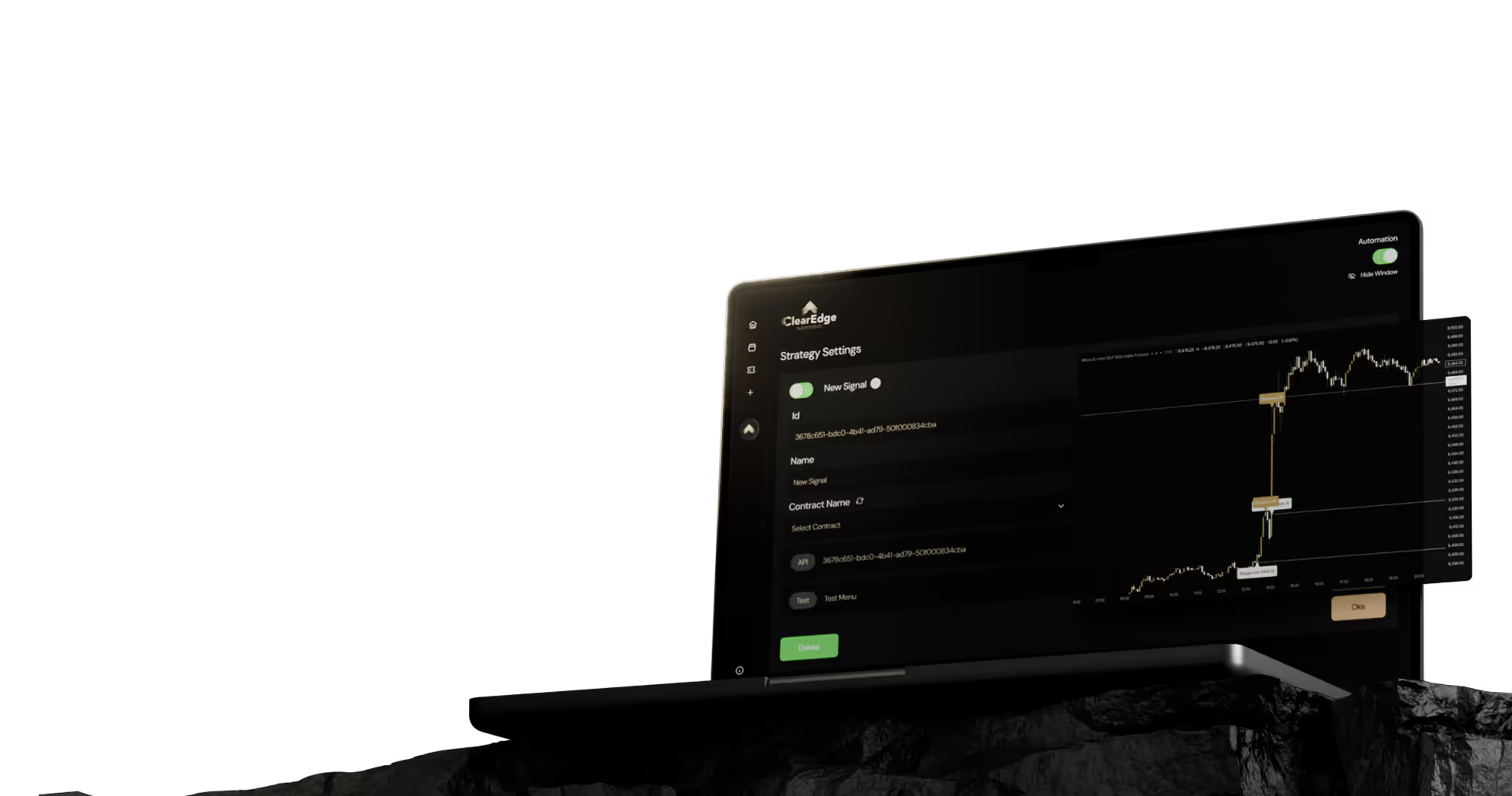
NQ Futures Gap Trading Automation Setup Guide
Bridge the gap in your NQ futures strategy. Automate TradingView alerts to execute precision fade or continuation trades with robust risk management controls.


NQ futures gap trading automation setup involves configuring TradingView alerts to detect overnight gaps in the E-mini Nasdaq contract and automatically executing trades through a webhook-connected platform when specific gap criteria are met. The setup requires defining gap thresholds (typically 0.5-1.5% from previous close), establishing entry rules for fade or continuation strategies, and programming risk parameters including position sizing and stop losses that account for NQ's $5 tick value and characteristic volatility during RTH open.
Key Takeaways
- NQ futures gaps of 0.75-1.25% occur approximately 2-3 times weekly and offer automation opportunities with defined entry parameters
- Gap fade strategies work best with 15-30 minute confirmation periods after the 9:30 AM ET open to filter false signals
- Automation requires webhook integration between TradingView alerts and execution platforms, with typical latency of 3-40ms
- Position sizing must account for NQ's $5 per tick value—a 10-point gap represents $200 per contract of potential movement
Table of Contents
- What Is NQ Futures Gap Trading?
- Core Components of Gap Trading Automation
- How to Configure TradingView Alerts for NQ Gaps
- Gap Fade vs. Gap Continuation Strategies
- Risk Management Parameters for Automated Gap Trading
- Common Mistakes in NQ Gap Automation
- Frequently Asked Questions
- Conclusion
What Is NQ Futures Gap Trading?
NQ futures gap trading exploits price discontinuities that occur when the E-mini Nasdaq opens at a significantly different price than its previous close. A gap forms when overnight news, earnings reports, or global market movements create buying or selling pressure before the 9:30 AM ET Regular Trading Hours (RTH) session begins. These gaps typically range from 0.25% to 2.0% of the contract value, with larger gaps occurring around major economic announcements or geopolitical events.
Gap: A price gap occurs when a futures contract opens outside the previous session's closing range with no trading activity at intermediate price levels. For NQ futures, gaps above 0.5% are considered tradable events that often trigger mean-reversion or continuation patterns.
The E-mini Nasdaq (NQ) is particularly suited for gap trading because it trades nearly 24 hours (Sunday 6:00 PM to Friday 5:00 PM ET) with a brief 60-minute maintenance window. During overnight and early morning sessions, lower liquidity can amplify gap formation. According to CME Group data, NQ futures average approximately 350,000 contracts in daily volume, with significant concentration at the RTH open when gaps either fill or extend.
Automation addresses the execution challenge of gap trading: decisions must be made within seconds of the 9:30 AM open. Manual traders often hesitate or miss optimal entry points. Automated systems execute predefined rules instantly when gap conditions are met, removing emotional decision-making from high-pressure market opens.
Core Components of Gap Trading Automation
NQ futures gap trading automation setup requires three integrated components: detection logic, execution infrastructure, and risk management controls. The detection layer identifies when a gap meets your specified criteria—gap size, direction, and pre-market volume conditions. The execution layer converts that detection into an actual broker order. The risk layer ensures position sizing and stop placement align with your account parameters.
TradingView serves as the detection engine for most retail automation setups. Using Pine Script or built-in alert conditions, you program the platform to monitor the difference between NQ's current price and the previous day's settlement (typically 5:00 PM ET close). When that difference exceeds your threshold—say 50 points or 0.75%—TradingView triggers an alert containing your trade parameters.
Webhook: A webhook is an automated HTTP message sent from TradingView to your automation platform when an alert fires. The webhook carries JSON-formatted data specifying the instrument, action (buy/sell), quantity, and any conditional orders like stops and targets.
The execution platform receives the webhook and translates it into a broker-compatible order format. Platforms like ClearEdge Trading support 20+ futures brokers and handle order routing, position tracking, and confirmation feedback. Execution speed matters—during volatile gap opens, a 200ms delay can mean 2-5 ticks of slippage on NQ, equating to $10-25 per contract.
Risk management operates at both the strategy and account level. Strategy-level controls include maximum position size per signal, stop loss distance from entry, and profit targets. Account-level controls include daily loss limits (critical for prop firm traders), maximum open positions, and trading hour restrictions to prevent overnight exposure if your strategy is RTH-only.
ComponentFunctionTypical LatencyTradingView AlertGap detection and webhook trigger1-5msWebhook TransmissionData sent to automation platform10-50msOrder RoutingPlatform to broker execution3-40msBroker FillOrder matched on exchange1-10ms
How to Configure TradingView Alerts for NQ Gaps
Configuring TradingView for NQ futures gap trading automation setup begins with selecting the correct instrument symbol and timeframe. Use the continuous contract symbol (NQU2024, NQZ2024, etc., or the generic NQ1! symbol) on a daily or 30-minute chart. The daily chart provides clear previous-close reference points, while 30-minute charts offer more granular entry timing during the RTH open.
Your alert condition calculates gap percentage using this formula: (current_open - previous_close) / previous_close * 100. In Pine Script, this translates to a simple comparison that fires when the absolute gap exceeds your threshold. Most NQ gap traders use 0.5% as a minimum (approximately 65 points) to filter noise, with maximum thresholds of 1.5-2.0% (195-260 points) beyond which gaps become less predictable.
TradingView Alert Setup Checklist
- ☐ Set symbol to NQ1! (continuous) or current active contract
- ☐ Define gap threshold condition (0.5-1.5% typical range)
- ☐ Specify direction filter (gap up vs. gap down or both)
- ☐ Set alert frequency to "Once Per Bar Close" or "Only Once"
- ☐ Configure webhook URL with your automation platform endpoint
- ☐ Include trade parameters in webhook message: direction, quantity, stops, targets
- ☐ Test alert in pre-market using historical gap days to verify triggering
The webhook message format typically follows JSON structure: {"ticker":"NQ1!", "action":"buy", "quantity":1, "stop":16250, "target":16380}. Your automation platform parses this data and constructs the corresponding broker order. Include contract-specific details—NQ's tick size is 0.25 points ($5 per tick), so stop and target levels should align with quarter-point increments to ensure valid orders.
Alert timing is critical for gap strategies. Set alerts to trigger "at bar close" for daily charts (5:00 PM ET settlement) or "on bar open" for intraday charts monitoring the 9:30 AM RTH session start. Some traders use a 5-minute delay after RTH open to allow initial volatility to settle, reducing false signals from momentary gap extensions that immediately reverse.
For traders using multiple gap strategies simultaneously—such as separate fade and continuation approaches—create distinct alerts with different webhook endpoints or message identifiers. This allows your automation platform to route each signal to the appropriate strategy ruleset. The TradingView automation guide provides detailed webhook configuration examples for multi-strategy setups.
Gap Fade vs. Gap Continuation Strategies
Gap fade and gap continuation represent opposing approaches to NQ futures gap trading automation, each suited to different gap characteristics and market conditions. Gap fade strategies bet that the gap will partially or fully fill—price returns toward the previous close—within the trading session. Gap continuation strategies bet that the gap signals strong directional momentum that extends further in the gap direction.
Gap Fill: A gap fill occurs when price returns to the previous session's closing level, "filling" the empty space created by the gap. Approximately 50-60% of gaps between 0.5-1.0% fill within the same trading day, though this varies by market conditions and news catalysts.
Gap fade automation triggers when NQ opens above or below the previous close by your threshold percentage and enters a position opposite the gap direction. For a gap up (open higher than previous close), the system sells short, anticipating downward price movement back toward the close. Entry often waits 15-30 minutes after the 9:30 AM open to confirm the gap isn't extending. Stop losses typically sit 10-20 points beyond the opening range high (for gap-up fades) to allow for initial volatility.
Gap continuation automation enters in the same direction as the gap, betting on follow-through. These strategies often require confirmation conditions: volume exceeding the 10-day average, gap size above 1.0%, or alignment with overnight ES futures direction. Entry occurs on a pullback toward the gap rather than chasing at the extreme, improving risk/reward ratios. Stops place just inside the previous close level—if price crosses back through the gap, the continuation thesis is invalidated.
FactorGap FadeGap ContinuationEntry DirectionCounter to gap (sell gap-up, buy gap-down)With gap direction (buy gap-up, sell gap-down)Optimal Gap Size0.5-1.0% (65-130 points)1.0-2.0% (130-260 points)Confirmation Period15-30 minutes after open5-15 minutes, enter on pullbackTypical Stop Distance10-20 points beyond opening range15-30 points beyond previous closeTarget50-100% gap fillGap extension of 1-2x original gap sizeWin Rate55-65% (higher frequency, smaller wins)40-50% (lower frequency, larger wins)
Market context significantly affects which strategy performs better. On FOMC announcement days or during earnings season for major Nasdaq components (AAPL, MSFT, NVDA, GOOGL, AMZN), continuation strategies often outperform as institutional order flow drives sustained directional movement. During quieter periods without clear catalysts, fade strategies capitalize on profit-taking and range-bound behavior that brings price back toward the previous session's equilibrium.
Some automated systems implement a hybrid approach: trade gap fades for gaps between 0.5-0.9% and gap continuations for gaps exceeding 1.2%, avoiding the middle zone where behavior is most unpredictable. This requires separate alert conditions and strategy logic within your automation platform to route signals appropriately based on gap magnitude.
Risk Management Parameters for Automated Gap Trading
Risk management in NQ futures gap trading automation setup must account for the instrument's leverage and volatility characteristics. Each NQ contract represents $20 per point of index movement (0.25 point tick = $5). A 50-point stop loss translates to $1,000 risk per contract—substantial for many retail accounts. Position sizing should cap risk at 1-2% of account equity per trade, meaning a $50,000 account should risk $500-1,000, supporting 1 contract with a 50-point stop or 2 contracts with 25-point stops.
Tick Value: NQ futures have a tick value of $5.00 per 0.25 point movement. A 10-point move equals 40 ticks or $200 per contract. This 4-to-1 point-to-tick ratio is crucial for calculating risk and position sizing accurately.
Stop loss placement for gap strategies follows different logic than trend-following approaches. For gap fades, stops sit beyond the opening range extreme—if NQ gaps up to 16,400 and the first 15 minutes establish a high of 16,420, place stops at 16,430-16,440. This allows room for typical early-session volatility while protecting against genuine continuation moves. For gap continuations, stops go just inside the gap—if buying a gap up at 16,380 after a dip from 16,420 open (previous close 16,290), stops might sit at 16,270-16,280.
Time-based exits complement price-based stops for gap strategies. Many gaps that don't fill within the first 60-90 minutes of RTH tend not to fill at all that day. Automation can include a "close position at 11:00 AM ET if target not hit and price hasn't moved 50% toward target" rule to free capital for other opportunities. This prevents holding losing positions through lunch-hour chop that neither validates nor invalidates the thesis.
Risk Control Advantages
- Automated stops execute instantly without emotional override
- Position sizing calculates precisely based on stop distance and account equity
- Daily loss limits prevent account damage from multiple losing gap trades
- Time stops reduce opportunity cost of capital tied in stalled positions
Risk Control Limitations
- Gap opens can slice through stops during extreme volatility, causing larger-than-planned losses
- Automated systems can't interpret breaking news that invalidates original gap thesis
- Multiple simultaneous gaps across correlated instruments (ES, NQ, YM) can concentrate risk
- Slippage during fast markets may result in fills 2-5 ticks worse than stop price
For traders operating under prop firm rules, gap trading automation requires specific safeguards. Most prop firms impose daily loss limits of 2-5% and trailing drawdown limits of 3-6%. A single poorly-managed NQ gap trade can trigger these limits. Configure hard stops at the account level—if daily loss reaches 80% of the allowed limit, the system should halt all trading until the next session. The prop firm automation guide details compliance features for common evaluation programs.
Margin requirements for NQ futures vary by broker and account type. Intraday margins typically run $1,500-2,500 per contract, while overnight margins range $12,000-17,000. Gap trading that holds positions past 4:00 PM ET must account for the jump in margin requirements. Automation platforms with broker integration display real-time margin availability, preventing order rejections due to insufficient margin—a common issue when holding multiple positions into settlement.
Common Mistakes in NQ Gap Automation
Overtrading small gaps represents the most frequent error in NQ futures gap trading automation setup. Gaps below 0.5% (approximately 65 points) often result from normal overnight price discovery rather than meaningful supply/demand imbalances. These micro-gaps fill randomly, producing win rates near 50% with negative expectancy after commissions and slippage. Set minimum gap thresholds at 0.5-0.75% to focus on statistically significant moves.
Ignoring pre-market volume context leads to false signals. A 1.0% gap on light overnight volume (fewer than 10,000 contracts traded) lacks conviction and often reverses quickly after RTH opens. Conversely, the same gap size on heavy volume (50,000+ contracts) suggests institutional positioning that may drive continuation. TradingView alerts can incorporate volume filters: if gap_percentage > 0.75 and volume > volume_sma_10, trigger alert.
Failing to adjust for economic calendar events causes predictable losses. FOMC days, Non-Farm Payrolls, and CPI releases create gaps with follow-through characteristics that differ from typical patterns. Some traders disable gap fade automation entirely on major announcement days, while others tighten stops and reduce position sizes by 50%. The CME Group Economic Event Calendar provides specific dates and times for volatility-inducing releases.
Using identical parameters across all gap sizes treats dissimilar market conditions uniformly. A 0.6% gap and a 1.8% gap have different statistical behaviors and require different stop distances, targets, and holding periods. Implement tiered rulesets: 0.5-0.8% gaps get 30-point stops and 50% fill targets; 0.8-1.2% gaps get 40-point stops and 75% fill targets; 1.2%+ gaps switch to continuation logic with wider stops and extension targets.
Frequently Asked Questions
1. What gap percentage threshold works best for automated NQ futures trading?
Gap thresholds of 0.5-0.75% (65-100 points) balance signal frequency with statistical significance for most strategies. Below 0.5%, noise increases and win rates approach 50%. Above 1.5%, gaps become rare but more reliable for continuation strategies—expect 2-4 signals per month versus 8-12 for the 0.5-0.75% range.
2. How long should I wait after RTH open before entering a gap trade?
Waiting 15-30 minutes after the 9:30 AM ET open allows initial volatility to settle and reduces false signals by approximately 20-30%. Immediate entries at 9:30 catch more gap extensions but suffer higher stop-out rates from whipsaw action in the first 10 minutes of RTH.
3. Can I trade NQ gap strategies during overnight sessions or only RTH?
Gap strategies primarily target the RTH open (9:30 AM ET) when volume surges and gaps either fill or extend. Overnight session gaps (occurring between 6:00 PM and 9:30 AM ET) can be traded but require wider stops due to lower liquidity—typical spreads widen from 0.25 points RTH to 0.50-1.00 points overnight.
4. What stop loss distance should I use for NQ gap fade automation?
Stop losses for gap fades typically sit 10-20 points beyond the opening 15-minute range extreme. For a gap-up fade, if the first 15 minutes establishes a high of 16,420, place stops at 16,430-16,440. This provides buffer for normal volatility while limiting risk to $150-200 per contract.
5. Do NQ gaps behave differently than ES futures gaps?
NQ gaps tend to be larger in percentage terms (0.8% average vs. 0.5% for ES) due to the Nasdaq-100's concentration in volatile tech stocks. NQ gap fill rates run slightly lower—approximately 55% within the same session versus 60% for ES—but continuation moves can be more explosive when driven by sector-specific news affecting major components.
6. How do I handle contract rollover in automated NQ gap trading?
NQ futures expire quarterly (March, June, September, December). Switch your TradingView symbol to the new front-month contract 5-10 days before expiration when volume migrates. Using the NQ1! continuous contract symbol automates this process but verify your broker uses the same rollover convention to prevent symbol mismatches between alert and execution.
Conclusion
NQ futures gap trading automation setup combines technical configuration—TradingView alerts, webhook integration, and broker connectivity—with strategic design decisions about gap thresholds, fade versus continuation logic, and risk parameters tailored to the E-mini Nasdaq's $5 tick value and characteristic volatility. The most effective implementations use tiered approaches that adjust strategy based on gap size, incorporate volume and economic calendar filters, and enforce strict position sizing relative to account equity.
Paper trade any gap strategy for at least 20-30 actual gap occurrences before committing capital. This typically requires 4-6 weeks of observation. Track not just win rate and profit factor, but slippage, false signal frequency on different gap sizes, and performance on announcement days versus non-announcement days. For detailed automation setup across other futures instruments, reference the futures instrument automation guide.
Ready to automate your NQ gap trading strategies? Explore ClearEdge Trading and see how no-code automation connects TradingView alerts to your futures broker for instant execution.
References
- CME Group. "E-mini Nasdaq-100 Futures Contract Specs." https://www.cmegroup.com/markets/equities/nasdaq/e-mini-nasdaq-100.html
- CME Group. "Economic Event Calendar and Release Schedule." https://www.cmegroup.com/trading/market-calendar.html
- TradingView. "Webhooks and Alerts Documentation." https://www.tradingview.com/support/solutions/43000529348-about-webhooks/
- Commodity Futures Trading Commission. "CFTC Rule 4.41 - Hypothetical Performance Disclosures." https://www.cftc.gov/
Disclaimer: This article is for educational and informational purposes only. It does not constitute trading advice, investment advice, or any recommendation to buy or sell futures contracts. ClearEdge Trading is a software platform that executes trades based on your predefined rules—it does not provide trading signals, strategies, or personalized recommendations.
Risk Warning: Futures trading involves substantial risk of loss and is not suitable for all investors. You could lose more than your initial investment. Past performance of any trading system, methodology, or strategy is not indicative of future results. Before trading futures, you should carefully consider your financial situation and risk tolerance. Only trade with capital you can afford to lose.
CFTC RULE 4.41: HYPOTHETICAL OR SIMULATED PERFORMANCE RESULTS HAVE CERTAIN LIMITATIONS. UNLIKE AN ACTUAL PERFORMANCE RECORD, SIMULATED RESULTS DO NOT REPRESENT ACTUAL TRADING. ALSO, SINCE THE TRADES HAVE NOT BEEN EXECUTED, THE RESULTS MAY HAVE UNDER-OR-OVER COMPENSATED FOR THE IMPACT, IF ANY, OF CERTAIN MARKET FACTORS, SUCH AS LACK OF LIQUIDITY.
By: ClearEdge Trading Team | 29+ Years CME Floor Trading Experience | About























































Steal the PlaybooksOther TradersDon’t Share
Every week, we break down real strategies from traders with 100+ years of combined experience, so you can skip the line and trade without emotion.