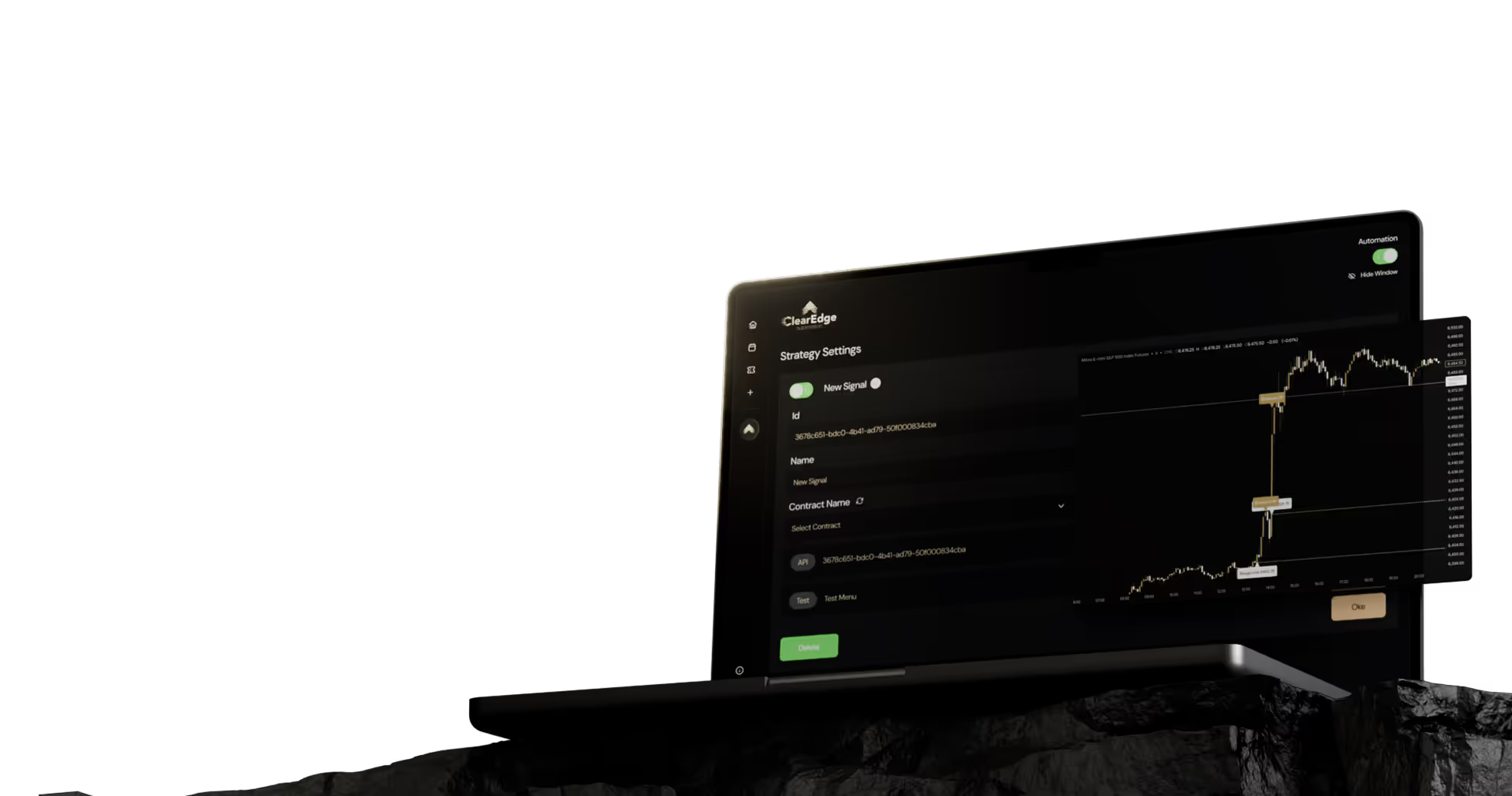
How To Start Algorithmic Trading As A Retail Trader: Complete 2026 Setup Guide
Automate your edge by turning TradingView alerts into executable trades. Launch no-code algorithmic strategies with $500 and remove emotion from your trading.


Retail traders can start algorithmic trading by selecting a no-code automation platform that connects TradingView alerts to their futures broker, defining their strategy rules, and paper trading before going live. The process requires no programming experience when using platforms like ClearEdge Trading, which automate order execution based on your predefined technical indicators and alert conditions. Most retail traders can set up basic automation in 1-2 hours with capital requirements starting around $500-1,000 for micro contracts.
Key Takeaways
- No-code platforms let retail traders automate futures strategies without programming skills by connecting TradingView alerts to broker APIs
- Starting capital ranges from $500 for micro contracts (MES, MNQ) to $5,000+ for standard futures contracts (ES, NQ)
- Paper trading your automated strategy for 30-60 days helps validate execution logic before risking real capital
- Automation removes emotional decision-making but requires disciplined rule creation and ongoing performance monitoring
Table of Contents
- What Is Retail Algorithmic Trading?
- Choosing Your Automation Platform
- Developing Your Trading Rules
- How Much Capital Do You Need?
- Setting Up Your First Automated Strategy
- Risk Management for Automated Trading
- Common Mistakes to Avoid
- Frequently Asked Questions
What Is Retail Algorithmic Trading?
Retail algorithmic trading is the practice of using software to automatically execute futures trades based on predefined rules and technical indicators. Unlike institutional algo trading that requires programming teams and custom infrastructure, retail algo trading uses accessible platforms that connect TradingView or other charting software to your broker account. When your indicator conditions are met, the platform sends the order automatically without manual clicking.
Algorithmic Trading: The use of computer programs to execute trades based on predetermined rules, removing manual order entry. For retail traders, this typically means connecting alert-based signals from TradingView to broker execution platforms.
The main advantage for retail traders is execution consistency. You trade your rules exactly as designed, eliminating hesitation during volatile markets and removing the emotional component that causes many traders to override their plans. Execution speeds range from 3-40 milliseconds depending on your platform and broker connection, fast enough to capture most intraday opportunities.
According to CME Group data, algorithmic trading now accounts for approximately 70% of futures volume. While institutional traders dominate this space, retail automation focuses on different goals: removing execution delays, maintaining discipline, and scaling tested strategies across multiple contracts or accounts.
Choosing Your Automation Platform
Your automation platform connects your trading signals to your broker's order execution system. The right platform depends on whether you want to code your strategies or use a no-code solution, your broker compatibility, and your budget.
No-code platforms like ClearEdge Trading let you automate TradingView strategies using webhook alerts without writing any code. You create your strategy in TradingView's Pine Script editor or use existing indicators, set up alert conditions, and configure the webhook URL to send trade signals to the automation platform. These platforms handle the order routing, position tracking, and risk management through a visual interface.
Platform TypeBest ForLearning CurveMonthly CostNo-Code (ClearEdge, WunderTrading)TradingView users, non-programmers1-2 hours$50-150Code-Based (NinjaTrader, TradeStation)Custom strategy developers2-6 months$0-200Hybrid (QuantConnect, MultiCharts)Backtesting focus1-3 months$0-300
Check supported broker integrations before committing to a platform. Popular futures brokers for automation include TradeStation, NinjaTrader Brokerage, Tradovate, and AMP Futures. Each has different API capabilities and connection requirements.
Developing Your Trading Rules
Successful automation starts with clear, testable rules. Your strategy needs specific entry conditions, exit conditions, position sizing logic, and risk parameters that can be translated into alerts or code.
Start with a simple concept you understand. Many retail algo traders begin with Opening Range breakouts, moving average crossovers, or momentum strategies based on volume and price action. The key is defining exactly when to enter and exit without ambiguity. "Buy when RSI is oversold" is too vague. "Buy 1 MES contract when RSI(14) crosses above 30 and price is above the 200 EMA" is specific enough to automate.
Backtesting: The process of testing your trading strategy against historical price data to evaluate how it would have performed. Backtesting helps identify if your rules have statistical edge before risking real capital.
Test your strategy in TradingView's Strategy Tester for at least 6-12 months of historical data. Look for consistent performance across different market conditions, not just bull markets. A profitable strategy should show positive expectancy (average win size × win rate > average loss size × loss rate) and reasonable drawdown periods under 20-25%.
Strategy Development Checklist
- ☐ Entry rules defined with specific indicator values and thresholds
- ☐ Exit rules include both profit targets and stop losses
- ☐ Position sizing matches your risk tolerance (typically 1-2% risk per trade)
- ☐ Strategy backtested on 6+ months of data with positive expectancy
- ☐ Rules account for trading session times and avoid major news events
How Much Capital Do You Need?
Starting capital for retail algo trading ranges from $500 for micro futures contracts to $5,000+ for standard contracts. Your capital requirement depends on the contracts you trade, your broker's margin requirements, and the drawdown buffer you need for strategy volatility.
Micro futures contracts offer the lowest barrier to entry. MES (Micro E-mini S&P 500) requires approximately $50-100 in margin per contract depending on your broker, with a tick value of $1.25. MNQ (Micro E-mini Nasdaq) has similar margin requirements with a $0.50 tick value. Starting with $500-1,000 gives you enough buffer to withstand normal strategy drawdowns while trading 1-2 micro contracts.
ContractTypical MarginTick ValueRecommended Starting CapitalMES (Micro S&P)$50-100$1.25$500-1,000MNQ (Micro Nasdaq)$50-150$0.50$500-1,000ES (E-mini S&P)$500-1,250$12.50$3,000-5,000NQ (E-mini Nasdaq)$800-2,000$5.00$5,000-8,000
Budget an additional $50-150 monthly for your automation platform subscription and $20-50 for TradingView's paid plan if you need real-time data and alerts. Total startup costs including software and initial capital typically range from $600-1,200 for micro contract trading.
Risk management rules suggest keeping maximum position risk at 1-2% of your account per trade. With a $1,000 account trading MES, a 10-point stop loss ($12.50) represents 1.25% risk, which fits within appropriate risk parameters. See our trading psychology automation guide for more on managing risk and emotions.
Setting Up Your First Automated Strategy
Setting up basic automation takes 1-2 hours once you have your platform and broker account ready. The process involves configuring your TradingView alerts, setting up webhook integration, and defining your risk parameters in the automation platform.
First, create or select your strategy in TradingView. If using Pine Script, code your entry and exit conditions, then add alert conditions to your script using the alertcondition() function. For indicator-based strategies, set up alerts by clicking the alert icon and defining your condition combinations (price crosses moving average, RSI crosses threshold, etc.).
Next, configure the webhook in your TradingView alert settings. Your automation platform provides a unique webhook URL that receives alert data. In the alert message field, you'll specify the trade parameters using JSON format: contract symbol, action (buy/sell), quantity, order type, and any stop loss or take profit values. The TradingView automation guide covers webhook setup in detail.
In your automation platform, connect your broker account via API credentials, set your risk limits (daily loss limit, maximum position size, trading hours), and activate the webhook listener. Most platforms offer a test mode where you can verify alerts are being received correctly before enabling live trading. Always test with paper trading first.
Setup Verification Steps
- ☐ TradingView alert fires correctly when conditions are met
- ☐ Webhook receives alert data in automation platform logs
- ☐ Paper trading executes orders with correct size and direction
- ☐ Stop loss and take profit orders place automatically
- ☐ Daily loss limit stops trading when threshold is reached
Risk Management for Automated Trading
Automated systems need hardcoded risk limits because they will execute every signal your strategy generates without hesitation. Set daily loss limits, maximum position sizes, and trading hour restrictions before activating any live automation.
A daily loss limit stops all trading once you've lost a specified dollar amount or percentage in a single session. For a $1,000 account, a $50 daily loss limit (5%) prevents a bad trading day from wiping out weeks of gains. Most automation platforms enforce this at the software level, automatically disabling trade execution once the limit is hit.
Daily Loss Limit: A hard stop that halts all automated trading after losses reach a predetermined threshold in a single trading day. Critical for protecting capital during unexpected market conditions or strategy failures.
Position sizing should scale with your account balance and match your risk tolerance. Never risk more than 2% per trade, and keep total exposure under 20% of your account across all open positions. If trading multiple strategies or instruments simultaneously, monitor correlation to avoid overconcentration in directional bets.
Avoid trading during major economic announcements unless your strategy is specifically designed for high-volatility events. FOMC announcements, Non-Farm Payrolls, and CPI releases cause spread widening and execution slippage that can invalidate your backtest assumptions. Set blackout periods in your automation platform for these scheduled events.
Advantages of Automated Risk Management
- Enforces stop losses without emotional override
- Prevents revenge trading after losses
- Maintains consistent position sizing
- Stops trading during network or data issues
Limitations to Monitor
- Can't adapt to unprecedented market conditions
- Requires regular monitoring of system health
- Needs manual updates for strategy adjustments
- May execute during broker connectivity issues
Common Mistakes to Avoid
New algo traders often skip paper trading and go live immediately, expecting their backtested results to translate directly to real markets. Paper trade for at least 30 days to verify your alerts fire correctly, orders execute as expected, and your risk limits work properly. Execution differences between backtests and live trading include slippage, partial fills, and webhook latency.
Over-optimization is another frequent mistake. Tweaking your strategy parameters until backtest results look perfect often creates a system that worked great on historical data but fails in live markets. If your strategy has more than 4-5 adjustable parameters, you're likely curve-fitting. Keep rules simple and test on out-of-sample data you didn't use during development.
Running automation without monitoring is dangerous. Check your system daily for execution errors, unexpected positions, or performance degradation. Markets change, and a strategy that worked for months can suddenly stop working when volatility or correlation patterns shift. Review weekly performance reports and pause automation if drawdowns exceed your backtest expectations.
Ignoring trading costs in backtest calculations leads to inflated profit expectations. Include commission, exchange fees, and realistic slippage estimates (0.5-1 tick for liquid contracts like ES during regular hours, 1-2 ticks during overnight sessions). A strategy that shows 2% monthly returns in backtests may only deliver 1% after real trading costs.
Frequently Asked Questions
1. Can I start algorithmic trading with no programming experience?
Yes, no-code platforms let you automate TradingView strategies using webhook alerts without writing code. You configure your strategy rules in TradingView's visual interface, set up alerts for your entry and exit conditions, and the automation platform handles order execution through your broker's API.
2. How long does it take to set up automated trading?
Basic setup takes 1-2 hours once you have your broker account and automation platform ready. This includes creating your TradingView strategy, configuring webhook alerts, connecting your broker API, and setting risk parameters. Add 30-60 days of paper trading to validate everything works correctly before live trading.
3. What's the minimum capital needed to start algo trading futures?
You can start with $500-1,000 trading micro futures contracts like MES or MNQ, which require $50-150 margin per contract. Standard contracts like ES or NQ need $3,000-5,000 minimum to maintain appropriate risk management with sufficient drawdown buffer.
4. Do automated strategies work during overnight trading sessions?
Yes, but overnight sessions typically have wider spreads and lower volume than regular trading hours. Your strategy should account for this by adjusting stop distances and profit targets. Many algo traders restrict automation to regular hours (9:30 AM - 4:00 PM ET) to avoid overnight execution issues.
5. How often should I monitor my automated trading system?
Check your system at least once daily to verify positions are correct, no errors occurred, and performance matches expectations. Review detailed performance metrics weekly to catch strategy degradation early. Automation removes manual execution but still requires active monitoring and periodic adjustments.
Conclusion
Starting algorithmic trading as a retail trader requires selecting a compatible automation platform, developing testable strategy rules, and paper trading for 30-60 days before risking real capital. Capital requirements start around $500-1,000 for micro contracts, with monthly software costs of $50-150.
Focus on simple strategies with clear rules, implement strict risk management with daily loss limits, and monitor your automated system regularly for execution issues or performance changes. For more on specific futures contracts to automate, see our futures instrument automation guide.
Want to dig deeper? Read our complete guide to algorithmic trading for more detailed setup instructions and strategies.
References
- CME Group. "E-mini S&P 500 Futures Contract Specs." https://www.cmegroup.com/markets/equities/sp/e-mini-sandp500.html
- TradingView. "Webhooks in Alerts." https://www.tradingview.com/support/solutions/43000529348-webhooks-in-alerts/
- National Futures Association. "Investor Resources." https://www.nfa.futures.org/investors/index.html
- CFTC. "Customer Advisory: Beware of Foreign Currency Trading Frauds." https://www.cftc.gov/ConsumerProtection/FraudAwarenessPrevention
Disclaimer: This article is for educational purposes only. It is not trading advice. ClearEdge Trading executes trades based on your rules—it does not provide signals or recommendations.
Risk Warning: Futures trading involves substantial risk. You could lose more than your initial investment. Past performance does not guarantee future results. Only trade with capital you can afford to lose.
CFTC RULE 4.41: Hypothetical results have limitations and do not represent actual trading.
By: ClearEdge Trading Team | About























































Steal the PlaybooksOther TradersDon’t Share
Every week, we break down real strategies from traders with 100+ years of combined experience, so you can skip the line and trade without emotion.