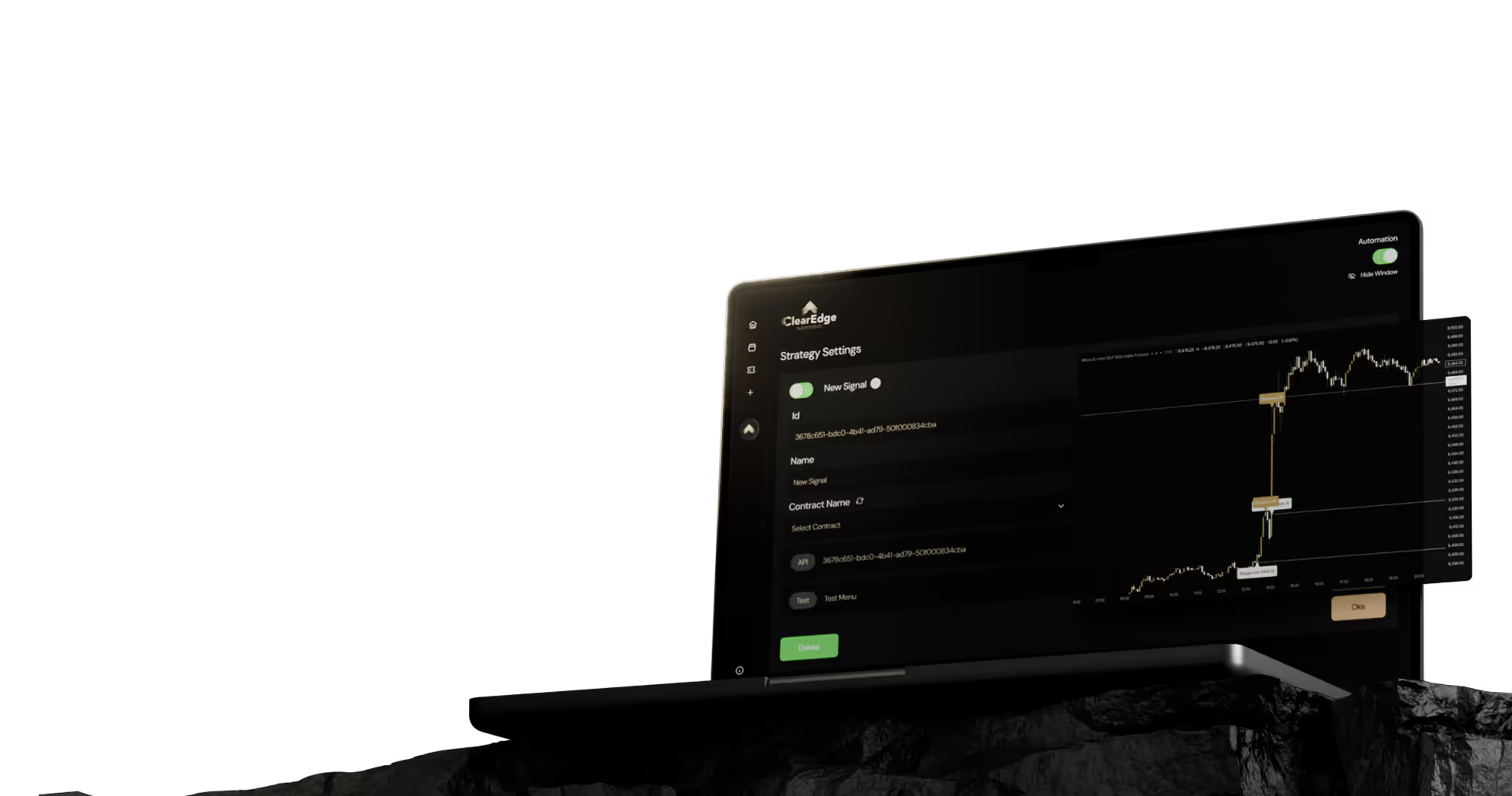
TradingView Automation During NFP Releases: Complete Setup Guide
Handle NFP volatility by adjusting TradingView automation stops and position sizes. Prevent ES futures slippage with these critical webhook setup tips.


TradingView automation during NFP (Non-Farm Payrolls) releases requires specific configurations to handle extreme volatility: wider stop losses (3-5 ES points vs. 1-2 normal), reduced position sizing (50% of standard), pre-event webhook testing, and optional trade suspension 2 minutes before/after the 8:30 AM ET release. NFP days see ES futures move 10-30+ points in seconds, making proper automation settings critical to avoid slippage and unintended fills.
Key Takeaways
- NFP releases occur first Friday monthly at 8:30 AM ET and often move ES 15-25 points within 60 seconds
- Widen stops to 3-5 points minimum during NFP vs. 1-2 points normal to avoid premature stop-outs from volatility spikes
- Reduce position size by 50% for NFP automation to manage increased risk from wider spreads and faster price action
- Test webhooks 30+ minutes before release and consider pausing automation 2 minutes pre/post-event to avoid erratic fills
- Broker API latency becomes critical—3-10ms execution platforms significantly outperform 50-100ms during NFP volatility
Table of Contents
- What Is NFP and Why Does It Matter for Automation?
- NFP Volatility Characteristics
- Key Automation Adjustments for NFP
- TradingView Alert Configuration for NFP
- Risk Parameter Changes During NFP
- Common NFP Automation Mistakes
- Frequently Asked Questions
- Conclusion
What Is NFP and Why Does It Matter for Automation?
Non-Farm Payrolls (NFP) is a monthly employment report released by the U.S. Bureau of Labor Statistics on the first Friday of each month at 8:30 AM ET. The report shows how many jobs were added or lost in the U.S. economy (excluding farm workers, government employees, and nonprofit organization employees), making it one of the most impactful economic indicators for futures markets. For automated trading systems, NFP represents the single highest-risk event on the monthly calendar due to extreme volatility, widened spreads, and rapid multi-directional price swings.
Non-Farm Payrolls (NFP): A monthly U.S. employment report measuring job creation across non-agricultural sectors, released first Friday at 8:30 AM ET. NFP releases routinely move ES futures 15-30 points in under two minutes, creating significant automation challenges.
ES futures typically average 0.25-0.50 point spreads during regular hours. During NFP releases, spreads can widen to 2-4 points for 30-90 seconds. This spread expansion combined with 10-30 point moves in 60 seconds means standard automation settings designed for normal market conditions will fail. Your 1.5-point stop loss that works 95% of the time becomes meaningless when the market gaps 8 points through your level in one second.
Automated systems execute exactly as programmed—they don't "sense" that market conditions have changed. Without specific NFP configurations, your automation will enter trades at terrible prices, get stopped out on noise, or miss fills entirely due to rapid price movement. The TradingView automation process requires explicit parameter changes for high-impact economic events.
NFP Volatility Characteristics
NFP releases create a distinct volatility pattern that differs from other economic events. The initial reaction happens within 5-15 seconds of the 8:30 AM release, typically moving ES 8-15 points in one direction. This is followed by a 30-60 second reversal or continuation that adds another 5-15 points of movement. Total range from initial reaction to 5-minute stabilization averages 15-25 points for ES, but can exceed 40 points on surprise readings.
Here's what makes NFP particularly challenging for automation:
Market ConditionNormal TradingNFP Release (8:30-8:35 AM ET)ES Bid-Ask Spread0.25-0.50 points1.5-4.0 pointsTypical 1-Min Range0.5-2.0 points8-20 pointsOrder Fill Slippage0-0.25 points1-5 pointsMarket Order RiskLowExtreme—avoid entirelyStop Order Slippage0.25-0.75 points3-10 points
The seconds immediately before 8:30 AM also see unusual behavior. Liquidity often thins at 8:29:30-8:29:59 as market makers pull orders, causing spreads to widen even before the data hits. Some algorithms pause entirely during this 30-second window. If your automation fires an alert at 8:29:45, you might face 2-point spreads before the actual news.
According to CME Group data, ES futures volume spikes 300-500% in the first minute after NFP compared to average morning volume. This creates a paradox: more volume but worse execution quality due to rapid price discovery and spread widening. Your automated execution system needs specific rules to handle this environment.
Key Automation Adjustments for NFP
Successful NFP automation requires five specific adjustments to your standard configuration. These should be implemented at minimum 30 minutes before the 8:30 AM release and can be reverted after 9:00 AM once volatility normalizes. Each adjustment addresses a specific failure mode that occurs during extreme volatility events.
1. Widen Stop Losses by 2-3x
Your standard 1.5-point ES stop becomes 3-5 points for NFP. This isn't about accepting more risk—it's about avoiding stop-outs on volatility noise. A 15-point favorable move that includes a 6-point pullback is normal during NFP. Standard stops will exit you at the worst possible time.
2. Reduce Position Size by 50%
If you normally trade 2 ES contracts, trade 1 during NFP. The wider stops mean your dollar risk per trade stays approximately the same (1 contract × 4 points = $200 risk vs. 2 contracts × 2 points = $200 risk). This compensates for the increased stop distance while maintaining risk consistency.
3. Switch to Limit Orders Only
Never use market orders during NFP releases. Configure your automation to use limit orders with a 1-2 point buffer from current price. For a long entry at 4500.00, use a limit buy at 4501.00-4502.00. You'll miss some fills, but you'll avoid catastrophic 5-point slippage on market orders.
Limit Order Buffer: The additional points added to your intended entry price when using limit orders during volatile events. A 1-point buffer on a 4500 ES long entry means placing a limit buy at 4501, ensuring you get filled during rapid upward movement without excessive slippage.
4. Extend Webhook Timeout Settings
Standard webhook timeouts of 1-3 seconds may fail during NFP as broker APIs experience load spikes. Increase timeouts to 5-10 seconds in your automation platform. Platforms like ClearEdge Trading allow per-event timeout configuration specifically for high-impact releases.
5. Consider Trade Suspension Windows
The most conservative approach: disable automation from 8:28-8:32 AM ET. Your TradingView alerts still fire and log, but execution is paused. Resume automation after the initial volatility spike passes. This prevents entries during the chaotic 30-90 second window when fills are most problematic.
TradingView Alert Configuration for NFP
TradingView alerts for NFP automation need specific modifications to your standard alert structure. The webhook payload should include conditional logic that adjusts parameters based on time proximity to the 8:30 AM release. While TradingView alerts themselves don't have built-in time awareness, your automation platform can interpret timestamp data and apply NFP rules.
Standard webhook JSON structure:
{
"ticker": "ES1!",
"action": "buy",
"price": {{close}},
"stop": {{plot("stop_loss")}},
"target": {{plot("take_profit")}},
"contracts": 2,
"event_mode": "normal"
}
Modified for NFP awareness (requires automation platform logic):
{
"ticker": "ES1!",
"action": "buy",
"price": {{close}},
"stop": {{plot("stop_loss_wide")}},
"target": {{plot("take_profit")}},
"contracts": 1,
"event_mode": "nfp",
"order_type": "limit",
"limit_buffer": 1.5
}
The key differences: reference to a wider stop plot, reduced contract count, explicit limit order type, and a limit buffer value. Your automation platform must recognize the "nfp" event_mode and apply appropriate execution logic. Some platforms like ClearEdge support economic calendar integration that automatically applies NFP rules based on release schedules without manual webhook changes.
For TradingView webhook setup, test your NFP configuration on a prior NFP date using historical replay. Run alerts in paper trading mode during the actual 8:30 AM window to verify fills, slippage, and stop behavior before risking live capital. Testing during normal market hours won't reveal NFP-specific issues.
Risk Parameter Changes During NFP
Risk management rules that work during normal trading require recalibration for NFP releases. Daily loss limits, maximum position sizes, and profit targets all need adjustment to account for the compressed timeframe and magnitude of NFP moves. These parameters should be set in your automation platform's risk control settings, not just in TradingView alert logic.
NFP Risk Parameter Checklist
- ☐ Daily loss limit reduced by 30% for NFP days (if normally $500, use $350 max for the day)
- ☐ Maximum position size reduced by 50% specifically for 8:15-9:00 AM ET window
- ☐ No new positions allowed 8:28-8:32 AM ET (4-minute blackout around release)
- ☐ Profit targets widened 2x for NFP trades (if normally 3 points, use 6 points for NFP entries)
- ☐ Maximum 1-2 trades during 8:30-9:00 AM window regardless of signals
- ☐ Trailing stop activation delayed until position is 3+ points profitable (vs. 1.5 normally)
The daily loss limit reduction accounts for the fact that NFP losses tend to be larger due to wider stops and faster adverse movements. If you're going to hit your daily limit, NFP days are when it's most likely. Reducing the limit by 30% for the entire day provides a buffer—you can still trade after 9:00 AM, but with awareness that morning volatility has already consumed part of your risk budget.
Position sizing deserves special attention. The 50% reduction applies to the 45-minute window around NFP (8:15-9:00 AM ET), not the entire day. After 9:00 AM, once spreads normalize and the initial reaction is complete, you can return to standard position sizing. This targeted reduction focuses protection on the highest-risk period without overly restricting your trading day.
For traders using prop firm automation, NFP days present additional challenges. Most prop firms have daily loss limits of 2-5% of account value. A single poorly-executed NFP trade with 5-point slippage on 2 contracts ($500 loss on ES) can consume 50-100% of a $5,000 account's daily limit. Conservative prop traders often skip NFP automation entirely until they've passed evaluation phases.
Common NFP Automation Mistakes
Even experienced automated traders make predictable errors during NFP releases. These mistakes stem from underestimating how different NFP volatility is from normal trading conditions. Here are the four most common failures and how to avoid them.
Using Standard Stop Distances
The number one mistake: leaving your 1-2 point stops in place during NFP. ES routinely whipsaws 5-8 points in both directions during the first 90 seconds after release. Your stop gets hit on noise, then the market runs 15 points in your original direction. Solution: 3-5 point minimum stops during NFP, or no trading at all during the 8:28-8:32 window.
Not Testing Webhook Latency Pre-Event
Your webhook works fine at 2:00 PM with 15ms round-trip time. At 8:30 AM during NFP, broker API servers are handling 50x normal request volume. That 15ms becomes 200ms or the request times out entirely. Send test webhooks at 8:00 AM and 8:15 AM on NFP morning to verify connectivity before the event. If tests fail or show >100ms latency, consider skipping automation.
Forgetting About Spread Widening
Your automation places a long at 4500.00 market price. During the 0.5 seconds between alert fire and order arrival, the spread widened from 0.25 to 3.0 points. You get filled at 4501.50 instead of 4500.25—an extra $62.50 slippage on one ES contract. Multiply this across multiple trades and NFP becomes expensive. Use limit orders with 1-2 point buffers rather than market orders.
Over-Trading the Volatility
NFP moves are large, so traders configure automation to take multiple entries during the 8:30-8:45 window. Result: 4-5 trades with mixed results, high cumulative slippage, and confused overall P&L. Better approach: maximum 1-2 trades during the NFP window, or wait until after 8:45 AM when initial volatility subsides. Quality over quantity matters more during extreme volatility events.
Frequently Asked Questions
1. Should I disable TradingView automation completely during NFP releases?
For new automated traders or those in prop firm evaluation phases, yes—disable automation from 8:25-8:35 AM ET on NFP days. Experienced traders with tested NFP configurations can trade the event, but should reduce position size by 50% and widen stops to 3-5 points minimum. The risk-reward often favors waiting until after 8:45 AM when volatility normalizes.
2. How do I configure different TradingView alert settings for NFP vs. normal days?
Create separate alert versions: "ES Strategy - Normal" and "ES Strategy - NFP" with different stop/target plots and position sizing variables. Manually enable the NFP version before 8:30 AM on first Friday of each month, then switch back to normal version after 9:00 AM. Some automation platforms like ClearEdge support economic calendar integration that applies NFP rules automatically without manual alert switching.
3. What's the minimum stop loss distance for ES during NFP releases?
3 points minimum for ES futures during NFP releases, with 4-5 points preferred for conservative risk management. The 8:30 AM release routinely produces 5-8 point whipsaws in the first 60-90 seconds. Stops tighter than 3 points have extremely high probability of getting hit on volatility noise rather than genuine directional moves.
4. Can I use market orders for TradingView automation during NFP?
No—market orders during NFP releases risk 3-7 point slippage on ES due to spread widening and rapid price movement. Use limit orders with 1-2 point buffers from your intended entry price. You'll miss some fills, but avoided slippage saves significantly more than missed opportunities cost. Configure your automation platform to convert market orders to limit orders during designated high-volatility windows.
5. How long does NFP volatility last and when can I resume normal automation settings?
Initial extreme volatility lasts 2-5 minutes (8:30-8:35 AM ET), with elevated volatility continuing until approximately 8:45-9:00 AM. Spreads typically normalize to 0.50-0.75 points by 8:45 AM, and directional bias becomes clearer. Resume normal automation settings after 9:00 AM once you observe consistent 0.25-0.50 point spreads and sub-2-point one-minute candle ranges.
Conclusion
NFP releases require specific TradingView automation adjustments: 50% position size reduction, 3-5 point stop distances, limit-only order types, and optional 8:28-8:32 AM trade suspension. The extreme volatility and spread widening during the 8:30 AM release make standard automation settings inadequate—ES futures regularly move 15-25 points in under two minutes with 2-4 point spreads.
Test your NFP configuration during previous NFP dates using TradingView replay and paper trading before risking live capital. Many successful automated traders simply pause trading during the 8:25-8:35 AM window entirely, resuming automation after initial volatility subsides. For detailed webhook configuration and broker-specific latency considerations, review the complete TradingView automation guide.
Want to explore automated execution with built-in economic event protection? Learn how ClearEdge Trading handles high-volatility releases with calendar-aware risk controls and no-code configuration.
References
- U.S. Bureau of Labor Statistics. "Employment Situation Summary." https://www.bls.gov/news.release/empsit.nr0.htm
- CME Group. "E-mini S&P 500 Futures Contract Specs." https://www.cmegroup.com/markets/equities/sp/e-mini-sandp500.html
- CME Group. "Economic Event Impact on Futures Markets - 2024 Data." https://www.cmegroup.com/education/articles-and-reports/economic-research.html
- TradingView. "About Webhooks in Alerts." https://www.tradingview.com/support/solutions/43000529348-about-webhooks/
Disclaimer: This article is for educational and informational purposes only. It does not constitute trading advice, investment advice, or any recommendation to buy or sell futures contracts. ClearEdge Trading is a software platform that executes trades based on your predefined rules—it does not provide trading signals, strategies, or personalized recommendations.
Risk Warning: Futures trading involves substantial risk of loss and is not suitable for all investors. You could lose more than your initial investment. Past performance of any trading system, methodology, or strategy is not indicative of future results. Before trading futures, you should carefully consider your financial situation and risk tolerance. Only trade with capital you can afford to lose.
CFTC RULE 4.41: HYPOTHETICAL OR SIMULATED PERFORMANCE RESULTS HAVE CERTAIN LIMITATIONS. UNLIKE AN ACTUAL PERFORMANCE RECORD, SIMULATED RESULTS DO NOT REPRESENT ACTUAL TRADING. ALSO, SINCE THE TRADES HAVE NOT BEEN EXECUTED, THE RESULTS MAY HAVE UNDER-OR-OVER COMPENSATED FOR THE IMPACT, IF ANY, OF CERTAIN MARKET FACTORS, SUCH AS LACK OF LIQUIDITY.
By: ClearEdge Trading Team | 29+ Years CME Floor Trading Experience | About ClearEdge Trading























































Steal the PlaybooksOther TradersDon’t Share
Every week, we break down real strategies from traders with 100+ years of combined experience, so you can skip the line and trade without emotion.