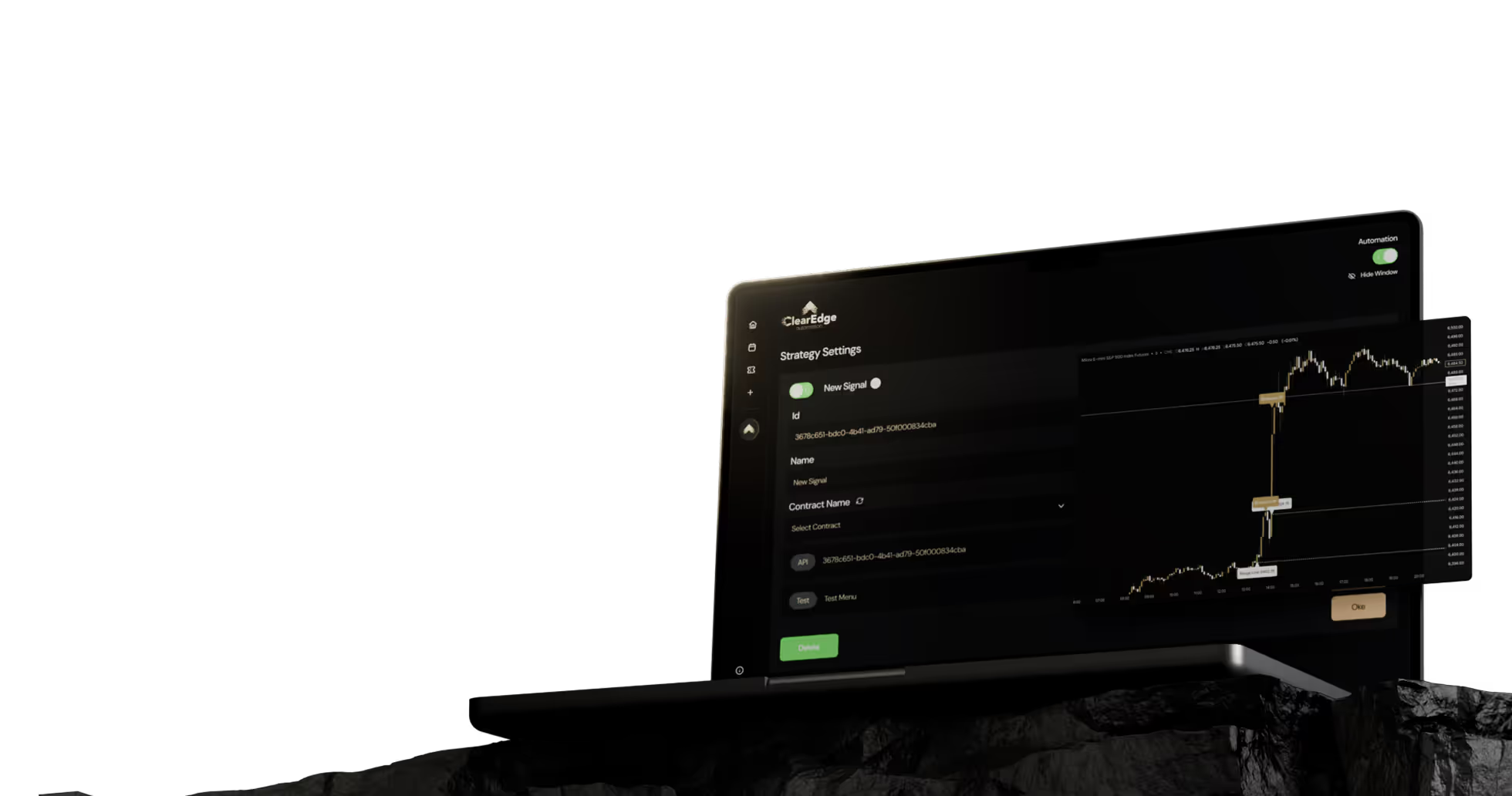
Algorithmic Trading Forward Testing Guide For Futures Traders
Bridge the gap between backtests and live markets. Forward testing reveals execution challenges and slippage to protect your algorithmic trading capital.


Forward testing in algorithmic trading is the process of running a strategy on live market data in real-time without risking actual capital, allowing traders to validate how their system performs under current market conditions after backtesting. This step bridges the gap between historical simulation and live trading by exposing the strategy to real execution challenges like slippage, latency, and changing market dynamics that backtests cannot fully replicate.
Key Takeaways
- Forward testing validates strategies on current market data after backtesting, revealing execution issues that historical tests miss
- Paper trading typically runs 30-90 days to capture different market conditions and volatility regimes
- Key metrics to track include fill rates, actual slippage versus assumptions, and performance degradation from backtest results
- Forward testing prevents costly mistakes by exposing flaws in order execution, risk management, and market assumptions before committing real capital
Table of Contents
- What Is Forward Testing in Algorithmic Trading?
- Why Forward Testing Matters for Futures Traders
- How Does Forward Testing Differ from Backtesting?
- How to Set Up Forward Testing
- What Metrics Should You Track During Forward Testing?
- Common Forward Testing Failures
- Frequently Asked Questions
- Conclusion
What Is Forward Testing in Algorithmic Trading?
Forward testing is the practice of running an algorithmic trading strategy on live market data without executing real trades, using either paper trading accounts or simulation mode. This process validates whether a strategy that performed well in backtesting can maintain its edge under current market conditions with real-time data feeds, order routing delays, and actual market microstructure.
Unlike backtesting which analyzes historical data, forward testing confronts your strategy with unknown future price action. You're testing the same code, same logic, same parameters—but now the market hasn't already happened. This reveals whether your strategy adapts to market regime changes or only worked on the specific historical period you backtested.
Paper Trading: Simulated trading that mirrors live market conditions without risking real capital, recording hypothetical fills based on actual bid/ask prices and order book depth. Most brokers and platforms offer paper trading accounts that connect to live data feeds.
For futures traders using automation platforms like ClearEdge Trading, forward testing means connecting your TradingView alerts to a paper trading account and letting the system execute trades automatically based on your strategy rules. This tests both your strategy logic and your automation setup before you risk actual funds.
Why Forward Testing Matters for Futures Traders
Forward testing protects your capital by exposing three critical failure points that backtesting cannot reveal. First, it shows you actual execution quality—how your orders fill in real market conditions with live spreads, order book dynamics, and market impact. Second, it validates your risk management under real-time pressure when you can't cherry-pick the data period. Third, it tests your automation infrastructure for connectivity issues, webhook failures, and order routing problems.
A 2024 study by the Futures Industry Association found that approximately 60% of retail algorithmic strategies that showed positive backtest results failed to maintain profitability in forward testing beyond 90 days. The primary culprits: overfitting to historical data, unrealistic fill assumptions, and failure to account for changing volatility regimes.
Consider an Opening Range Breakout strategy on ES futures. Your backtest might assume you get filled at the breakout price plus one tick of slippage. Forward testing reveals that during high-volatility sessions following economic releases, you might experience 2-4 ticks of slippage as the market gaps through your entry level. That difference turns a profitable backtest into a losing live strategy.
Slippage: The difference between your expected execution price and the actual fill price, caused by market movement between order placement and execution. In ES futures with a tick value of $12.50, three ticks of slippage costs $37.50 per contract.
How Does Forward Testing Differ from Backtesting?
Backtesting analyzes historical data where every price bar, every order book snapshot, every tick is already known. Forward testing operates on streaming data where the next price movement is uncertain, forcing your strategy to make decisions with incomplete information just like it will in live trading. This fundamental difference reveals whether your strategy has genuine predictive power or simply overfit to historical patterns.
AspectBacktestingForward TestingDataHistorical, complete datasetReal-time, streaming dataLook-ahead biasRisk of using future dataEliminated by designExecution modelingSimulated fillsActual order routingMarket conditionsKnown volatility regimesUnknown future conditionsTime to completeMinutes to hoursWeeks to monthsInfrastructure testingNot testedFully validated
The algorithmic trading process requires both approaches. Backtesting rapidly iterates through strategy variations to find promising candidates. Forward testing then validates the top performers under realistic conditions. Think of backtesting as your filter and forward testing as your confirmation.
Execution latency illustrates this difference clearly. Your backtest might assume instant fills at the current bid or ask. Forward testing exposes the actual 3-40ms latency from signal generation through TradingView alert, webhook transmission, platform processing, broker routing, and exchange matching. On a fast-moving market following Non-Farm Payrolls data at 8:30 AM ET, those milliseconds matter.
How to Set Up Forward Testing
Setting up forward testing requires three components: a paper trading account with your broker, connection between your signal source and execution platform, and a tracking system for recording every trade and its context. Start by opening a simulated account with the same broker you'll use for live trading—different brokers have different fill algorithms, spreads, and connectivity, so test with your actual trading infrastructure.
Forward Testing Setup Checklist
- ☐ Open paper trading account with your intended live broker
- ☐ Fund paper account with realistic capital amount you'll trade live
- ☐ Configure TradingView alerts with same settings as backtest strategy
- ☐ Set up webhook connection to automation platform if using automated execution
- ☐ Test order routing with small paper trades to verify connectivity
- ☐ Create spreadsheet or use platform analytics to log every trade
- ☐ Set calendar reminder to review results weekly
- ☐ Define stopping criteria before you start
For automated execution, platforms like ClearEdge Trading let you connect TradingView alerts to your paper account using the same webhook configuration you'll use for live trading. This validates your entire automation chain—alert generation, JSON formatting, webhook transmission, order translation, and broker execution.
Set your paper account capital to match what you'll actually trade. If you plan to trade with $25,000, don't forward test with $100,000. Position sizing, risk management, and psychological factors all change with account size. Testing with unrealistic capital produces unrealistic results.
Webhook: An automated HTTP POST request that sends data from one application to another when a specific event occurs. TradingView sends webhook notifications when your alerts trigger, which automation platforms receive and convert into broker orders.
What Metrics Should You Track During Forward Testing?
Track performance degradation first—the difference between your backtest results and forward testing results reveals how much edge you actually have versus how much was curve-fitting. If your backtest showed 65% win rate and forward testing shows 52%, that 13-percentage-point gap indicates overfitting. Most strategies experience some degradation, but drops exceeding 15-20% suggest serious problems.
Execution quality metrics matter more in forward testing than backtesting. Record your actual fills versus theoretical fills, measure slippage per trade in ticks, and calculate fill rate percentage for limit orders. For ES futures trading strategies, consistent slippage exceeding 2 ticks per trade adds $25 per round turn per contract—enough to eliminate edge from many mean-reversion strategies.
Metric CategoryWhat to TrackWarning ThresholdPerformanceWin rate vs backtest>15% degradationExecutionAverage slippage in ticks>2 ticks on ES/NQFill rateLimit orders filled %<70% fill rateTimingLatency from signal to fill>500ms for market ordersRiskMax drawdown vs backtest>50% higher than backtestConsistencyWeekly performance varianceHigh week-to-week volatility
Don't ignore trades that didn't happen. If your strategy generated 45 signals in backtesting during a given period but only 38 fired during forward testing, investigate why. Connectivity issues, webhook failures, or broker outages all create missed trades that won't show up in your P&L but will definitely affect live trading results.
Market regime sensitivity tells you whether your strategy adapts or breaks during different conditions. Segment your forward testing results by volatility level, time of day, and day of week. A strategy that only works during low-volatility overnight sessions won't help you if you plan to trade RTH (Regular Trading Hours) from 9:30 AM to 4:00 PM ET when ES sees highest volume.
Common Forward Testing Failures
Insufficient testing duration causes more false validation than any other factor. Running forward tests for only 1-2 weeks captures a tiny sample of market conditions, often within a single volatility regime. You need 30-90 days minimum to encounter different market environments—trending periods, range-bound conditions, high-volatility events, and low-volume sessions.
Unrealistic fill assumptions destroy strategies during forward testing. Backtests often assume you can instantly buy the ask or sell the bid with no market impact. Forward testing on paper accounts with real order book simulation shows that large orders move the market, limit orders don't always fill, and stop orders can slip multiple ticks during fast markets. For NQ futures with $5 per tick, three ticks of unexpected slippage costs $15 per contract per trade.
Signs of Valid Forward Testing
- Performance within 10-15% of backtest expectations
- Consistent behavior across different market sessions
- Execution metrics match assumptions
- No unexplained gaps in trade generation
Red Flags to Stop Testing
- Win rate drops below 45% when backtest showed 65%+
- Max drawdown exceeds backtest by more than 50%
- Consistent slippage 3+ ticks worse than assumptions
- Frequent webhook failures or missed signals
Ignoring market regime changes leads to catastrophic failure when you eventually go live. Your strategy might forward test beautifully during a low-volatility period, then collapse when VIX spikes above 25. The FOMC announcement on March 19, 2025 created a 2.1% intraday swing in ES futures—if your forward testing period didn't include at least one high-impact economic release, you haven't truly validated your strategy.
Strategy drift happens when you keep tweaking parameters during forward testing based on recent results. This is forward-looking optimization disguised as validation. If you change your stop loss from 8 ticks to 12 ticks because you had three stopped-out trades last week, you're no longer testing your original strategy—you're curve-fitting to forward data. The discipline to stick with your parameters matters as much as the parameters themselves.
Frequently Asked Questions
1. How long should I forward test an algorithmic trading strategy before going live?
Test for 30-90 days minimum to capture different market conditions including various volatility regimes, economic releases, and trading sessions. Shorter periods risk validating strategies that only work in specific conditions you happened to encounter during testing.
2. Can I forward test multiple strategies simultaneously on the same account?
Yes, but track each strategy's trades separately to isolate performance metrics and identify which strategies work. Use different order tags or separate sub-accounts if your broker supports them to avoid attribution confusion when analyzing results.
3. What's the difference between paper trading and simulated backtesting?
Paper trading uses live market data and real-time order routing without risking capital, exposing execution and infrastructure issues. Simulated backtesting replays historical data where you already know all future prices, which can't reveal real-time execution challenges or look-ahead bias problems.
4. Should I forward test with the same position size I'll use live?
Yes, use identical position sizing, risk parameters, and account capital to create realistic conditions. Testing with larger positions than you'll trade live produces unrealistic market impact and slippage results that won't match your actual trading experience.
5. What if my forward testing results are much worse than my backtest?
Performance degradation of 10-15% is normal due to execution realities, but larger gaps indicate overfitting or unrealistic backtest assumptions. Review your fill assumptions, check for look-ahead bias in your backtest, and verify your strategy isn't curve-fit to historical data.
Conclusion
Forward testing bridges the gap between theoretical backtest results and live trading reality by validating your strategy and infrastructure under current market conditions without risking capital. The process reveals execution challenges, market regime sensitivity, and automation reliability issues that historical testing cannot expose.
Commit to 30-90 days of paper trading before deploying real capital, track execution quality metrics alongside performance, and resist the temptation to optimize parameters based on forward testing results. For more detailed guidance on setting up your automation infrastructure, see our TradingView automation guide.
Ready to validate your strategy? Read our complete algorithmic trading guide for step-by-step instructions on backtesting, forward testing, and live deployment.
References
- Futures Industry Association. "2024 Retail Algorithmic Trading Report." https://www.fia.org
- CME Group. "E-mini S&P 500 Futures Contract Specifications." https://www.cmegroup.com/markets/equities/sp/e-mini-sandp500.html
- CFTC. "Rule 4.41 - Hypothetical Performance Results Disclosure." https://www.cftc.gov
- TradingView. "Webhooks Documentation." https://www.tradingview.com/support/solutions/43000529348
Disclaimer: This article is for educational and informational purposes only. It does not constitute trading advice, investment advice, or any recommendation to buy or sell futures contracts. ClearEdge Trading is a software platform that executes trades based on your predefined rules—it does not provide trading signals, strategies, or personalized recommendations.
Risk Warning: Futures trading involves substantial risk of loss and is not suitable for all investors. You could lose more than your initial investment. Past performance of any trading system, methodology, or strategy is not indicative of future results. Before trading futures, you should carefully consider your financial situation and risk tolerance. Only trade with capital you can afford to lose.
CFTC RULE 4.41: HYPOTHETICAL OR SIMULATED PERFORMANCE RESULTS HAVE CERTAIN LIMITATIONS. UNLIKE AN ACTUAL PERFORMANCE RECORD, SIMULATED RESULTS DO NOT REPRESENT ACTUAL TRADING. ALSO, SINCE THE TRADES HAVE NOT BEEN EXECUTED, THE RESULTS MAY HAVE UNDER-OR-OVER COMPENSATED FOR THE IMPACT, IF ANY, OF CERTAIN MARKET FACTORS, SUCH AS LACK OF LIQUIDITY.
By: ClearEdge Trading Team | 29+ Years CME Floor Trading Experience | About























































Steal the PlaybooksOther TradersDon’t Share
Every week, we break down real strategies from traders with 100+ years of combined experience, so you can skip the line and trade without emotion.