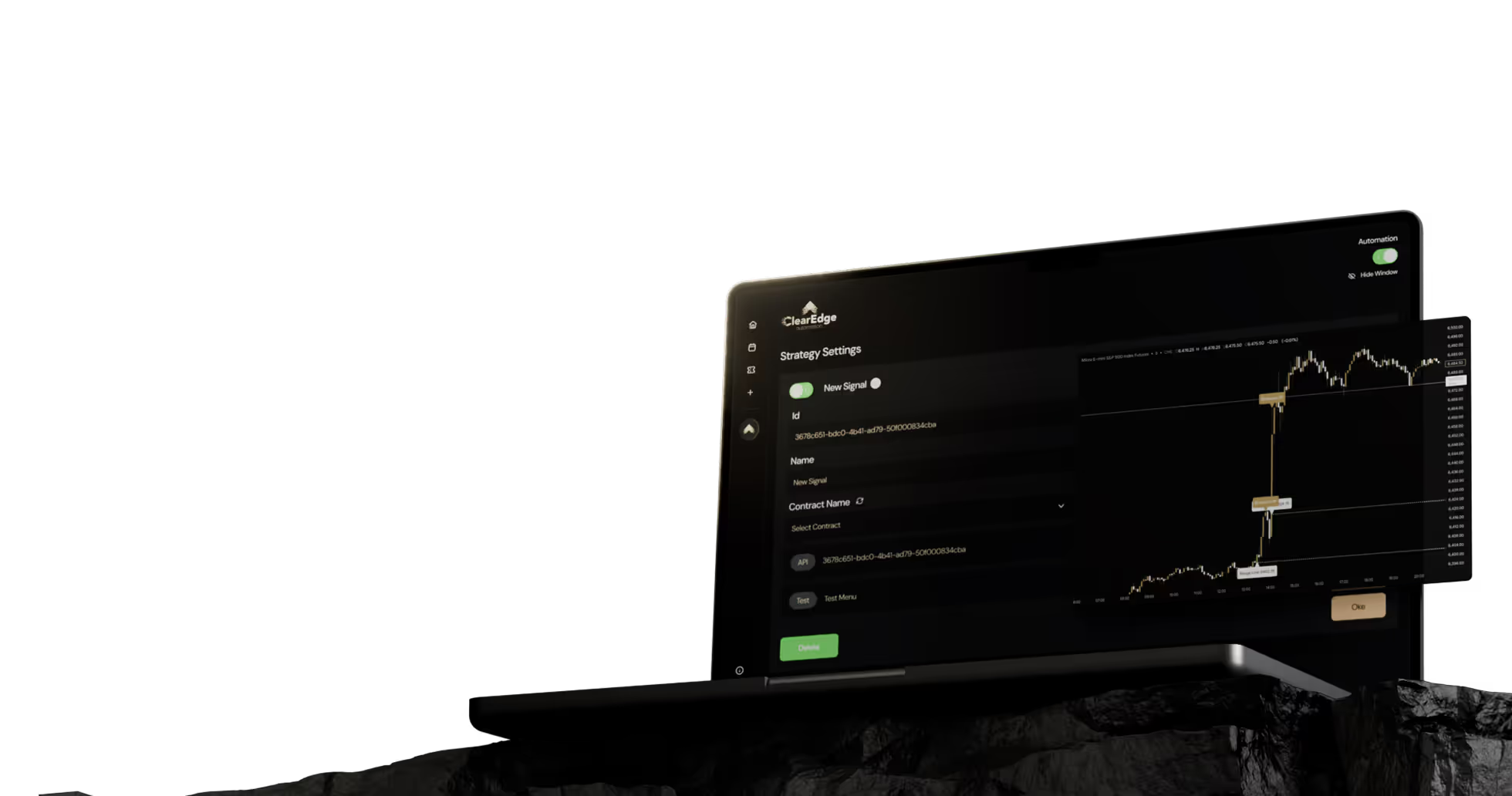
Top Futures Automation Platforms: Python Integration Comparison Guide
Master automated futures trading with the right Python integration. Compare native SDKs, API access, and no-code tools across leading automation platforms.


Futures automation platforms differ significantly in Python integration support. Some platforms offer full Python scripting with custom library access, while others limit scripting to proprietary languages or no-code builders. This comparison evaluates how leading futures automation platforms handle Python integration for custom strategy development, backtesting, and execution workflows based on API access, library support, and documentation quality.
Key Takeaways
- Full Python API access varies widely: some platforms offer native Python SDKs, others require REST or FIX protocol workarounds, and no-code platforms skip scripting entirely
- Platforms with Python support typically allow custom indicator development, strategy backtesting with pandas/numpy, and broker order routing through API calls
- No-code platforms like ClearEdge Trading trade Python flexibility for faster setup and lower maintenance, which suits traders without programming backgrounds
- API documentation quality and community library support are often better predictors of development speed than raw Python compatibility claims
- Paper trading environments with Python integration let you validate custom scripts before risking real capital
Table of Contents
- Why Python Integration Matters for Futures Automation
- How Do Futures Automation Platforms Compare on Python Support?
- Platforms With Full Python Scripting Access
- When No-Code Platforms Make More Sense Than Python
- How to Evaluate Python Integration Quality
- Custom Development Workflow: Python vs. Proprietary Languages
- Frequently Asked Questions
- Conclusion
Why Python Integration Matters for Futures Automation
Python has become the default scripting language for quantitative trading. According to a 2024 JetBrains Developer Survey, Python ranks as the most-used language among financial technology developers, with over 65% of quant developers reporting it as their primary tool [1]. For futures traders evaluating a futures automation platform Python integration comparison, understanding what "Python support" actually means on each platform is the difference between weeks of productive development and months of frustration.
Python integration in a futures automation context generally falls into three categories: native Python SDKs that let you write strategies directly in Python, REST API access that Python scripts can call externally, and proprietary scripting languages that resemble Python but aren't. Each approach has tradeoffs in flexibility, execution speed, and maintenance overhead.
Python SDK (Software Development Kit): A collection of Python libraries provided by a platform that lets you interact directly with the platform's features, including order placement, data streaming, and account management, using standard Python code. A native SDK typically reduces development time compared to raw API calls.
The practical difference matters. A trader who wants to run a machine learning model trained on ES futures order flow data needs full Python library access (scikit-learn, TensorFlow, pandas). A trader who just wants to automate a moving average crossover on NQ doesn't need Python at all. Your development needs should drive your platform choice, not the other way around.
How Do Futures Automation Platforms Compare on Python Support?
The table below summarizes Python integration capabilities across major futures automation platforms. Not all platforms advertise Python support in the same way, so this comparison focuses on what you can actually do with Python on each platform rather than marketing claims.
PlatformPython Support TypeCustom LibrariesBacktesting in PythonLive Execution via PythonBest ForNinjaTraderC#/.NET native; Python via external APILimited (external only)No (NinjaScript only)Yes (via API bridge)Developers comfortable with C#TradeStationEasyLanguage native; Python via Web APIExternal onlyNo (EasyLanguage only)Yes (REST API)Traders wanting proprietary languageQuantConnectNative Python SDKFull (pandas, numpy, sklearn)Yes (full cloud backtesting)Yes (live deployment)Quant developers building from scratchInteractive Brokers (TWS API)Native Python clientFull (any Python library)No (external backtesting)Yes (direct order routing)Experienced Python developersSierra ChartC/C++ native; no PythonNoneNoNo (C++ DLL only)Performance-focused C++ developersClearEdge TradingNo-code (TradingView webhook)N/A (no scripting required)Via TradingViewYes (webhook-to-broker)Traders who want automation without codingQuantowerC# native; Python via pluginsLimitedPartialVia plugin bridgeMulti-asset traders
The table shows a clear split. Platforms like QuantConnect and Interactive Brokers give you genuine Python environments where you control everything. Platforms like NinjaTrader and TradeStation have their own languages and treat Python as an external tool you can connect, but not deeply integrate. And no-code platforms skip scripting entirely, which is a valid choice for many traders.
Platforms With Full Python Scripting Access
Two platforms stand out for native Python support in futures trading: QuantConnect and Interactive Brokers' TWS API. Both let you write, test, and deploy strategies entirely in Python, though the experience differs considerably.
QuantConnect
QuantConnect provides a cloud-based IDE where you write Python strategies using their LEAN engine. You get access to pandas, numpy, scikit-learn, and most standard data science libraries. Futures data is available for backtesting, including ES, NQ, GC, and CL contracts with proper continuous contract handling [2]. The platform handles data sourcing, execution, and live deployment through connected brokerages.
The catch: QuantConnect has a learning curve. Their API documentation is thorough but the framework has its own conventions. You need to understand their universe selection, data normalization, and scheduling systems. This isn't "write a Python script and run it." It's "learn QuantConnect's Python framework and build within it." For a trader who already knows Python and wants a full development environment, it's worth the investment. For someone learning Python, it can be overwhelming.
Interactive Brokers TWS API
Interactive Brokers offers an official Python client library (ib_insync is the popular wrapper) that connects directly to their Trader Workstation. You write Python scripts on your own machine, connect to TWS, and send orders. This gives you complete freedom: any Python library, any IDE, any operating system [3].
The downside is that IB provides no backtesting infrastructure. You build and maintain your own. You also handle your own data management, error handling, reconnection logic, and order state tracking. The API is powerful but raw. A simple strategy might take 200-400 lines of Python just for the infrastructure code before you write any trading logic.
REST API: A web-based interface that lets external programs send HTTP requests to a platform to place orders, retrieve data, or manage accounts. REST APIs work with any programming language, including Python, but require more code than native SDKs to handle authentication, rate limits, and error responses.
When No-Code Platforms Make More Sense Than Python
Python is powerful, but it's not always the right tool. If your strategy logic can be expressed as TradingView indicator conditions, a no-code automated trading platform removes weeks or months of development time. The question isn't whether Python is "better." It's whether the added complexity earns its keep for your specific use case.
Consider the maintenance burden. A Python-based trading system running against the Interactive Brokers API requires ongoing attention: library updates, API version changes, server uptime monitoring, error log review, and reconnection handling. When IB changes their API (which happens periodically), your code breaks until you update it. A no-code platform like ClearEdge Trading handles that infrastructure layer. You focus on your strategy in TradingView, and the platform handles the execution pipeline with 3-40ms latency.
Here's a rough comparison of time-to-live for the same strategy (a simple opening range breakout on ES futures):
ApproachSetup TimeOngoing MaintenanceFlexibilityPython + IB API40-80 hours5-10 hours/monthUnlimitedPython + QuantConnect20-40 hours2-5 hours/monthHigh (within framework)NinjaScript (C#)15-30 hours3-5 hours/monthModerateTradingView + No-Code2-4 hours1-2 hours/monthLimited to TV indicators
For traders whose strategies rely on standard technical indicators, price action, or time-based rules, the no-code path is usually faster and more reliable. For traders building custom models with machine learning, alternative data sources, or multi-leg spread strategies, Python is the better tool. The futures automation platform comparison guide covers broader platform evaluation criteria beyond just scripting support.
How to Evaluate Python Integration Quality
Not all "Python support" is equal. Some platforms list Python compatibility but deliver a frustrating development experience. Here are the specific criteria that separate good Python integration from marketing fluff in a futures automation platform Python integration comparison.
API Documentation Quality
Check whether the platform provides complete Python code examples, not just endpoint descriptions. Interactive Brokers publishes a full Python client library with sample scripts. QuantConnect maintains searchable documentation with runnable Python examples for each feature [2]. TradeStation's Web API docs include Python snippets but focus more on HTTP-level descriptions. Poor documentation costs you development hours.
Our API documentation quality guide covers what to look for in more detail.
Library Compatibility
Ask specifically: can I import pandas, numpy, and ta-lib? Cloud platforms may restrict which libraries you install for security reasons. Local installations (IB API, for example) let you use anything, but you maintain the environment. Check version compatibility too. Some platforms lock you to Python 3.8 when current versions are 3.12+.
Execution Speed From Python
Python is not a fast language. For HFT-style microsecond execution, it's a poor fit. For most retail futures strategies where execution measured in milliseconds is fine, Python works. But measure the round-trip time from signal generation in your Python script to order acknowledgment from the broker. On the IB API, typical round trips run 50-200ms depending on your connection. On QuantConnect's cloud, it varies by server load [3].
Round-Trip Latency: The total time from when your script decides to place an order until the broker confirms receipt. For futures trading on instruments like ES (tick value $12.50) or CL (tick value $10.00), even 100ms of additional latency can mean one or more ticks of slippage during volatile periods like FOMC announcements.
Paper Trading Support
Can you run your Python strategy in a simulated environment before going live? QuantConnect offers paper trading as part of their platform. Interactive Brokers provides a paper trading account through TWS. Some platforms only support live execution from Python, which forces you to risk real money during testing. Always validate with paper trading first.
Community and Support
Active community forums, GitHub repositories with example strategies, and responsive customer support for API questions all reduce development friction. QuantConnect has an active community forum with thousands of shared strategies. The IB API community is large but fragmented across third-party forums and Stack Overflow.
Custom Development Workflow: Python vs. Proprietary Languages
Choosing between Python and a platform's proprietary language (NinjaScript, EasyLanguage, Pine Script) comes down to what you want to build and how much control you need over the process.
Python excels when your strategy needs external data. Say you want to incorporate CFTC Commitment of Traders data, weather data for agricultural futures, or sentiment analysis from financial news. In Python, you pull that data with standard HTTP libraries, process it with pandas, and feed it into your strategy logic. In NinjaScript or EasyLanguage, you're limited to data the platform provides natively.
Proprietary languages excel when your strategy is chart-based. Pine Script on TradingView, for instance, is purpose-built for indicator logic. A moving average crossover that would take 50 lines in Python (plus 200 lines of infrastructure) takes 10 lines in Pine Script. For traders using TradingView automation, Pine Script combined with webhook-based execution is often the most efficient path.
Hybrid Approaches
Some traders use both. They run analysis in Python (backtesting, optimization, machine learning model training) and deploy execution through a no-code or low-code platform. For example, you might use Python to identify optimal parameters for an opening range strategy, then configure those parameters in TradingView and route execution through a webhook-based platform. This gives you Python's analytical power without Python's execution maintenance burden.
The algorithmic trading guide covers strategy development workflows in more detail, including how to move from research in Python to production execution.
Frequently Asked Questions
1. Which futures automation platform has the best native Python support?
QuantConnect offers the most complete native Python environment for futures automation, including cloud-based backtesting, live deployment, and access to standard data science libraries. Interactive Brokers' TWS API provides more flexibility but requires you to build your own infrastructure.
2. Can I use Python with NinjaTrader for futures trading?
NinjaTrader's native language is NinjaScript (based on C#). You can connect Python scripts externally through NinjaTrader's API or third-party bridges, but you cannot write strategies directly in Python within the NinjaTrader environment.
3. Is Python fast enough for futures scalping?
For most retail scalping strategies, Python's execution speed (50-200ms round-trip via broker APIs) is acceptable. If you need sub-millisecond execution, Python is too slow and you would need C++ or a co-located solution.
4. Do no-code platforms support any scripting at all?
Most no-code platforms like ClearEdge Trading rely on TradingView's Pine Script for strategy logic and handle execution without additional coding. You write indicator logic in Pine Script and the platform manages order routing through supported brokers.
5. How much Python knowledge do I need to automate futures trading?
For platforms like QuantConnect, intermediate Python skills are sufficient: you should be comfortable with classes, data structures, and pandas DataFrames. For building a raw system on the IB API, you need advanced skills including async programming, error handling, and network socket management.
6. Can I backtest futures strategies in Python without a platform?
Yes. Open-source libraries like Backtrader, Zipline-Reloaded, and vectorbt let you backtest futures strategies in standalone Python. You'll need to source your own historical data, and continuous contract construction for futures requires careful handling of rollovers.
Conclusion
A thorough futures automation platform Python integration comparison shows that the right choice depends entirely on your development skills and strategy complexity. QuantConnect and Interactive Brokers give experienced Python developers full control, while no-code platforms offer faster deployment for strategies that fit within TradingView's indicator framework.
Start by defining what your strategy actually requires. If standard technical indicators cover your logic, test a no-code workflow first. If you need custom models or alternative data, invest the time in a Python-native platform. Either way, paper trade your setup before committing real capital.
Ready to automate your futures trading? Explore ClearEdge Trading and see how no-code automation works with your TradingView strategies. Check platform features to see if webhook-based execution fits your workflow.
References
- JetBrains - Developer Ecosystem Survey 2024
- QuantConnect - Documentation and Algorithm Framework
- Interactive Brokers - TWS API Documentation
- CME Group - E-mini S&P 500 Contract Specifications
- TradingView - Webhook Alert Documentation
Disclaimer: This article is for educational purposes only. It is not trading advice. ClearEdge Trading executes trades based on your rules; it does not provide signals or recommendations.
Risk Warning: Futures trading involves substantial risk. You could lose more than your initial investment. Past performance does not guarantee future results. Only trade with capital you can afford to lose.
CFTC RULE 4.41: Hypothetical results have limitations and do not represent actual trading.
By: ClearEdge Trading Team | About























































Steal the PlaybooksOther TradersDon’t Share
Every week, we break down real strategies from traders with 100+ years of combined experience, so you can skip the line and trade without emotion.