How Trading Automation Prevents Sunk Cost Fallacy Bad Holds
Stop letting past losses dictate your future. Trading automation defeats the sunk cost fallacy by enforcing objective exit rules when your strategy triggers.


The sunk cost fallacy causes traders to hold losing positions because they've already invested time, money, or emotional energy into the trade. Trading automation prevents bad holds by enforcing predefined exit rules regardless of how much a trader has already committed to a position. When exit criteria are met, the system closes the trade without hesitation or rationalization.
Key Takeaways
- The sunk cost fallacy leads traders to hold losers longer because they anchor to what they've already lost rather than what the market is doing now
- Automated exit rules remove the human tendency to rationalize staying in a bad trade by executing stops and targets without emotional override
- Research from behavioral economics shows sunk cost bias affects roughly 85% of decision-makers, and traders are no exception
- Combining automation with a trading journal helps identify patterns where sunk cost thinking previously caused account damage
- Exit discipline through automation protects against the compounding effect of bad holds, where one ignored stop leads to progressively larger losses
Table of Contents
- What Is the Sunk Cost Fallacy in Trading?
- Why Do Traders Hold Losing Positions Too Long?
- How Automation Enforces Exit Discipline
- Sunk Cost Fallacy vs. Other Cognitive Biases in Trading
- Building Automated Exit Rules That Counteract Sunk Cost Thinking
- What Sunk Cost Trading Looks Like in Practice
- Frequently Asked Questions
- Conclusion
What Is the Sunk Cost Fallacy in Trading?
The sunk cost fallacy is a cognitive bias where people continue a behavior or endeavor because of previously invested resources (time, money, effort) rather than evaluating current and future value. In trading, it shows up when you hold a losing position because you've already lost $500 on it and "don't want that loss to be for nothing." The rational decision would be to evaluate the trade on its current merits. But the brain doesn't work that way.
Sunk Cost Fallacy: The tendency to continue an action because of past investment rather than future expected returns. In futures trading, this often manifests as holding losing positions past predefined stop levels because exiting would "confirm" the loss.
Daniel Kahneman and Amos Tversky documented this bias extensively in their prospect theory research [1]. Their work showed that people feel the pain of losses roughly twice as intensely as the pleasure of equivalent gains. That asymmetry is what makes a trader stare at a losing ES futures position down 20 points and think, "It'll come back." The $250 already lost on that single ES contract (20 points × $12.50 per tick × 4 ticks per point) becomes an anchor. The trader stops evaluating the chart and starts negotiating with their own psychology.
This is where the sunk cost fallacy and trading psychology automation intersect directly. Automation doesn't negotiate. It doesn't remember what you've already lost on the trade. It reads the current conditions against your rules and acts.
Why Do Traders Hold Losing Positions Too Long?
Traders hold losers because closing the position makes the loss feel real and permanent, while keeping it open preserves the illusion that recovery is possible. This isn't a character flaw. It's how human brains are wired.
Several psychological mechanisms stack on top of each other:
Loss aversion. Kahneman and Tversky's research showed people need roughly 2x the potential gain to accept a given loss [1]. A trader down $300 on a CL futures position doesn't just need to believe recovery is possible. They need to believe recovery is likely, because the emotional weight of locking in $300 is equivalent to missing a $600 gain. That math is unconscious, but it drives real decisions.
Commitment escalation. The more time you've spent watching a trade, adjusting your stop, reading news that supports your thesis, the harder it becomes to walk away. Each additional minute invested makes the exit psychologically more expensive. Behavioral researchers call this escalation of commitment [2].
Cognitive dissonance. If you identified the trade setup, analyzed the chart, and placed the order, closing at a loss conflicts with your self-image as a competent trader. The brain resolves this tension by finding reasons to stay in rather than admitting the analysis was wrong.
Loss Aversion: The tendency to prefer avoiding losses over acquiring equivalent gains. In trading, this makes exiting a losing position feel disproportionately painful compared to the relief of cutting the loss early.
The result is predictable. A trader with a stop at -10 points on NQ watches it hit -9.75, breathes a sigh of relief when it bounces to -6, then watches it slide to -15, -20, -30. At each new low, the sunk cost gets larger and the exit feels worse. This is how small, manageable losses become account-damaging drawdowns. A systematic approach to holding losing trades addresses this pattern directly.
How Automation Enforces Exit Discipline
Automation prevents sunk-cost-driven bad holds by executing your exit rules at the moment conditions are met, with no pause for emotional reconsideration. The system doesn't know or care how long you've been in the trade or how much is already lost.
Here's what actually happens in the execution chain. Your TradingView strategy fires an exit alert when price hits your predefined stop level. That alert sends a webhook to your automation platform. The platform routes an order to your broker. Total time from signal to order: typically 3-40ms depending on broker connection. There's no window for the sunk cost fallacy to intervene.
Compare that to manual execution. Price hits your stop level. You see it. Your brain immediately starts generating reasons to wait: "It's at support," "Volume is drying up on the sell side," "I'll just give it one more candle." Those rationalizations feel like analysis. They're usually sunk cost thinking disguised as strategy.
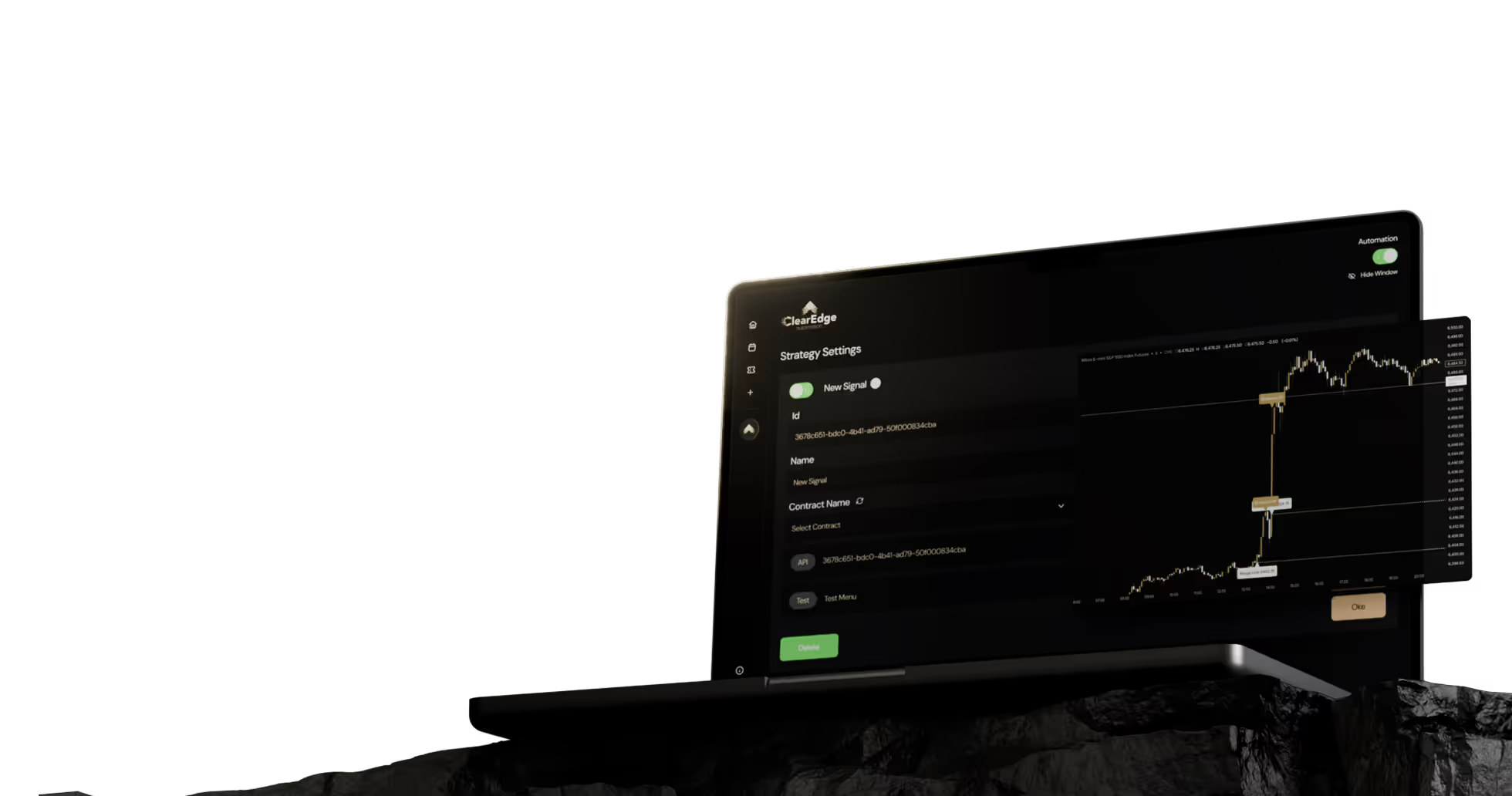
Platforms like ClearEdge Trading connect TradingView alerts to broker execution without manual intervention. You define your exit criteria when you're thinking clearly, before the trade is on and emotions are engaged. The automation then enforces those decisions mechanically.
This separation between decision-making and execution is what makes automated trading discipline effective against cognitive biases. You're not relying on willpower in the moment. You're relying on a system that was configured during a period of rational thought.
Exit Discipline: The practice of closing trades at predetermined levels regardless of emotional impulse or rationalization. Automation enforces exit discipline by removing the human decision point at the moment of execution.
Sunk Cost Fallacy vs. Other Cognitive Biases in Trading
The sunk cost fallacy rarely acts alone. It typically combines with other cognitive biases to create a reinforcing loop that keeps traders in bad positions. Understanding how these biases interact helps explain why exit discipline is so difficult to maintain manually.
Cognitive BiasHow It Manifests in TradingHow It Compounds Sunk CostConfirmation biasSeeking information that supports your existing positionYou find "reasons" to hold after the stop should have triggeredOverconfidenceBelieving you can predict the recoveryYou widen your stop because "you know" it's coming backRecency biasWeighting recent events more heavilyA recent recovery reinforces the belief that this loser will also recoverAnchoringFixating on entry price or previous highYou measure the trade against where it was, not where it's goingFOMOFear of missing the reversalYou hold because "what if it turns around right after I exit?"
When confirmation bias stacks with sunk cost thinking, a trader actively ignores bearish signals and focuses only on data supporting the position. Add overconfidence from a recent winning streak, and the trader might even add to the losing position. This kind of cascading bias is why even experienced traders blow up. The problem isn't knowledge. It's the real-time interaction of multiple cognitive biases under financial stress.
Automation doesn't eliminate these biases from your thinking. You'll still feel them. But it prevents them from affecting execution. Your automated rules run regardless of what your brain is telling you in the moment.
Building Automated Exit Rules That Counteract Sunk Cost Thinking
Effective automated exit rules work because they're defined before you have skin in the game. The goal is to encode your rational risk parameters into the system so the sunk cost fallacy never gets a vote.
Here are the components that matter most:
Hard stop losses. Set a maximum loss per trade in dollar or point terms and make it non-negotiable in your automation. For ES futures, this might be 8-12 points depending on your strategy and account size. For NQ, maybe 30-50 points. The exact number depends on your backtesting and risk tolerance, but the key is that the number doesn't change once the trade is live.
Time-based exits. Some trades just don't work. If your NQ scalp hasn't hit target within 15 minutes, the setup is probably dead. Time-based exits prevent the "I'll just wait a little longer" loop that sunk cost thinking thrives on. You can configure time-based TradingView alerts to handle this automatically.
Daily loss limits. Even with per-trade stops, a series of losses can trigger revenge trading, which is sunk cost thinking applied to the entire session. "I'm already down $800 today, I need to make it back." Automated daily loss limits shut down trading when you hit a predefined threshold.
Trailing stops. These protect profits while giving winning trades room to run. More importantly for sunk cost prevention, they prevent a winning trade from turning into a loser, which eliminates the "I was up $400 and now I'm down $200" scenario that triggers aggressive holding behavior.
Revenge Trading: The impulse to immediately re-enter the market after a loss to recover what was lost. It's driven by the same sunk cost psychology that causes bad holds, applied to the trading session as a whole rather than a single position.
The most effective approach is layering these rules. A trade has a hard stop, a time limit, and exists within a daily loss framework. If any one of those conditions triggers, the position closes. No exceptions. This layered approach means the sunk cost fallacy would need to bypass multiple automated guardrails simultaneously, which it can't.
What Sunk Cost Trading Looks Like in Practice
Consider a concrete example. A trader enters long on ES at 5,450 based on an opening range breakout. The initial stop is at 5,440, risking 10 points ($125 on a Micro ES contract, $500 on an E-mini). Price drops to 5,441 and the trader starts watching the order book, looking for buyers. Price touches 5,440.25. The trader moves their stop to 5,438 to "give it room." Price hits 5,435, and now the loss is 15 points. At this point, the original 10-point risk has been exceeded by 50%, and the trader is thinking about the $187.50 (MES) or $750 (ES) already lost rather than the deteriorating price action.
With automation, the stop at 5,440 fires. The position closes. The loss is exactly what was planned. The trader's account is positioned to take the next setup without the psychological baggage of an unplanned drawdown.
This scenario plays out thousands of times daily across futures markets. A 2023 study published in the Journal of Behavioral Finance found that retail traders held losing positions an average of 1.7 times longer than winning positions [3]. That asymmetry is the sunk cost fallacy in aggregate.
Keeping a trading journal alongside your automation helps you spot these patterns after the fact. When you review trades where automation closed positions at the stop, you can track how often price continued moving against you afterward. Most traders who do this exercise find that their automated stops saved them from significantly larger losses in the majority of cases. That data builds trust in the system over time, which addresses the related challenge of trusting automation with your capital.
For a broader look at how automation addresses the full spectrum of emotional trading challenges, see our guide to removing emotions from trading.
Frequently Asked Questions
1. What is the sunk cost fallacy in futures trading?
The sunk cost fallacy in futures trading is holding a losing position because you've already invested money, time, or emotional energy into it. Instead of evaluating the trade's current merit, you anchor to past costs and resist taking the loss.
2. How does trading automation prevent sunk cost fallacy bad holds?
Automation executes predefined exit rules the moment conditions are met, removing the human decision point where sunk cost thinking occurs. The system doesn't factor in how long you've held the trade or how much you've already lost.
3. Can I still override my automated stops if I want to?
Most platforms allow manual override, but doing so defeats the purpose of automation for bias prevention. Some traders intentionally avoid monitoring live trades to remove the temptation to intervene.
4. Is the sunk cost fallacy the same as loss aversion?
They're related but different. Loss aversion is the tendency to feel losses more intensely than equivalent gains. The sunk cost fallacy is specifically about continuing a course of action because of past investment rather than future expected value. Loss aversion amplifies sunk cost thinking.
5. How do I know if sunk cost thinking is affecting my trading?
Review your trading journal for patterns: moving stops further away, holding positions past your planned exit time, or averaging down on losers without a strategy-based reason. If losing trades consistently last longer than winners, sunk cost bias is likely a factor.
6. Does automation eliminate all emotional trading problems?
Automation eliminates emotional interference at the execution level, but it doesn't remove the emotions themselves. You may still feel anxiety or regret, but those feelings won't translate into impulsive actions because the system handles execution based on your predefined rules.
Conclusion
The sunk cost fallacy is one of the most damaging cognitive biases in trading because it turns small, planned losses into large, unplanned drawdowns. Trading automation prevents bad holds by enforcing exit discipline mechanically, closing positions when your predefined rules say to close them, regardless of how much you've already invested in the trade.
If you recognize sunk cost patterns in your own trading, start by reviewing your journal for trades where you held past your stop level. Then build automated exit rules during calm, rational moments and let the system enforce them when emotions run high. Paper trade your automated rules first to validate the approach before committing real capital.
Want to dig deeper? Read our complete guide to trading psychology automation for more on how systematic execution addresses cognitive biases across your entire trading process.
References
- Kahneman, D. & Tversky, A. (1979). "Prospect Theory: An Analysis of Decision under Risk." Econometrica, 47(2), 263-291.
- Staw, B. M. (1981). "The Escalation of Commitment to a Course of Action." Academy of Management Review, 6(4), 577-587.
- Journal of Behavioral Finance - Research on retail trader holding periods and disposition effect.
- CME Group - Introduction to Futures Trading Education.
- National Futures Association (NFA) - Investor Resources and Risk Disclosure.
Disclaimer: This article is for educational purposes only. It is not trading advice. ClearEdge Trading executes trades based on your rules; it does not provide signals or recommendations.
Risk Warning: Futures trading involves substantial risk. You could lose more than your initial investment. Past performance does not guarantee future results. Only trade with capital you can afford to lose.
CFTC RULE 4.41: Hypothetical results have limitations and do not represent actual trading.
By: ClearEdge Trading Team | About























































Steal the PlaybooksOther TradersDon’t Share
Every week, we break down real strategies from traders with 100+ years of combined experience, so you can skip the line and trade without emotion.